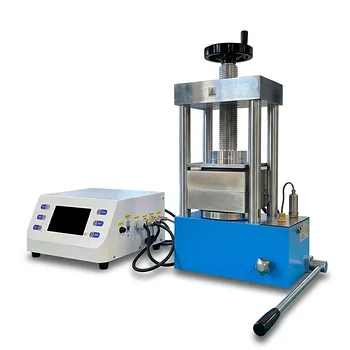
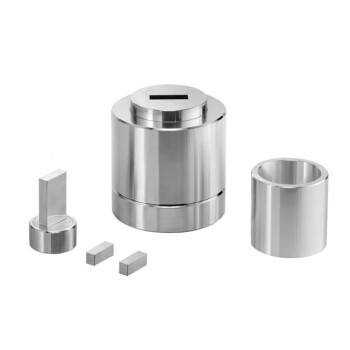
The laboratory hydraulic press acts as a critical regulator of cathode microstructure, directly determining the efficiency of lithium-air batteries. By applying precise pressure to specialized molds containing catalysts, conductive carbon, and binders, the press controls the resulting porosity of the cathode material, which is the deciding factor in oxygen transport and discharge product storage.
Core Takeaway: The hydraulic press serves as a microstructural architect; its ability to deliver precise, stable pressure allows for the creation of an "optimal porosity" sweet spot. This balance is essential for maximizing discharge capacity and ensuring the cathode can physically accommodate lithium peroxide ($Li_2O_2$) accumulation without choking off oxygen flow.
The Mechanics of Cathode Formation
Ingredients and Consolidation
To create a functioning cathode, you must combine conductive carbon, binders, and catalysts into a cohesive shape.
The hydraulic press applies force to these loose powders within a specialized mold.
This process transforms disparate materials into a unified structure capable of conducting electrons and facilitating chemical reactions.
The Role of Precision Control
The primary value of the hydraulic press lies in its ability to apply regulated, stable pressure.
Unlike simple compaction, this process allows you to dial in specific structural parameters.
By adjusting the tonnage, you define the void space (porosity) between particles, which is the most critical variable in lithium-air chemistry.
Why Porosity Defines Performance
Facilitating Oxygen Transport
Lithium-air batteries require a constant supply of oxygen from the external environment to function.
If the press applies too much pressure, the material becomes too dense, choking off the pathways required for oxygen diffusion.
Optimal porosity ensures that oxygen can penetrate deep into the cathode structure to reach the reaction sites.
Accommodating Discharge Products
During discharge, lithium-air batteries produce solid byproducts, specifically lithium peroxide ($Li_2O_2$).
These solids accumulate within the pores of the cathode.
The hydraulic press must create sufficient internal volume (pore size) to store these products; otherwise, the pores clog, and the reaction stops prematurely.
Impact on Rate Performance and Capacity
The structural decisions made during pressing directly dictate the battery's output.
A well-pressed cathode with tuned porosity enhances discharge capacity by offering ample storage volume for reaction products.
Simultaneously, it improves rate performance by maintaining open highways for oxygen mass transfer, even under high loads.
Understanding the Trade-offs
The Risk of Over-Densification
While supplementary data from solid-state battery manufacturing suggests that high pressure (up to 370 MPa) is used to eliminate pores and densify electrolytes, this approach can be detrimental to lithium-air cathodes.
Applying excessive pressure to a Li-air cathode will crush the necessary void spaces.
This creates a dense barrier that blocks oxygen and severely limits the battery's capacity, rendering it inefficient.
The Risk of Insufficient Binding
Conversely, applying too little pressure results in a "green body" with poor mechanical strength.
Without sufficient compaction, the contact between carbon particles and the current collector remains loose.
This leads to high internal resistance and a cathode that may structurally disintegrate during the stress of cycling.
Making the Right Choice for Your Goal
To optimize your lithium-air cathode manufacturing, consider the specific requirements of your active material and desired battery characteristics.
- If your primary focus is maximizing discharge capacity: Use lower pressure settings to maintain higher porosity, maximizing the internal volume available for $Li_2O_2$ deposition.
- If your primary focus is mechanical stability: Incrementally increase pressure to ensure robust particle-to-particle contact, but monitor porosity closely to avoid blocking oxygen pathways.
- If your primary focus is reproducibility: Rely on the press’s pressure-holding capability to ensure every batch has the exact same density and microstructural characteristics.
Ultimately, the hydraulic press is not just a compaction tool, but a precision instrument for tuning the breathing capacity of your lithium-air battery.
Summary Table:
| Factor | Effect of High Pressure | Effect of Low Pressure | Ideal State (Tuned Pressing) |
|---|---|---|---|
| Porosity | Low (Dense) | High (Loose) | Optimized Void Space |
| Oxygen Flow | Restricted/Blocked | High Diffusion | Maximum Mass Transfer |
| Byproduct Storage | Minimal Capacity | High Volume | Maximum $Li_2O_2$ Accumulation |
| Mechanical Strength | Excellent | Poor (Structural Failure) | Robust Particle Contact |
| Electrical Contact | Superior | Poor (High Resistance) | Efficient Electron Path |
Elevate Your Battery Research with KINTEK Precision
Unlock the full potential of your energy storage materials with KINTEK’s high-precision laboratory hydraulic presses. Whether you are developing lithium-air cathodes, solid-state electrolytes, or advanced electrode materials, our range of pellet, hot, and isostatic presses provides the stable, regulated pressure necessary to master microstructure and porosity.
From high-temperature furnaces and CVD systems to specialized battery research tools and consumables, KINTEK is your partner in laboratory excellence. Don't let inconsistent compaction limit your battery's capacity and rate performance.
Ready to refine your cathode architecture? Contact our technical experts today to find the perfect pressing solution for your lab!
References
- Aldo Saul Gago, Nicolás Alonso‐Vante. Tailoring nanostructured catalysts for electrochemical energy conversion systems. DOI: 10.1515/ntrev-2012-0013
This article is also based on technical information from Kintek Solution Knowledge Base .
Related Products
- Laboratory Hydraulic Press Split Electric Lab Pellet Press
- Automatic Laboratory Hydraulic Pellet Press Machine for Lab Use
- Laboratory Hydraulic Press Lab Pellet Press Machine for Glove Box
- Laboratory Hydraulic Pellet Press for XRF KBR FTIR Lab Applications
- Laboratory Manual Hydraulic Pellet Press for Lab Use
People Also Ask
- What role does a laboratory hydraulic press play in platinum recovery research? Enhancing Sample Precision
- What are the specific applications of a lab hydraulic press in biochar evaluation? Optimize density and data accuracy.
- What are the roles of a laboratory hydraulic press and stainless steel molds in the preparation of graphite samples?
- What is the role of a laboratory hydraulic press in electrode prep? Maximize Energy Density & Sealing Precision
- Why must a laboratory hydraulic press equipped with cylindrical molds be used when preparing BZY green bodies? High Density