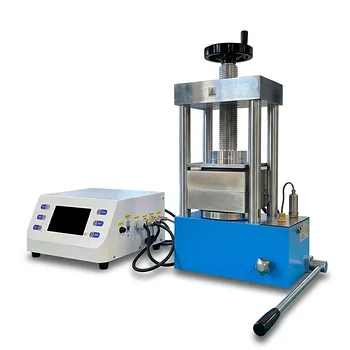
A laboratory hydraulic press is the critical variable for structural integrity in the manufacturing of regenerated leather composite boards. It serves as the primary mechanism for applying constant, uniform vertical pressure to the raw mixture of leather fibers, polyurethane binders, and plant fibers. This mechanical force is essential for transforming a loose amalgamation of materials into a cohesive, high-performance product.
Core Takeaway By strictly controlling vertical pressure, the hydraulic press forces the composite mixture to pack tightly while expelling trapped air. This process directly eliminates internal density inconsistencies, preventing structural failure and significantly enhancing the tensile strength and tear resistance of the final board.
The Mechanics of Quality Improvement
Maximizing Fiber Packing
The fundamental role of the press is to reduce the volume of the loose material mixture. It forces the leather fibers and binders to pack tightly within the mold cavity.
This compression minimizes the distance between the organic fibers and the polyurethane binder. Tighter packing is the prerequisite for forming a solid, unified composite rather than a loose aggregate.
Expulsion of Trapped Air
Air pockets within a composite material act as weak points that invite failure. The constant pressure applied during molding systematically forces this trapped air out of the matrix.
By removing these voids, the press ensures the material is dense and continuous. This creates a "void-free" internal structure that is essential for durability.
Eliminating Density Gradients
Without precise pressure application, a composite board will likely suffer from internal density inconsistencies. This means some areas would be soft and porous while others are hard and brittle.
The hydraulic press applies force uniformly, ensuring the density is consistent across the entire surface area of the board. This uniformity is vital for predictable performance in the finished leather product.
Impact on Mechanical Properties
Enhancing Tensile Strength
A tightly packed composite naturally resists pulling forces better than a loosely bonded one. The hydraulic press ensures strong mechanical anchoring between the fibers and the binder.
This enhanced bonding directly translates to higher tensile strength. The material can withstand significant stretching forces without tearing or deforming.
Preventing Structural Defects
Two common failure modes for regenerated leather are delamination (layers separating) and cracking. These issues usually stem from weak internal bonds or air gaps.
By ensuring high-density fusion and consistent packing, the press effectively engineers these defects out of the product. The result is a board that remains intact under stress and maintains its visual and structural quality over time.
Critical Process Variables
The Necessity of Precision Control
It is not enough to simply crush the material; the pressure must be controlled. The hydraulic press allows for precise regulation to match the specific volume of the mold cavity.
If pressure is too low, the material remains porous and weak. If pressure is uncontrolled, it could potentially distort the fibers. The value lies in the precise application of force to achieve specific density targets.
The Role of Binder Interaction
While pressure is the physical driver, it facilitates a chemical result. By forcing the binder into intimate contact with the leather and plant fibers, the press maximizes the efficiency of the adhesive.
Drawing from similar bio-composite processes, this close contact is what allows the binder to effectively cross-link and stabilize the fibers. The press acts as the catalyst for this physical and chemical unification.
Making the Right Choice for Your Goal
To maximize the utility of a laboratory hydraulic press for regenerated leather, tailor your approach to your specific quality metrics.
- If your primary focus is Durability: Prioritize high, constant pressure to maximize density and eliminate all inter-particle voids, ensuring the highest possible tear resistance.
- If your primary focus is Surface Finish: Focus on pressure uniformity to prevent density inconsistencies that lead to visible cracking or uneven textures.
- If your primary focus is Process Stability: Use the press's control features to ensure the material volume exactly matches the mold cavity, preventing delamination.
Ultimately, the hydraulic press converts a mixture of loose fibers into a high-value composite by replacing air gaps with structural strength.
Summary Table:
| Quality Factor | Role of Hydraulic Press | Impact on Final Product |
|---|---|---|
| Fiber Packing | Minimizes distance between fibers and binders | High-performance cohesive structure |
| Air Removal | Systematic expulsion of trapped air voids | Void-free structure prevents internal failure |
| Density Uniformity | Constant, uniform vertical force application | Prevents delamination and brittle spots |
| Mechanical Bonding | Facilitates cross-linking and anchoring | Enhanced tensile strength and tear resistance |
Elevate Your Composite Material Research with KINTEK
Precision is the key to structural integrity in regenerated leather and bio-composite manufacturing. KINTEK specializes in high-performance laboratory equipment, offering a robust range of hydraulic presses (pellet, hot, isostatic) designed to provide the constant, uniform pressure your materials require.
Whether you are aiming to eliminate density gradients, maximize fiber packing, or prevent structural defects like delamination, our engineering solutions provide the control you need. From crushing and milling systems to advanced high-temperature furnaces and cooling solutions, KINTEK supports every stage of your material development.
Ready to transform your loose fibers into high-value composites? Contact our experts today to find the perfect hydraulic press for your laboratory's needs.
References
- Yanchun Li, Deyi Zhu. Research progress on resource utilization of leather solid waste. DOI: 10.1186/s42825-019-0008-6
This article is also based on technical information from Kintek Solution Knowledge Base .
Related Products
- Heated Hydraulic Press Machine with Integrated Manual Heated Plates for Lab Use
- Automatic Laboratory Hydraulic Press for XRF & KBR Pellet Press
- Laboratory Hydraulic Press Split Electric Lab Pellet Press
- Automatic High Temperature Heated Hydraulic Press Machine with Heated Plates for Lab
- Laboratory Manual Hydraulic Pellet Press for Lab Use
People Also Ask
- Why is a heated laboratory hydraulic press necessary for composite laminates? Achieve Void-Free Structural Integrity
- What role does a heated hydraulic press play in Cold Sintering (CSP)? Enhancing LATP-Halide Densification
- What technical conditions does a heated hydraulic press provide for PEO batteries? Optimize Solid-State Interfaces
- Why is the heating function of a laboratory hydraulic press essential for MEA assembly in DEFC? Optimize Cell Bonding
- What are heated hydraulic presses used for? Molding Composites, Vulcanizing Rubber, and More