Knowledge rotary furnace How does a rotary hearth furnace work? Achieve Continuous, High-Volume Thermal Processing
Author avatar

Tech Team · Kintek Solution

Updated 2 months ago

How does a rotary hearth furnace work? Achieve Continuous, High-Volume Thermal Processing


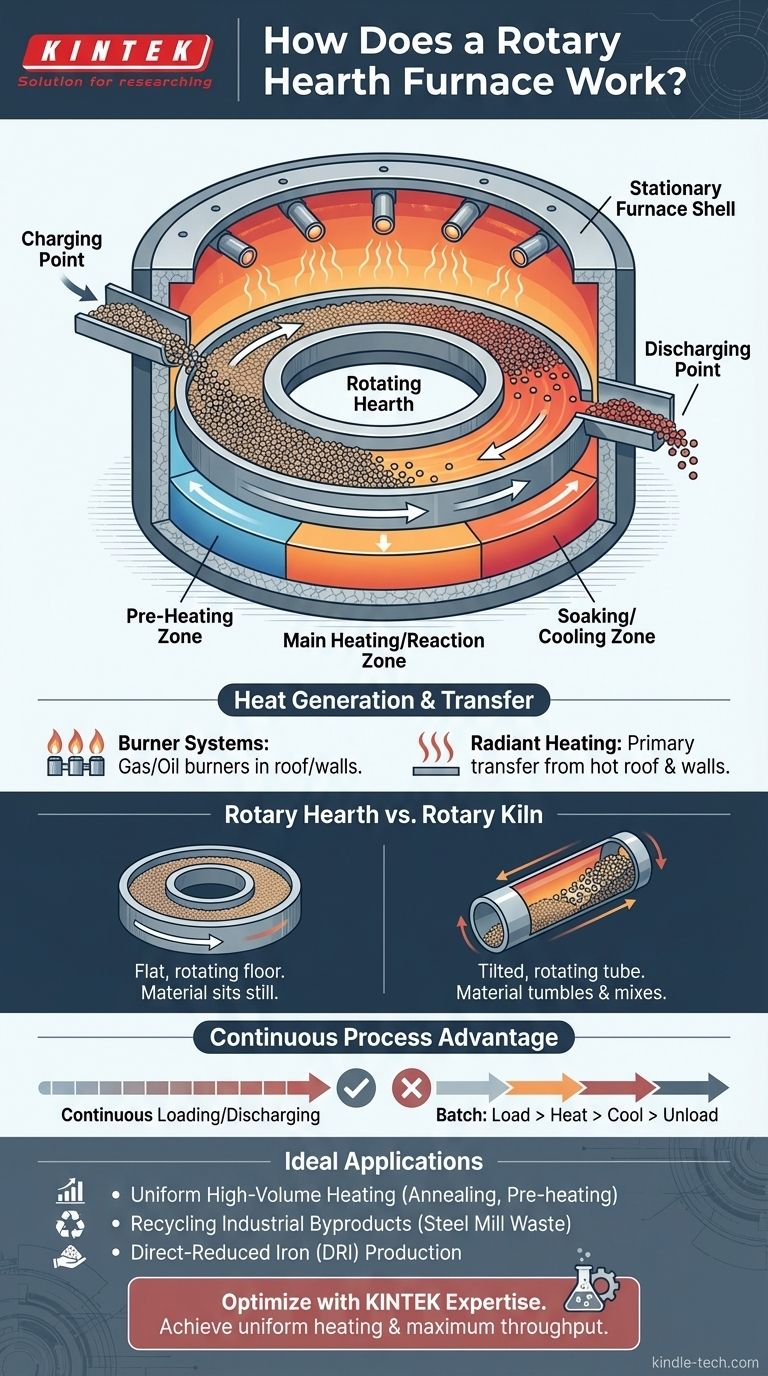
In essence, a rotary hearth furnace works by moving materials on a large, rotating circular floor (the hearth) through different, stationary heating zones contained within a fixed furnace shell. Material is loaded at one point, undergoes a precise thermal treatment as it travels in a circle, and is removed after completing nearly a full rotation.

The central principle of a rotary hearth furnace is not the rotation of the entire furnace, but the slow, continuous movement of the material-carrying hearth through fixed, specialized temperature zones. This allows for highly uniform, continuous, and controlled heat treatment.

How does a rotary hearth furnace work? Achieve Continuous, High-Volume Thermal Processing

The Core Components and Process Flow

A rotary hearth furnace is a sophisticated system for continuous thermal processing. Its design is based on moving the product through the heat, rather than heating and cooling the entire furnace chamber for each batch.

The Rotating Hearth

The "hearth" is the floor of the furnace. It is a large, donut-shaped or circular steel table lined with refractory materials capable of withstanding extreme temperatures. This entire structure rotates slowly around a central axis.

The Stationary Furnace Shell

Enclosing the hearth is a fixed, insulated shell, also lined with refractory. This shell contains the heat, the atmosphere, and the heating systems. It has dedicated openings for loading raw material onto the hearth and for discharging the finished product.

Distinct Temperature Zones

The stationary shell is divided into several distinct zones, each with its own temperature controls. As the hearth rotates, it carries the material sequentially through these zones—for example, a pre-heating zone, a main heating or reaction zone, and a soaking or cooling zone.

Charging and Discharging

Material is continuously fed onto the hearth at a specific charging point. After traveling through the various zones for a set period (typically one full rotation, which can take anywhere from minutes to hours), the processed material is removed by a discharge mechanism, often located right next to the charging point.

How Heat is Generated and Transferred

The effectiveness of the furnace depends on precise and efficient heat application. This is managed through carefully placed heating systems within the stationary shell.

Burner Systems

Heat is most commonly generated by a series of gas or oil burners. These are strategically mounted in the roof and walls of the stationary shell, firing into the different temperature zones to maintain their specific setpoints.

Radiant Heating

The primary method of heat transfer is radiation. Heat radiates from the hot furnace roof, walls, and the combustion gases directly onto the surface of the material sitting on the hearth below. The slow rotation ensures every part of the load receives an equal amount of energy for exceptionally uniform heating.

Understanding the Trade-offs and Distinctions

While highly effective, it's critical to distinguish the rotary hearth furnace from other designs that use the term "rotary." The provided references cause common confusion on this point.

Misconception: Rotary Hearth vs. Rotary Kiln

A rotary hearth furnace has a flat, rotating floor where material sits relatively still. In contrast, a rotary kiln (or rotary drum furnace) is a long, rotating tube or barrel that is tilted. Material tumbles and mixes as it travels from the high end to the low end, which is a fundamentally different process.

Advantage: Continuous vs. Batch Processing

Traditional "batch" furnaces require loading the entire chamber, heating it up, letting it soak, and cooling it down before unloading. A rotary hearth furnace operates continuously, with material constantly being loaded and discharged, which dramatically increases throughput and energy efficiency for high-volume production.

Making the Right Choice for Your Goal

The rotary hearth furnace is a specialized tool designed for specific industrial processes where uniformity and high throughput are paramount.

  • If your primary focus is high-volume, uniform heating: The design's ability to move a continuous stream of product through fixed temperature zones is ideal for consistent heat treatment, annealing, or pre-heating.
  • If your primary focus is recycling industrial byproducts: This technology excels at processing steel mill waste, such as dusts and sludges, to recover valuable iron units in a process known as direct reduction.
  • If your primary focus is producing direct-reduced iron (DRI): The furnace provides the controlled atmosphere and temperature profile needed to convert iron ore pellets into metallic iron without melting them.

Ultimately, the rotary hearth furnace provides an elegant and efficient solution for continuous, high-temperature material processing.

Summary Table:

Component Function
Rotating Hearth Circular, refractory-lined floor that carries material in a continuous loop.
Stationary Furnace Shell Fixed, insulated enclosure containing the heat, atmosphere, and heating systems.
Distinct Temperature Zones Separate areas (e.g., pre-heat, heat, soak/cool) within the shell for precise thermal control.
Charging/Discharging Mechanisms for continuous loading of raw material and unloading of finished product.
Burner Systems Gas or oil burners mounted in the shell to generate heat in each zone via radiation.

Optimize your high-volume thermal processing with KINTEK's expertise.

A rotary hearth furnace is the ideal solution for achieving uniform heating and maximum throughput in applications like annealing, pre-heating, or direct reduction. KINTEK specializes in providing robust lab equipment and consumables to meet the demanding needs of industrial and research laboratories.

Our team can help you determine if this continuous processing technology is right for your goals, ensuring energy efficiency and consistent product quality.

Contact KINTEK today to discuss how our solutions can enhance your laboratory's efficiency and productivity.

Visual Guide
How does a rotary hearth furnace work? Achieve Continuous, High-Volume Thermal Processing Visual Guide

Related Products

People Also Ask

Related Products

Rotary Tube Furnace Split Multi Heating Zone Rotating Tube Furnace

Rotary Tube Furnace Split Multi Heating Zone Rotating Tube Furnace

Multi zone rotary furnace for high-precision temperature control with 2-8 independent heating zones. Ideal for lithium ion battery electrode materials and high-temperature reactions. Can work under vacuum and controlled atmosphere.

Laboratory Vacuum Tilt Rotary Tube Furnace Rotating Tube Furnace

Laboratory Vacuum Tilt Rotary Tube Furnace Rotating Tube Furnace

Discover the versatility of Laboratory Rotary Furnace: Ideal for calcination, drying, sintering, and high-temperature reactions. Adjustable rotating and tilting functions for optimal heating. Suitable for vacuum and controlled atmosphere environments. Learn more now!

Electric Rotary Kiln Small Rotary Furnace for Activated Carbon Regeneration

Electric Rotary Kiln Small Rotary Furnace for Activated Carbon Regeneration

Revitalize your activated carbon with KinTek's Electric Regeneration Furnace. Achieve efficient and cost-effective regeneration with our highly automated rotary kiln and intelligent thermal controller.

Electric Rotary Kiln Small Rotary Furnace Biomass Pyrolysis Plant

Electric Rotary Kiln Small Rotary Furnace Biomass Pyrolysis Plant

Learn about Rotary Biomass Pyrolysis Furnaces & how they decompose organic material at high temps without oxygen. Use for biofuels, waste processing, chemicals & more.

Vacuum Sealed Continuous Working Rotary Tube Furnace Rotating Tube Furnace

Vacuum Sealed Continuous Working Rotary Tube Furnace Rotating Tube Furnace

Experience efficient material processing with our vacuum-sealed rotary tube furnace. Perfect for experiments or industrial production, equipped with optional features for controlled feeding and optimized results. Order now.

Electric Rotary Kiln Continuous Working Small Rotary Furnace Heating Pyrolysis Plant

Electric Rotary Kiln Continuous Working Small Rotary Furnace Heating Pyrolysis Plant

Efficiently calcine and dry bulk powder and lump fluid materials with an electric heating rotary furnace. Ideal for processing lithium ion battery materials and more.

Electric Rotary Kiln Pyrolysis Furnace Plant Machine Calciner Small Rotary Kiln Rotating Furnace

Electric Rotary Kiln Pyrolysis Furnace Plant Machine Calciner Small Rotary Kiln Rotating Furnace

Electric rotary kiln - precisely controlled, it's ideal for calcination and drying of materials like lithium cobalate, rare earths, and non-ferrous metals.

High Temperature Muffle Oven Furnace for Laboratory Debinding and Pre Sintering

High Temperature Muffle Oven Furnace for Laboratory Debinding and Pre Sintering

KT-MD High temperature debinding and pre-sintering furnace for ceramic materials with various molding processes. Ideal for electronic components such as MLCC and NFC.

Large Vertical Graphite Vacuum Graphitization Furnace

Large Vertical Graphite Vacuum Graphitization Furnace

A large vertical high-temperature graphitization furnace is a type of industrial furnace used for the graphitization of carbon materials, such as carbon fiber and carbon black. It is a high-temperature furnace that can reach temperatures of up to 3100°C.

Vertical High Temperature Graphite Vacuum Graphitization Furnace

Vertical High Temperature Graphite Vacuum Graphitization Furnace

Vertical high temperature graphitization furnace for carbonization and graphitization of carbon materials up to 3100℃.Suitable for shaped graphitization of carbon fiber filaments and other materials sintered in a carbon environment.Applications in metallurgy, electronics, and aerospace for producing high-quality graphite products like electrodes and crucibles.

Vacuum Heat Treat Furnace with Ceramic Fiber Liner

Vacuum Heat Treat Furnace with Ceramic Fiber Liner

Vacuum furnace with polycrystalline ceramic fiber insulation liner for excellent heat insulation and uniform temperature field. Choose from 1200℃ or 1700℃ max. working temperature with high vacuum performance and precise temperature control.

600T Vacuum Induction Hot Press Furnace for Heat Treat and Sintering

600T Vacuum Induction Hot Press Furnace for Heat Treat and Sintering

Discover the 600T Vacuum Induction Hot Press Furnace, designed for high-temperature sintering experiments in vacuum or protected atmospheres. Its precise temperature and pressure control, adjustable working pressure, and advanced safety features make it ideal for nonmetal materials, carbon composites, ceramics, and metal powders.

Laboratory Rapid Thermal Processing (RTP) Quartz Tube Furnace

Laboratory Rapid Thermal Processing (RTP) Quartz Tube Furnace

Get lightning-fast heating with our RTP Rapid Heating Tube Furnace. Designed for precise, high-speed heating and cooling with convenient sliding rail and TFT touch screen controller. Order now for ideal thermal processing!

Graphite Vacuum Continuous Graphitization Furnace

Graphite Vacuum Continuous Graphitization Furnace

High-temperature graphitization furnace is a professional equipment for graphitization treatment of carbon materials. It is a key equipment for the production of high-quality graphite products. It has high temperature, high efficiency and uniform heating. It is suitable for various high-temperature treatments and graphitization treatments. It is widely used in metallurgy, electronics, aerospace, etc. industry.

Mesh belt controlled atmosphere furnace

Mesh belt controlled atmosphere furnace

Discover our KT-MB mesh belt sintering furnace - perfect for high-temperature sintering of electronic components & glass insulators. Available for open air or controlled atmosphere environments.

Ultra-High Temperature Graphite Vacuum Graphitization Furnace

Ultra-High Temperature Graphite Vacuum Graphitization Furnace

The ultra-high temperature graphitization furnace utilizes medium frequency induction heating in a vacuum or inert gas environment. The induction coil generates an alternating magnetic field, inducing eddy currents in the graphite crucible, which heats up and radiates heat to the workpiece, bringing it to the desired temperature. This furnace is primarily used for graphitization and sintering of carbon materials, carbon fiber materials, and other composite materials.

Laboratory Muffle Oven Furnace Bottom Lifting Muffle Furnace

Laboratory Muffle Oven Furnace Bottom Lifting Muffle Furnace

Efficiently produce batches with excellent temperature uniformity using our Bottom Lifting Furnace. Features two electric lifting stages and advanced temperature control up to 1600℃.

Graphite Vacuum Furnace High Thermal Conductivity Film Graphitization Furnace

Graphite Vacuum Furnace High Thermal Conductivity Film Graphitization Furnace

The high thermal conductivity film graphitization furnace has uniform temperature, low energy consumption and can operate continuously.

1200℃ Split Tube Furnace with Quartz Tube Laboratory Tubular Furnace

1200℃ Split Tube Furnace with Quartz Tube Laboratory Tubular Furnace

KT-TF12 split tube furnace: high-purity insulation, embedded heating wire coils, and max. 1200C. Widely used for new materials and chemical vapour deposition.

Controlled Nitrogen Inert Hydrogen Atmosphere Furnace

Controlled Nitrogen Inert Hydrogen Atmosphere Furnace

KT-AH Hydrogen atmosphere furnace - induction gas furnace for sintering/annealing with built-in safety features, dual housing design, and energy-saving efficiency. Ideal for lab and industrial use.


Leave Your Message