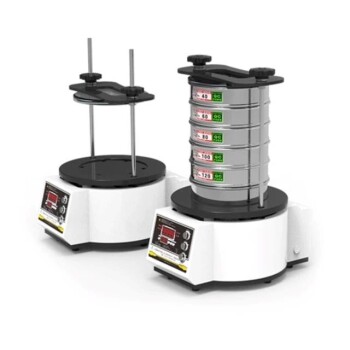
A standard test sieve serves as a critical mechanical filter during the preparation of BCZYYb electrolyte powders, specifically following the high-temperature calcination and grinding stages. Its immediate function is to isolate and remove large agglomerated particles that inevitably form during thermal processing, ensuring that only refined material moves forward in production.
Sieving is not just about separation; it is the fundamental step that ensures particle size uniformity. This uniformity is the prerequisite for achieving the high flowability and packing density required to produce a dense, structurally sound electrolyte.
The Mechanics of Powder Refinement
Removing Process Artifacts
During the preparation of BCZYYb, precursors undergo high-temperature calcination. This process often causes particles to fuse into large, irregular clumps known as agglomerates.
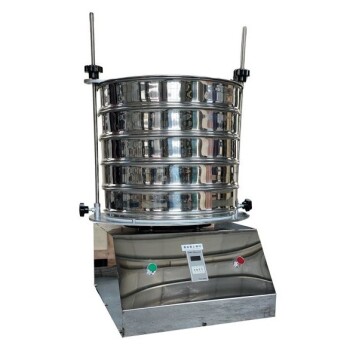
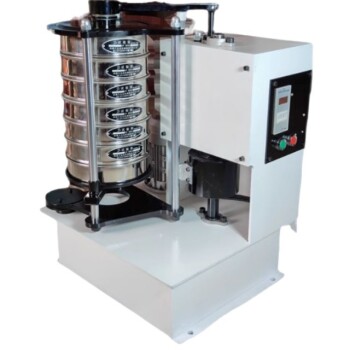
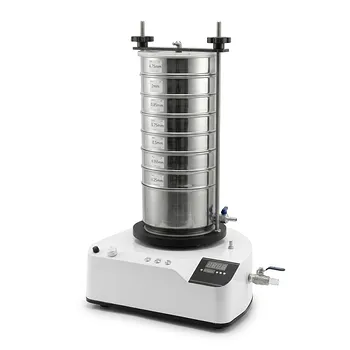
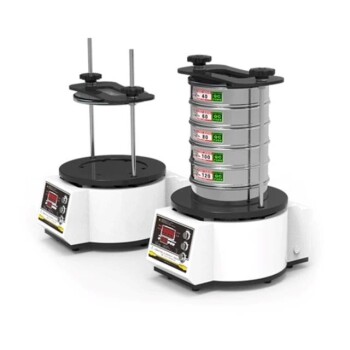
Subsequent grinding breaks these down, but not perfectly. A standard test sieve, such as a 60-mesh sieve, acts as the final gatekeeper to catch any remaining coarse particles.
Establishing Uniformity
The primary output of the sieving process is a powder with a uniform particle size distribution.
Without this mechanical screening, the powder would contain a mix of fine dust and coarse chunks. This inconsistency makes the material difficult to handle and process reliably.
Impact on the Final Electrolyte
Enhancing Powder Characteristics
Uniform particles exhibit superior flowability. This allows the powder to fill molds or dies evenly without bridging or clogging.
Furthermore, screened powders achieve higher packing density. Because the particles are consistent, they arrange themselves more efficiently when pressed.
Determining Microstructure and Density
The physical properties of the powder directly dictate the quality of the "green body" (the pressed, unsintered form). High packing density leads to better microstructural uniformity in this stage.
Crucially, this uniformity translates to the final product. A well-packed green body allows for optimal densification during sintering, resulting in a high-quality, dense electrolyte.
Understanding the Process Risks
The Consequence of Poor Screening
If the sieving step is skipped or performed with an incorrect mesh size, large agglomerates remain in the powder.
These large particles disrupt the packing order. They create voids and irregularities in the green body that cannot be fixed by sintering.
Dependency on Prior Steps
It is important to note that a sieve is a filter, not a grinder. It relies on the success of the grinding phase.
If the grinding is insufficient, the sieve will simply reject a large volume of material, leading to material waste rather than refined product.
Making the Right Choice for Your Goal
To ensure the highest quality BCZYYb electrolyte, apply the following principles:
- If your primary focus is Process Efficiency: Ensure your grinding stage is robust enough so that the 60-mesh sieve acts only as a safety filter, minimizing waste.
- If your primary focus is Maximum Density: Prioritize strict adherence to the sieving protocol, as particle uniformity is the single biggest factor influencing the final sintered density.
The sieve is the bridge between raw, calcined material and a high-performance ceramic microstructure.
Summary Table:
| Stage | Function of Sieving | Impact on BCZYYb Quality |
|---|---|---|
| Post-Calcination | Removes fused agglomerates | Prevents structural defects in the green body |
| Powder Refinement | Ensures particle size uniformity | Enhances powder flowability and mold filling |
| Pressing/Compaction | Optimizes packing density | Facilitates uniform microstructure development |
| Final Sintering | Enables full densification | Results in a high-performance, dense electrolyte |
Elevate Your Electrolyte Research with KINTEK Precision
Achieving the perfect microstructure for BCZYYb electrolyte powders requires more than just high-quality precursors—it demands precision at every stage. KINTEK specializes in the laboratory equipment necessary for advanced material synthesis, offering a comprehensive range of:
- Sieving Equipment & Standard Test Sieves: Ensure consistent particle size distribution and maximum packing density.
- Crushing & Milling Systems: Achieve the ideal grind before the screening process to minimize material waste.
- High-Temperature Furnaces: Reliable muffle and tube furnaces for precise calcination and sintering protocols.
- Hydraulic Pellets & Isostatic Presses: Create flawless green bodies from your refined powders.
From high-performance ceramic crucibles to specialized electrolytic cells, KINTEK provides the tools global researchers trust for battery and electrolyte innovation. Contact KINTEK today to optimize your powder preparation workflow!
Related Products
- Laboratory Test Sieves and Sieving Machines
- Laboratory Test Sieves and Vibratory Sieve Shaker Machine
- Custom PTFE Teflon Parts Manufacturer for PTFE Mesh F4 Sieve
- Laboratory Vibratory Sieve Shaker Machine Slap Vibrating Sieve
- Laboratory Vibratory Sieve Shaker Machine for Dry and Wet Three-Dimensional Sieving
People Also Ask
- What are laboratory test sieves used for? A Guide to Particle Size Analysis
- How do you calculate the sieve test? Master Particle Size Distribution for Quality Control
- How does a lab test sieve contribute to biomass charcoal powder preparation? Achieve Uniform Particle Size
- What are the specifications for test sieves? A Guide to ASTM & ISO Standards for Accurate Particle Analysis
- What materials are required for sieving? Achieve Accurate Particle Size Analysis