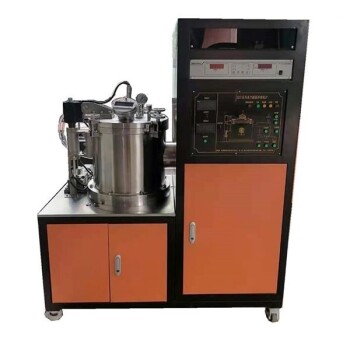
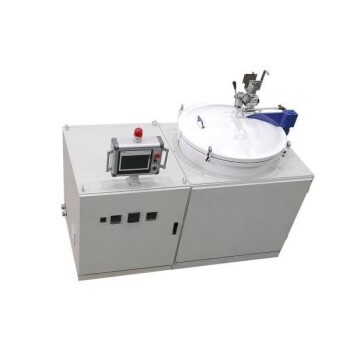
A vacuum furnace facilitates the synthesis of Mg3Sb2 primarily by creating a strictly controlled, oxygen-free environment. By evacuating atmospheric air and backfills the chamber with an inert gas like Argon, the furnace prevents the highly reactive Magnesium from oxidizing. This allows the raw materials to undergo a complete reaction at high temperatures (around 1173 K) without contamination.
Zintl phase Mg3Sb2 synthesis requires high heat and absolute purity. The vacuum furnace solves the conflict between these two needs by replacing reactive oxygen with inert Argon, ensuring the Magnesium reacts with Antimony rather than the atmosphere.
Overcoming the Reactivity of Magnesium
The Threat of Oxidation
Magnesium (Mg) is an active metal that reacts aggressively with oxygen, especially when heated.
Eliminating Contamination Sources
If standard air were present during the melt, the Magnesium would oxidize immediately, ruining the stoichiometry of the Mg3Sb2 compound.
Vacuum as the First Line of Defense
The vacuum furnace creates a hermetic seal and pumps out oxygen and carbon sources. This removal of air is the foundational step that makes high-temperature processing of Magnesium possible.
The Role of Controlled Atmosphere
Introducing Inert Gas
While the "vacuum" removes the air, the process relies on the introduction of inert gases like Argon.
creating a Protective Blanket
The primary reference notes that the furnace does not just operate in a void; it provides a controlled atmosphere. The Argon gas acts as a non-reactive medium that surrounds the raw materials.
Ensuring Complete Reaction
This protective environment ensures that the Magnesium and Antimony can mix and react fully. It guarantees that the final product is pure Mg3Sb2, rather than a mixture of the desired compound and Magnesium Oxide impurities.
Managing Thermal Conditions
Reaching High Temperatures
The synthesis of Mg3Sb2 requires elevated temperatures, specifically around 1173 K.
Radiative Heating
In a vacuum or low-pressure environment, heat transfer by convection (air movement) is eliminated. The furnace relies on radiation to heat the sample, providing precise temperature control without the variables introduced by gas currents.
Understanding the Trade-offs
The Risk of Vaporization
While a deep vacuum removes oxygen, it can also lower the boiling point of volatile metals like Magnesium.
Balancing Pressure
If the furnace runs under a "hard" vacuum (without enough Argon backfill), the Magnesium might vaporize (sublime) before it reacts with the Antimony.
Managing Stoichiometry
You must balance the need for purity (removing gas) with the need to keep the Magnesium in the crucible. Using a partial pressure of Argon is the standard solution to suppress Magnesium evaporation while still excluding oxygen.
Making the Right Choice for Your Goal
To achieve high-quality Zintl phase synthesis, consider these operational priorities:
- If your primary focus is Phase Purity: Ensure the furnace is evacuated to a high vacuum level before backfilling with Argon to remove all trace moisture and oxygen.
- If your primary focus is Stoichiometric Control: Maintain a sufficient overpressure of Argon gas during the 1173 K hold time to prevent the loss of Magnesium due to evaporation.
The success of Mg3Sb2 synthesis hinges on using the vacuum furnace not just to remove air, but to precisely engineer the atmosphere surrounding the melt.
Summary Table:
| Feature | Role in Mg3Sb2 Synthesis | Benefit |
|---|---|---|
| Vacuum Evacuation | Removes oxygen, moisture, and carbon sources | Prevents Magnesium oxidation and contamination |
| Inert Backfill | Introduces high-purity Argon gas | Creates a protective blanket for stable reaction |
| Atmosphere Control | Manages partial pressure of Argon | Suppresses Magnesium vaporization and maintains stoichiometry |
| Radiative Heating | Reaches temperatures up to 1173 K | Provides precise, uniform heating without convective interference |
Elevate Your Advanced Material Synthesis with KINTEK
Achieving the perfect stoichiometry for Zintl phases like Mg3Sb2 requires absolute precision and a contamination-free environment. KINTEK specializes in high-performance laboratory equipment, offering a comprehensive range of high-temperature vacuum and atmosphere furnaces specifically designed for reactive metal processing.
Our advanced solutions, including vacuum furnaces, induction melting systems, and CVD/PECVD equipment, empower researchers to master thermal conditions while protecting sample integrity. From high-temperature reactors to crucibles and ceramic consumables, we provide the tools you need for groundbreaking results.
Ready to optimize your synthesis process? Contact our specialists today to find the ideal equipment for your laboratory needs.
Related Products
- Vacuum Hot Press Furnace Heated Vacuum Press Machine Tube Furnace
- 600T Vacuum Induction Hot Press Furnace for Heat Treat and Sintering
- Vacuum Heat Treat Furnace with Ceramic Fiber Liner
- Vacuum Heat Treat and Pressure Sintering Furnace for High Temperature Applications
- Vacuum Heat Treat Furnace and Levitation Induction Melting Furnace
People Also Ask
- What advantages does a vacuum hot press furnace provide for LSLBO ceramic electrolytes? Achieve 94% Relative Density
- What role does a Vacuum Hot Press (VHP) furnace play in the densification of austenitic stainless steel 316 composites?
- What are the advantages of using a vacuum hot pressing furnace? Superior Densification for 2024Al/Gr/SiC Composites
- What are the advantages of a vacuum hot press furnace for LTPO solid electrolytes? Boost Density and Conductivity
- What core processing conditions does a vacuum hot press furnace provide? Achieve High-Density Cu-SiC/Diamond Composites