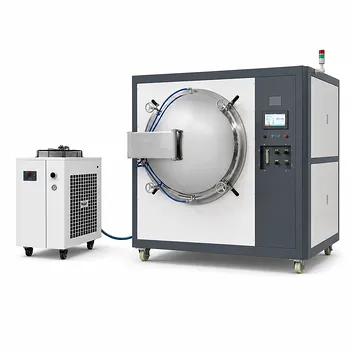
A vacuum hot press sintering furnace acts as the primary driver for densification and bonding in the preparation of Al0.6CoCrFeNi/5052Al composites. Specifically, it applies a mechanical pressure of 30 MPa while maintaining a temperature of 823K within a vacuum environment. This tri-factor approach forces the powder particles into close contact, induces plastic deformation, and prevents the oxidation that typically inhibits successful sintering of aluminum-based materials.
Core Takeaway The furnace functions not merely as a heater, but as a dual-action compaction tool. By combining thermal energy with mechanical force in an oxygen-free zone, it overcomes the natural oxide barriers of aluminum powders, facilitating atomic diffusion and resulting in a chemically bonded, highly dense composite structure.
Mechanisms of Densification
The furnace facilitates the transition from loose powder to solid composite through distinct physical mechanisms.
Application of Mechanical Pressure
The furnace exerts a uniaxial pressure of 30 MPa directly onto the powder mixture. This external force is critical because thermal energy alone is often insufficient to densify aluminum composites.
Particle Rearrangement and Deformation
Under this pressure, the powder particles physically rearrange to fill large voids. As the material softens, the pressure induces plastic deformation, forcing the malleable 5052Al matrix to flow around the harder Al0.6CoCrFeNi reinforcement particles, effectively closing interstitial gaps.
Thermal Activation at 823K
Simultaneously, the furnace maintains a sintering temperature of 823K. This thermal energy lowers the yield strength of the matrix, making the applied pressure more effective at densifying the material.
The Role of the Vacuum Environment
Controlling the atmosphere is as critical as applying heat and pressure, particularly for aluminum alloys which are highly prone to oxidation.
Prevention of Oxidation
The vacuum environment eliminates oxygen from the chamber. This prevents the formation of new oxide layers on the metal surfaces at high temperatures, which would otherwise act as a barrier to bonding and weaken the final composite.
Elimination of Adsorbed Gases
The vacuum actively promotes the desorption of gases trapped on the surface of the powder particles. Removing these gases prevents porosity and blistering, ensuring the internal structure remains solid.
Formation of Metallurgical Bonds
By keeping particle surfaces clean and bringing them into intimate contact via pressure, the furnace facilitates atomic diffusion. This allows for the creation of a stable metallurgical bonding interface between the Al0.6CoCrFeNi reinforcement and the 5052Al matrix.
Understanding the Trade-offs
While vacuum hot pressing is effective for high-quality composites, it introduces specific limitations that must be managed.
Geometry Constraints
Because the pressure is typically uniaxial (applied from one direction), the process is generally limited to simple geometries like plates or cylinders. Complex 3D shapes usually require post-processing or different sintering methods.
Process Efficiency
The requirement to pump down to a high vacuum and the simultaneous application of heat and pressure makes this a batch process. It is generally slower and more resource-intensive than continuous sintering methods like pressureless sintering.
Making the Right Choice for Your Goal
To maximize the effectiveness of this equipment for your specific application, focus on these operational priorities:
- If your primary focus is Maximum Density: Ensure the 30 MPa pressure is applied consistently throughout the heating phase to maximize plastic flow while the matrix is soft.
- If your primary focus is Interface Strength: Prioritize the vacuum integrity and holding time at 823K to allow sufficient atomic diffusion across the clean particle boundaries.
Ultimately, the vacuum hot press sintering furnace is essential for converting the potential of Al0.6CoCrFeNi/5052Al powders into a structurally sound, oxidation-free reality.
Summary Table:
| Feature | Parameter/Function | Benefit in Composite Preparation |
|---|---|---|
| Sintering Temperature | 823K | Lowers yield strength & enables plastic deformation |
| Applied Pressure | 30 MPa (Uniaxial) | Forces particle rearrangement and closes interstitial voids |
| Environment | High Vacuum | Prevents oxidation and eliminates adsorbed gases for clean bonding |
| Core Mechanism | Atomic Diffusion | Facilitates stable metallurgical interfaces between reinforcement & matrix |
| Final Result | High Density | Produces structurally sound, pore-free Al0.6CoCrFeNi/5052Al structures |
Elevate Your Material Research with KINTEK
Precision in sintering is the difference between a failed sample and a breakthrough. KINTEK specializes in advanced laboratory solutions, providing high-performance vacuum hot presses, muffle furnaces, and isostatic presses designed to meet the rigorous demands of composite fabrication.
Whether you are developing Al-based composites or next-generation alloys, our expertise in high-temperature high-pressure reactors, crushing systems, and specialized consumables (crucibles, ceramics, and PTFE) ensures your lab is equipped for success.
Ready to achieve superior densification and bond integrity?
Contact KINTEK experts today to find the perfect furnace for your application.
Related Products
- 600T Vacuum Induction Hot Press Furnace for Heat Treat and Sintering
- Vacuum Heat Treat and Sintering Furnace with 9MPa Air Pressure
- Vacuum Heat Treat and Pressure Sintering Furnace for High Temperature Applications
- 2200 ℃ Tungsten Vacuum Heat Treat and Sintering Furnace
- Vacuum Hot Press Furnace Heated Vacuum Press Machine Tube Furnace
People Also Ask
- What role does an induction vacuum hot pressing furnace play in sintering? Achieve 98% Density in Carbide Blocks
- What advantages does a vacuum hot press furnace provide for LSLBO ceramic electrolytes? Achieve 94% Relative Density
- What role does a Vacuum Hot Press (VHP) furnace play in the densification of austenitic stainless steel 316 composites?
- What are the advantages of a vacuum hot press furnace for W-50%Cu? Achieve 99.6% Density at Lower Temperatures
- What role does mechanical pressure play during the vacuum diffusion bonding of tungsten and copper? Keys to Solid Bonding