Knowledge Resources How does heat treatment annealing improve mechanical properties? Tailor Metal Strength and Ductility
Author avatar

Tech Team · Kintek Solution

Updated 3 months ago

How does heat treatment annealing improve mechanical properties? Tailor Metal Strength and Ductility


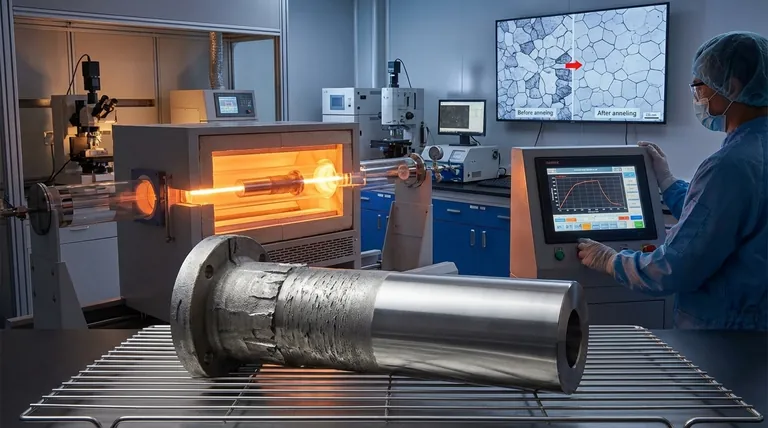
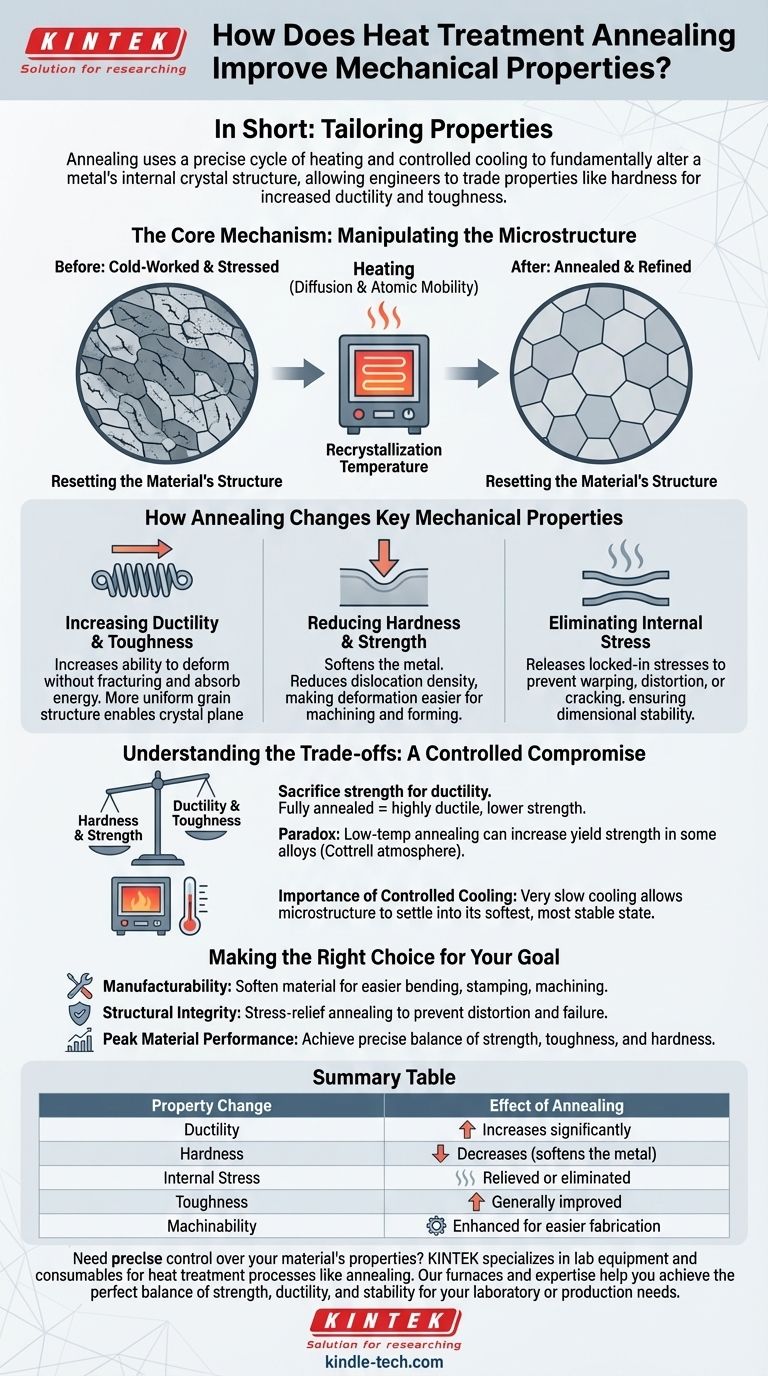
In short, annealing improves mechanical properties by using a precise cycle of heating and controlled cooling to fundamentally alter a metal's internal crystal structure. This process relieves internal stresses, refines the grain structure, and adjusts the density of atomic-level defects, allowing engineers to trade properties like hardness for increased ductility and toughness.

The term "improve" is entirely dependent on the application's goal. Annealing doesn’t make a material universally "better"; it tailors its properties for a specific purpose, most often by making a hard, brittle metal softer, more ductile, and easier to work with.
How does heat treatment annealing improve mechanical properties? Tailor Metal Strength and Ductility

The Core Mechanism: Manipulating the Microstructure

To understand how annealing works, you must look inside the metal at its crystal structure, or microstructure. This internal architecture dictates its performance.

What is the Goal of Annealing?

When a metal is bent, stamped, or welded (a process known as cold working), its internal structure becomes stressed and distorted. This makes the metal harder but also more brittle.

The primary goal of annealing is to reverse these effects. It aims to increase ductility (the ability to deform without fracturing), relieve internal stresses, and refine the grain structure to create a more uniform and predictable material.

The Role of Heat and Diffusion

Heating a metal provides the thermal energy its atoms need to move, a process called diffusion. This atomic mobility is the engine of change.

As the metal is held at the annealing temperature, atoms can rearrange themselves into a more stable, lower-energy state, effectively healing the defects introduced during cold working.

Recrystallization: Resetting the Material's Structure

For a heavily cold-worked material, heating it above its recrystallization temperature triggers the formation of entirely new, strain-free crystals or "grains."

This process effectively erases the previous microstructure, replacing the distorted, stressed grains with a new set that is softer and more ductile.

How Annealing Changes Key Mechanical Properties

The changes to the microstructure translate directly into tangible changes in performance.

Increasing Ductility and Toughness

By creating a more uniform, stress-free grain structure, annealing allows the metal's internal crystal planes to slide past one another more easily. This dramatically increases its ability to bend, stretch, and absorb energy before fracturing.

Reducing Hardness and Strength

In most cases, especially with full annealing, the process softens the metal. Relieving stress and reducing the density of defects (dislocations) makes the material easier to deform.

This reduction in hardness and yield strength is often the desired outcome, making the metal easier to machine, form, or stamp in subsequent manufacturing steps.

Eliminating Internal Stress

Internal stresses from processes like welding or casting can cause a component to warp, distort, or even crack over time.

Annealing allows the microstructure to relax, releasing these locked-in stresses and ensuring the part remains dimensionally stable throughout its service life.

Understanding the Trade-offs

Annealing is not a magic bullet; it is a process of controlled compromise. Understanding the inherent trade-offs is critical for making sound engineering decisions.

The Hardness vs. Ductility Exchange

The most fundamental trade-off in annealing is between strength and ductility. You almost always sacrifice one to gain the other.

A fully annealed component will be highly ductile and easy to form but will have a lower tensile strength and hardness than its cold-worked counterpart.

When Annealing Can Increase Strength

Paradoxically, specific low-temperature annealing treatments can sometimes increase yield strength. This occurs in certain alloys, like some steels, after light cold working.

The heat allows carbon atoms to migrate to and lock dislocations in place, forming a "Cottrell atmosphere." This pinning action makes it harder to initiate movement (higher yield strength) but often reduces overall elongation.

The Importance of Controlled Cooling

The rate of cooling is just as important as the heating temperature. Cooling too quickly can introduce new stresses or create a different, harder microstructure.

True annealing almost always involves very slow cooling, often by leaving the part inside the insulated furnace as it cools down. This ensures the microstructure can settle into its softest, most stable state.

Making the Right Choice for Your Goal

The "improvement" you seek from annealing depends entirely on your end goal.

  • If your primary focus is manufacturability: Annealing is used to soften the material, making it easier to bend, stamp, or machine without cracking.
  • If your primary focus is structural integrity after fabrication: Stress-relief annealing is critical to prevent distortion and premature failure in welded or cast components.
  • If your primary focus is peak material performance: You must see annealing as one step in a sequence of heat treatments designed to achieve a precise balance of strength, toughness, and hardness.

Ultimately, annealing provides control, allowing you to reset a material's properties to achieve a specific engineering outcome.

Summary Table:

Property Change Effect of Annealing
Ductility Increases significantly
Hardness Decreases (softens the metal)
Internal Stress Relieved or eliminated
Toughness Generally improved
Machinability Enhanced for easier fabrication

Need precise control over your material's properties? KINTEK specializes in lab equipment and consumables for heat treatment processes like annealing. Our furnaces and expertise help you achieve the perfect balance of strength, ductility, and stability for your laboratory or production needs. Contact us today to discuss your application!

Visual Guide
How does heat treatment annealing improve mechanical properties? Tailor Metal Strength and Ductility Visual Guide

Related Products

People Also Ask

Related Products

Vacuum Heat Treat Furnace with Ceramic Fiber Liner

Vacuum Heat Treat Furnace with Ceramic Fiber Liner

Vacuum furnace with polycrystalline ceramic fiber insulation liner for excellent heat insulation and uniform temperature field. Choose from 1200℃ or 1700℃ max. working temperature with high vacuum performance and precise temperature control.

2200 ℃ Graphite Vacuum Heat Treat Furnace

2200 ℃ Graphite Vacuum Heat Treat Furnace

Discover the power of the KT-VG Graphite Vacuum Furnace - with a maximum working temperature of 2200℃, it's perfect for vacuum sintering of various materials. Learn more now.

Molybdenum Vacuum Heat Treat Furnace

Molybdenum Vacuum Heat Treat Furnace

Discover the benefits of a high-configuration molybdenum vacuum furnace with heat shield insulation. Ideal for high-purity, vacuum environments like sapphire crystal growth and heat treatment.

600T Vacuum Induction Hot Press Furnace for Heat Treat and Sintering

600T Vacuum Induction Hot Press Furnace for Heat Treat and Sintering

Discover the 600T Vacuum Induction Hot Press Furnace, designed for high-temperature sintering experiments in vacuum or protected atmospheres. Its precise temperature and pressure control, adjustable working pressure, and advanced safety features make it ideal for nonmetal materials, carbon composites, ceramics, and metal powders.

Vacuum Heat Treat and Pressure Sintering Furnace for High Temperature Applications

Vacuum Heat Treat and Pressure Sintering Furnace for High Temperature Applications

Vacuum pressure sintering furnaces are designed for high temperature hot pressing applications in metal and ceramic sintering. Its advanced features ensure precise temperature control, reliable pressure maintenance, and a robust design for seamless operation.

1400℃ Controlled Atmosphere Furnace with Nitrogen and Inert Atmosphere

1400℃ Controlled Atmosphere Furnace with Nitrogen and Inert Atmosphere

Achieve precise heat treatment with KT-14A controlled atmosphere furnace. Vacuum sealed with a smart controller, it's ideal for lab and industrial use up to 1400℃.

1200℃ Controlled Atmosphere Furnace Nitrogen Inert Atmosphere Furnace

1200℃ Controlled Atmosphere Furnace Nitrogen Inert Atmosphere Furnace

Discover our KT-12A Pro Controlled atmosphere furnace - high precision, heavy duty vacuum chamber, versatile smart touch screen controller, and excellent temperature uniformity up to 1200C. Ideal for both laboratory and industrial application.

1700℃ Controlled Atmosphere Furnace Nitrogen Inert Atmosphere Furnace

1700℃ Controlled Atmosphere Furnace Nitrogen Inert Atmosphere Furnace

KT-17A Controlled atmosphere furnace: 1700℃ heating, vacuum sealing technology, PID temperature control, and versatile TFT smart touch screen controller for laboratory and industrial use.

2200 ℃ Tungsten Vacuum Heat Treat and Sintering Furnace

2200 ℃ Tungsten Vacuum Heat Treat and Sintering Furnace

Experience the ultimate refractory metal furnace with our Tungsten vacuum furnace. Capable of reaching 2200℃, perfect for sintering advanced ceramics and refractory metals. Order now for high-quality results.

Laboratory Rapid Thermal Processing (RTP) Quartz Tube Furnace

Laboratory Rapid Thermal Processing (RTP) Quartz Tube Furnace

Get lightning-fast heating with our RTP Rapid Heating Tube Furnace. Designed for precise, high-speed heating and cooling with convenient sliding rail and TFT touch screen controller. Order now for ideal thermal processing!

Vacuum Hot Press Furnace Machine Heated Vacuum Press

Vacuum Hot Press Furnace Machine Heated Vacuum Press

Discover the advantages of Vacuum Hot Press Furnace! Manufacture dense refractory metals & compounds, ceramics, and composites under high temp and pressure.

Multi-zone Laboratory Tube Furnace

Multi-zone Laboratory Tube Furnace

Experience precise, efficient thermal testing with our Multi Zone Tube Furnace. Independent heating zones and temperature sensors allow for controlled high-temperature gradient heating fields. Order now for advanced thermal analysis!

Electric Rotary Kiln Continuous Working Small Rotary Furnace Heating Pyrolysis Plant

Electric Rotary Kiln Continuous Working Small Rotary Furnace Heating Pyrolysis Plant

Efficiently calcine and dry bulk powder and lump fluid materials with an electric heating rotary furnace. Ideal for processing lithium ion battery materials and more.

Laboratory Muffle Oven Furnace Bottom Lifting Muffle Furnace

Laboratory Muffle Oven Furnace Bottom Lifting Muffle Furnace

Efficiently produce batches with excellent temperature uniformity using our Bottom Lifting Furnace. Features two electric lifting stages and advanced temperature control up to 1600℃.

High Temperature Muffle Oven Furnace for Laboratory Debinding and Pre Sintering

High Temperature Muffle Oven Furnace for Laboratory Debinding and Pre Sintering

KT-MD High temperature debinding and pre-sintering furnace for ceramic materials with various molding processes. Ideal for electronic components such as MLCC and NFC.

Ultra-High Temperature Graphite Vacuum Graphitization Furnace

Ultra-High Temperature Graphite Vacuum Graphitization Furnace

The ultra-high temperature graphitization furnace utilizes medium frequency induction heating in a vacuum or inert gas environment. The induction coil generates an alternating magnetic field, inducing eddy currents in the graphite crucible, which heats up and radiates heat to the workpiece, bringing it to the desired temperature. This furnace is primarily used for graphitization and sintering of carbon materials, carbon fiber materials, and other composite materials.

1200℃ Split Tube Furnace with Quartz Tube Laboratory Tubular Furnace

1200℃ Split Tube Furnace with Quartz Tube Laboratory Tubular Furnace

KT-TF12 split tube furnace: high-purity insulation, embedded heating wire coils, and max. 1200C. Widely used for new materials and chemical vapour deposition.

Horizontal High Temperature Graphite Vacuum Graphitization Furnace

Horizontal High Temperature Graphite Vacuum Graphitization Furnace

Horizontal Graphitization Furnace: This type of furnace is designed with the heating elements placed horizontally, allowing for uniform heating of the sample. It's well-suited for graphitizing large or bulky samples that require precise temperature control and uniformity.

Vacuum Sealed Continuous Working Rotary Tube Furnace Rotating Tube Furnace

Vacuum Sealed Continuous Working Rotary Tube Furnace Rotating Tube Furnace

Experience efficient material processing with our vacuum-sealed rotary tube furnace. Perfect for experiments or industrial production, equipped with optional features for controlled feeding and optimized results. Order now.

1700℃ Muffle Oven Furnace for Laboratory

1700℃ Muffle Oven Furnace for Laboratory

Get superior heat control with our 1700℃ Muffle Furnace. Equipped with intelligent temperature microprocessor, TFT touch screen controller & advanced insulation materials for precise heating up to 1700C. Order now!


Leave Your Message



















