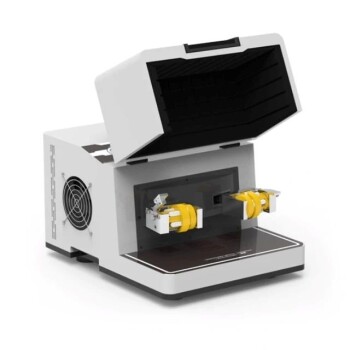
Precision grinding equipment ensures measurement accuracy by systematically removing material until the spherical sample is ground down to its exact diameter. This specific depth exposes the true radial cross-section of the steel. By revealing the sphere's geometric center, the equipment eliminates angular distortions, allowing researchers to measure the actual thickness of surface features like iron nitride layers without calculation errors.
Accurate analysis of spherical samples relies entirely on geometry; checking a layer's thickness at any point other than the exact center (diameter) creates a slanted viewing angle. Precision grinding solves this by targeting the sphere's equator to ensure the cross-section is perpendicular to the surface, presenting the true physical dimensions.
The Geometric Challenge of Spheres
The Risk of Optical Distortion
When you prepare a spherical sample for microscopy, the angle at which you cut through the surface determines what you see. If the cross-section is taken above or below the center line, the cut passes through the surface layers at a slant.
False Thickness Readings
This slanted cut artificially elongates the appearance of surface layers. Without reaching the exact diameter, a thin iron nitride layer will appear significantly thicker under a microscope than it is in reality.
The Necessity of the "True" Cross-Section
To obtain data that reflects reality, you must expose the true radial cross-section. This is the only plane where the viewing angle is perfectly perpendicular to the surface tangent, eliminating geometric deviation.
How Precision Equipment Solves the Problem
Meticulous Depth Control
The primary function of precision grinding in this context is depth management. The equipment is calibrated to grind the steel sphere down to the precise midpoint of its geometry.
Revealing the Porous Zone
Beyond just the surface layer, accurate grinding is essential for observing internal structures. The primary reference notes that the porous zone beneath the nitride layer can only be observed without distortion if the grinding depth is exact.
Eliminating Calculation Variables
By physically achieving the correct geometry through grinding, researchers remove the need for complex mathematical corrections. The measurement taken under the microscope represents the direct, actual thickness of the material.
Understanding the Trade-offs
The Margin for Error is Zero
The precision of this method is binary. If the grinding stops even slightly short of the diameter, or proceeds slightly past it, the geometric distortion returns, and the measurement becomes unreliable.
Destructive Analysis
This process is inherently destructive. Because the sample must be ground to its center to yield accurate data, the spherical component cannot be returned to service or used for further mechanical testing.
Ensuring Accuracy in Your Analysis
To ensure your metallographic preparation yields valid data, consider the following approach:
- If your primary focus is absolute thickness measurement: Ensure your grinding protocol includes a verification step to confirm the cross-section has reached the sphere's maximum diameter.
- If your primary focus is structural analysis: Pay close attention to the porous zone; if it appears smeared or elongated, the grinding depth likely missed the true radial center.
Precision grinding is not just about smoothing a surface; it is about revealing the correct geometry to make truth visible.
Summary Table:
| Factor | Impact on Measurement | Precision Grinding Solution |
|---|---|---|
| Grinding Depth | Off-center cuts cause slanted viewing angles. | Targets the exact equator for a 90° viewing angle. |
| Layer Thickness | Slanted cuts artificially elongate surface layers. | Exposes the true physical dimensions of nitride layers. |
| Porous Zone | Misalignment smears or hides internal structures. | Reveals clear internal zones without geometric distortion. |
| Calculation | Requires complex math for off-center errors. | Provides direct, reliable measurements without correction. |
Elevate Your Metallographic Precision with KINTEK
Don't let geometric distortions compromise your research integrity. KINTEK specializes in high-performance laboratory equipment, offering the advanced crushing and milling systems and precision sample preparation tools necessary to achieve the true radial cross-sections your analysis demands.
From robust high-temperature furnaces for sample treatment to precision hydraulic presses and metallographic consumables, our comprehensive portfolio supports materials scientists and battery researchers in achieving absolute measurement accuracy.
Ready to optimize your sample preparation workflow? Contact our technical experts today to discover how KINTEK’s precision equipment can enhance your lab's efficiency and data reliability.
References
- T. Frączek, Justyna Owczarek. Phase Transformations of Iron Nitrides during Annealing in Nitrogen and Hydrogen Atmosphere. DOI: 10.3390/coatings13111882
This article is also based on technical information from Kintek Solution Knowledge Base .
Related Products
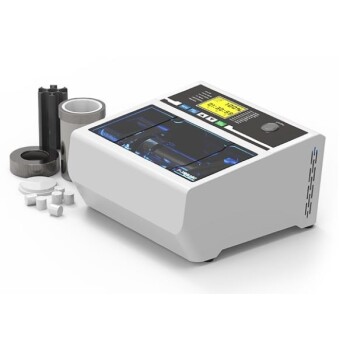
- Laboratory Grinding Mill Mortar Grinder for Sample Preparation
- Laboratory Micro Horizontal Jar Mill for Precision Sample Preparation in Research and Analysis
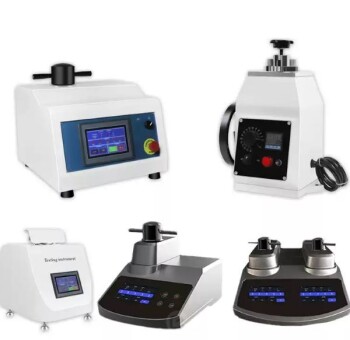
- Metallographic Specimen Mounting Machine for Laboratory Materials and Analysis
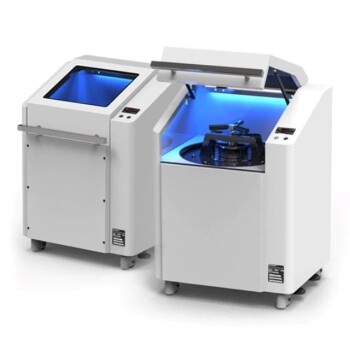
- Laboratory Disc Cup Vibratory Mill for Sample Grinding
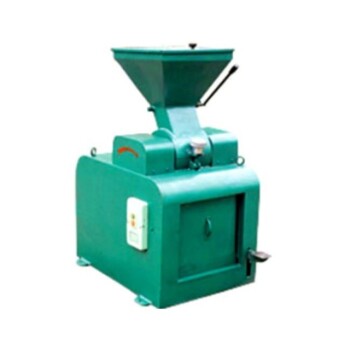
- Laboratory Sealed Hammer Crusher for Efficient Sample Preparation
People Also Ask
- What laboratory apparatus is used for grinding? Match the Right Mill to Your Sample Material
- What is the function of a laboratory grinding mill? Achieve Precise Sample Preparation for Accurate Results
- What is the purpose of using a laboratory grinder and standard sieves? Unlock Precise Rice Husk Pretreatment
- What is the role of laboratory-grade grinders and sieves in sample prep? Ensure High-Precision Corrosion Analysis
- What is the purpose of using a laboratory grinder with specific mesh sieves for oat straw? Optimize Pellet Quality