Knowledge How much energy is required for methane pyrolysis? The Real Cost of Clean Hydrogen Production
Author avatar

Tech Team · Kintek Solution

Updated 5 days ago

How much energy is required for methane pyrolysis? The Real Cost of Clean Hydrogen Production


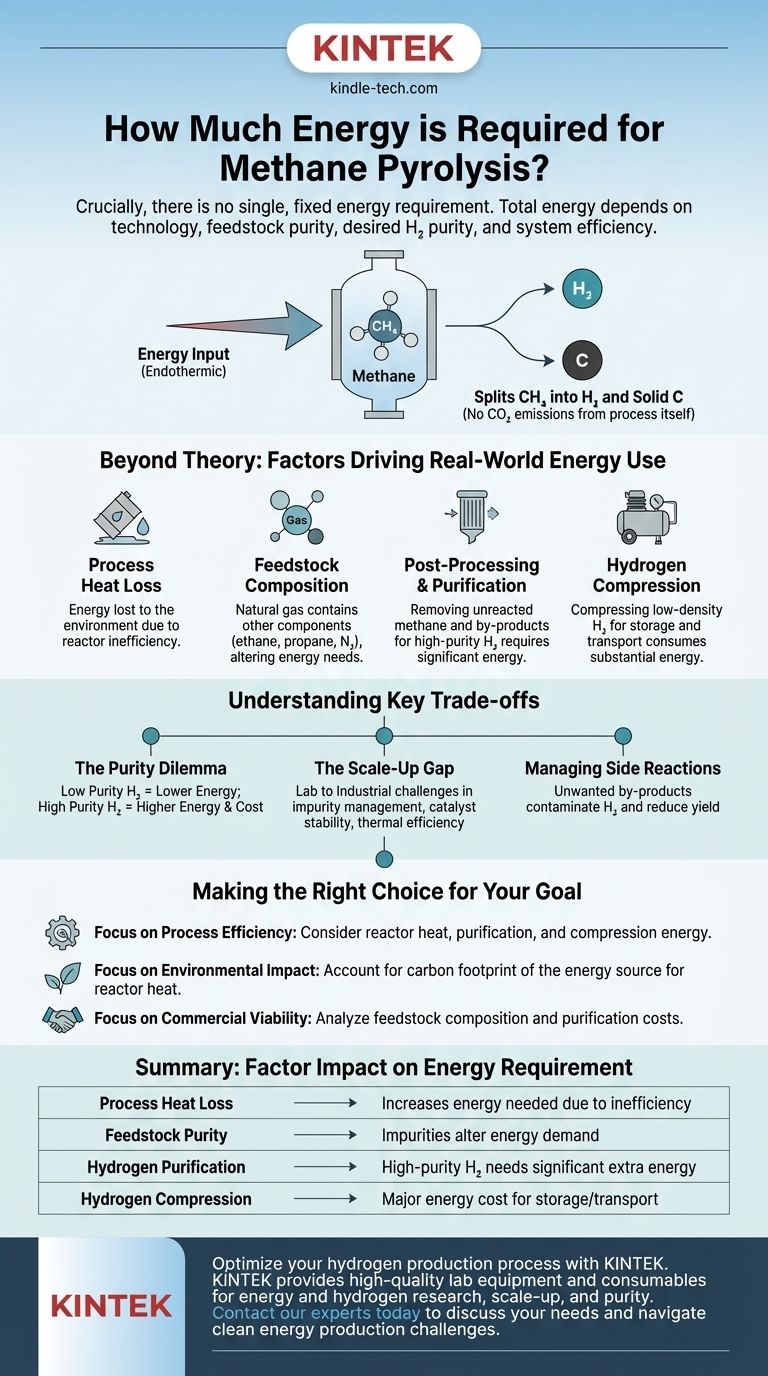
Crucially, there is no single, fixed energy requirement for methane pyrolysis. The total energy needed is highly variable, depending on the specific technology used, the purity of the natural gas feedstock, the desired purity of the final hydrogen product, and the efficiency of the overall system.

The theoretical energy needed to break methane's chemical bonds is only the starting point. The practical, real-world energy cost is significantly higher, driven by process heat loss, gas purification, and the energy-intensive step of hydrogen compression.
How much energy is required for methane pyrolysis? The Real Cost of Clean Hydrogen Production

The Core Thermal Demand

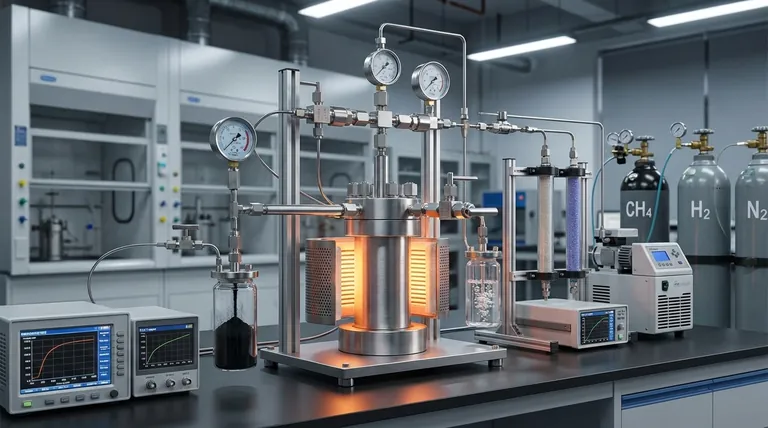
Methane pyrolysis is an endothermic process, meaning it requires a continuous input of energy to function. This energy is used to heat methane (CH₄) to high temperatures, which breaks the strong chemical bonds between carbon and hydrogen atoms.

What the Energy Does

The primary goal of the energy input is to split the methane molecule into its constituent parts: hydrogen gas (H₂) and solid carbon (C). This is achieved without reacting the methane with oxygen, which is why the process itself does not produce CO₂ emissions.

Beyond Theory: Factors Driving Real-World Energy Use

The baseline thermal energy is just one piece of the puzzle. In any industrial application, several other factors add significant energy costs to the overall process.

Process Heat Loss

No industrial process is perfectly insulated. A portion of the thermal energy supplied to the reactor will inevitably be lost to the surrounding environment. This inefficiency means more energy must be supplied than is theoretically required just to make the reaction happen.

Feedstock Composition (Natural Gas vs. Methane)

While research often uses pure methane, industrial facilities use natural gas. Natural gas contains other components like ethane, propane, and nitrogen. These additional substances can influence the reaction, potentially requiring different operating temperatures or catalytic processes, thereby altering the energy demand.

Post-Processing and Purification

The gas stream leaving the reactor is not pure hydrogen. It contains unreacted methane and other hydrocarbon by-products. If high-purity hydrogen is the goal (e.g., for petrochemicals), this mixture must undergo energy-intensive purification and separation steps.

Hydrogen Compression

Hydrogen is the lightest element, meaning it has a very low density. To store or transport it effectively, the resulting hydrogen gas must be heavily compressed. This mechanical process consumes a substantial amount of electrical energy and is a major component of the total energy budget.

Understanding the Key Trade-offs

Evaluating methane pyrolysis requires understanding the practical challenges that directly impact its energy efficiency and economic viability.

The Purity Dilemma

The energy required to produce a mixed "dirty" hydrogen stream is far lower than what is needed for 99.9%+ pure hydrogen. The decision to pursue higher purity levels introduces significant energy and capital costs associated with advanced gas separation technologies.

The Scale-Up Gap

There is a notable gap between controlled laboratory experiments and large-scale industrial reality. Challenges related to managing impurities in natural gas, ensuring catalyst stability, and maintaining thermal efficiency become far more pronounced at an industrial scale.

Managing Side Reactions

Unwanted side reactions can produce other hydrocarbons or aromatic compounds. These by-products not only contaminate the hydrogen stream, making purification more difficult and energy-intensive, but also represent a loss of potential hydrogen yield from the feedstock.

Making the Right Choice for Your Goal

To assess the energy requirement for a specific application, you must look beyond the core reaction and consider the entire system.

  • If your primary focus is process efficiency: Your analysis must account for the total energy input, including heat for the reactor, electricity for purification, and the significant energy consumed by hydrogen compression.
  • If your primary focus is environmental impact: While the pyrolysis reaction is CO₂-free, you must consider the carbon footprint of the energy source used to heat the reactor. If natural gas is burned to generate this heat, the process will still have associated emissions.
  • If your primary focus is commercial viability: A detailed analysis of your natural gas feedstock is critical. Its specific composition will determine the complexity and energy cost of the purification train required to meet your customer's hydrogen purity specifications.

Ultimately, understanding the true energy cost of methane pyrolysis requires a holistic view of the entire production chain, from the natural gas wellhead to the final compressed hydrogen product.

Summary Table:

Factor Impact on Energy Requirement
Process Heat Loss Increases energy needed due to reactor inefficiency
Feedstock Purity Impurities in natural gas can alter energy demand
Hydrogen Purification High-purity H₂ requires significant additional energy
Hydrogen Compression A major energy cost for storage and transport

Optimize your hydrogen production process with KINTEK.

Understanding the complex energy dynamics of methane pyrolysis is key to developing an efficient and cost-effective operation. The right lab equipment is essential for accurate research, process development, and quality control.

KINTEK specializes in providing high-quality laboratory equipment and consumables to support your energy and hydrogen research. Whether you are scaling up from lab to pilot or ensuring product purity, our solutions help you achieve reliable results and improve process efficiency.

Contact our experts today to discuss how KINTEK can support your specific laboratory needs and help you navigate the challenges of clean energy production.

Visual Guide
How much energy is required for methane pyrolysis? The Real Cost of Clean Hydrogen Production Visual Guide

Related Products

People Also Ask

Related Products

Customizable High Pressure Reactors for Advanced Scientific and Industrial Applications

Customizable High Pressure Reactors for Advanced Scientific and Industrial Applications

This laboratory-scale high-pressure reactor is a high-performance autoclave engineered for precision and safety in demanding research and development environments.

High Temperature Muffle Oven Furnace for Laboratory Debinding and Pre Sintering

High Temperature Muffle Oven Furnace for Laboratory Debinding and Pre Sintering

KT-MD High temperature debinding and pre-sintering furnace for ceramic materials with various molding processes. Ideal for electronic components such as MLCC and NFC.

High Pressure Laboratory Vacuum Tube Furnace Quartz Tubular Furnace

High Pressure Laboratory Vacuum Tube Furnace Quartz Tubular Furnace

KT-PTF High Pressure Tube Furnace: Compact split tube furnace with strong positive pressure resistance. Working temp up to 1100°C and pressure up to 15Mpa. Also works under controller atmosphere or high vacuum.

High Pressure Laboratory Autoclave Reactor for Hydrothermal Synthesis

High Pressure Laboratory Autoclave Reactor for Hydrothermal Synthesis

Discover the applications of Hydrothermal Synthesis Reactor - a small, corrosion-resistant reactor for chemical labs. Achieve rapid digestion of insoluble substances in a safe and reliable way. Learn more now.

Ultra-High Temperature Graphite Vacuum Graphitization Furnace

Ultra-High Temperature Graphite Vacuum Graphitization Furnace

The ultra-high temperature graphitization furnace utilizes medium frequency induction heating in a vacuum or inert gas environment. The induction coil generates an alternating magnetic field, inducing eddy currents in the graphite crucible, which heats up and radiates heat to the workpiece, bringing it to the desired temperature. This furnace is primarily used for graphitization and sintering of carbon materials, carbon fiber materials, and other composite materials.

Graphite Vacuum Continuous Graphitization Furnace

Graphite Vacuum Continuous Graphitization Furnace

High-temperature graphitization furnace is a professional equipment for graphitization treatment of carbon materials. It is a key equipment for the production of high-quality graphite products. It has high temperature, high efficiency and uniform heating. It is suitable for various high-temperature treatments and graphitization treatments. It is widely used in metallurgy, electronics, aerospace, etc. industry.

Stainless High Pressure Autoclave Reactor Laboratory Pressure Reactor

Stainless High Pressure Autoclave Reactor Laboratory Pressure Reactor

Discover the versatility of Stainless High Pressure Reactor - a safe and reliable solution for direct and indirect heating. Built with stainless steel, it can withstand high temperatures and pressures. Learn more now.

Mini SS High Pressure Autoclave Reactor for Laboratory Use

Mini SS High Pressure Autoclave Reactor for Laboratory Use

Mini SS High Pressure Reactor - Ideal for medicine, chemical, and scientific research industries. Programmed heating temp and stirring speed, up to 22Mpa pressure.

Molybdenum Vacuum Heat Treat Furnace

Molybdenum Vacuum Heat Treat Furnace

Discover the benefits of a high-configuration molybdenum vacuum furnace with heat shield insulation. Ideal for high-purity, vacuum environments like sapphire crystal growth and heat treatment.

2200 ℃ Tungsten Vacuum Heat Treat and Sintering Furnace

2200 ℃ Tungsten Vacuum Heat Treat and Sintering Furnace

Experience the ultimate refractory metal furnace with our Tungsten vacuum furnace. Capable of reaching 2200℃, perfect for sintering advanced ceramics and refractory metals. Order now for high-quality results.

Vertical High Temperature Graphite Vacuum Graphitization Furnace

Vertical High Temperature Graphite Vacuum Graphitization Furnace

Vertical high temperature graphitization furnace for carbonization and graphitization of carbon materials up to 3100℃.Suitable for shaped graphitization of carbon fiber filaments and other materials sintered in a carbon environment.Applications in metallurgy, electronics, and aerospace for producing high-quality graphite products like electrodes and crucibles.

Electric Rotary Kiln Small Rotary Furnace Biomass Pyrolysis Plant

Electric Rotary Kiln Small Rotary Furnace Biomass Pyrolysis Plant

Learn about Rotary Biomass Pyrolysis Furnaces & how they decompose organic material at high temps without oxygen. Use for biofuels, waste processing, chemicals & more.

Molybdenum Disilicide (MoSi2) Thermal Elements Electric Furnace Heating Element

Molybdenum Disilicide (MoSi2) Thermal Elements Electric Furnace Heating Element

Discover the power of Molybdenum Disilicide (MoSi2) Heating Element for high-temperature resistance. Unique oxidation resistance with stable resistance value. Learn more about its benefits now!

Vacuum Heat Treat and Sintering Furnace with 9MPa Air Pressure

Vacuum Heat Treat and Sintering Furnace with 9MPa Air Pressure

The air pressure sintering furnace is a high-tech equipment commonly used for the sintering of advanced ceramic materials. It combines vacuum sintering and pressure sintering techniques to achieve high-density and high-strength ceramics.

2200 ℃ Graphite Vacuum Heat Treat Furnace

2200 ℃ Graphite Vacuum Heat Treat Furnace

Discover the power of the KT-VG Graphite Vacuum Furnace - with a maximum working temperature of 2200℃, it's perfect for vacuum sintering of various materials. Learn more now.

1200℃ Controlled Atmosphere Furnace Nitrogen Inert Atmosphere Furnace

1200℃ Controlled Atmosphere Furnace Nitrogen Inert Atmosphere Furnace

Discover our KT-12A Pro Controlled atmosphere furnace - high precision, heavy duty vacuum chamber, versatile smart touch screen controller, and excellent temperature uniformity up to 1200C. Ideal for both laboratory and industrial application.

Vacuum Heat Treat and Molybdenum Wire Sintering Furnace for Vacuum Sintering

Vacuum Heat Treat and Molybdenum Wire Sintering Furnace for Vacuum Sintering

A vacuum molybdenum wire sintering furnace is a vertical or bedroom structure, which is suitable for withdrawal, brazing, sintering and degassing of metal materials under high vacuum and high temperature conditions. It is also suitable for dehydroxylation treatment of quartz materials.

Lab-Scale Vacuum Induction Melting Furnace

Lab-Scale Vacuum Induction Melting Furnace

Get precise alloy composition with our Vacuum Induction Melting Furnace. Ideal for aerospace, nuclear energy, and electronic industries. Order now for effective smelting and casting of metals and alloys.

Vacuum Heat Treat Furnace with Ceramic Fiber Liner

Vacuum Heat Treat Furnace with Ceramic Fiber Liner

Vacuum furnace with polycrystalline ceramic fiber insulation liner for excellent heat insulation and uniform temperature field. Choose from 1200℃ or 1700℃ max. working temperature with high vacuum performance and precise temperature control.

Small Vacuum Heat Treat and Tungsten Wire Sintering Furnace

Small Vacuum Heat Treat and Tungsten Wire Sintering Furnace

The small vacuum tungsten wire sintering furnace is a compact experimental vacuum furnace specially designed for universities and scientific research institutes. The furnace features a CNC welded shell and vacuum piping to ensure leak-free operation. Quick-connect electrical connections facilitate relocation and debugging, and the standard electrical control cabinet is safe and convenient to operate.


Leave Your Message