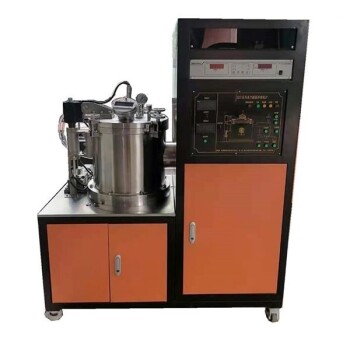
Knowledge Vacuum Furnace How is vacuum created in a furnace? A Guide to Achieving a Contamination-Free Heat Treatment Environment
Author avatar

Tech Team · Kintek Solution

Updated 2 months ago

How is vacuum created in a furnace? A Guide to Achieving a Contamination-Free Heat Treatment Environment


In short, a vacuum is created in a furnace by using a specialized pumping system to mechanically remove the air and other gases from a sealed furnace chamber. This process lowers the internal pressure to a level far below the normal atmosphere, creating the vacuum environment required for processing.

A vacuum furnace doesn't create "vacuum" as a substance; it systematically removes atmospheric gases. This fundamental act prevents unwanted chemical reactions like oxidation at high temperatures, which is the core reason for its use in advanced material processing.

How is vacuum created in a furnace? A Guide to Achieving a Contamination-Free Heat Treatment Environment

The Core Principle: From Atmosphere to Vacuum

Creating a vacuum is a process of subtraction. A vacuum furnace is engineered to be an isolated system where the internal atmosphere can be precisely controlled by removing almost all of the air that would normally be present.

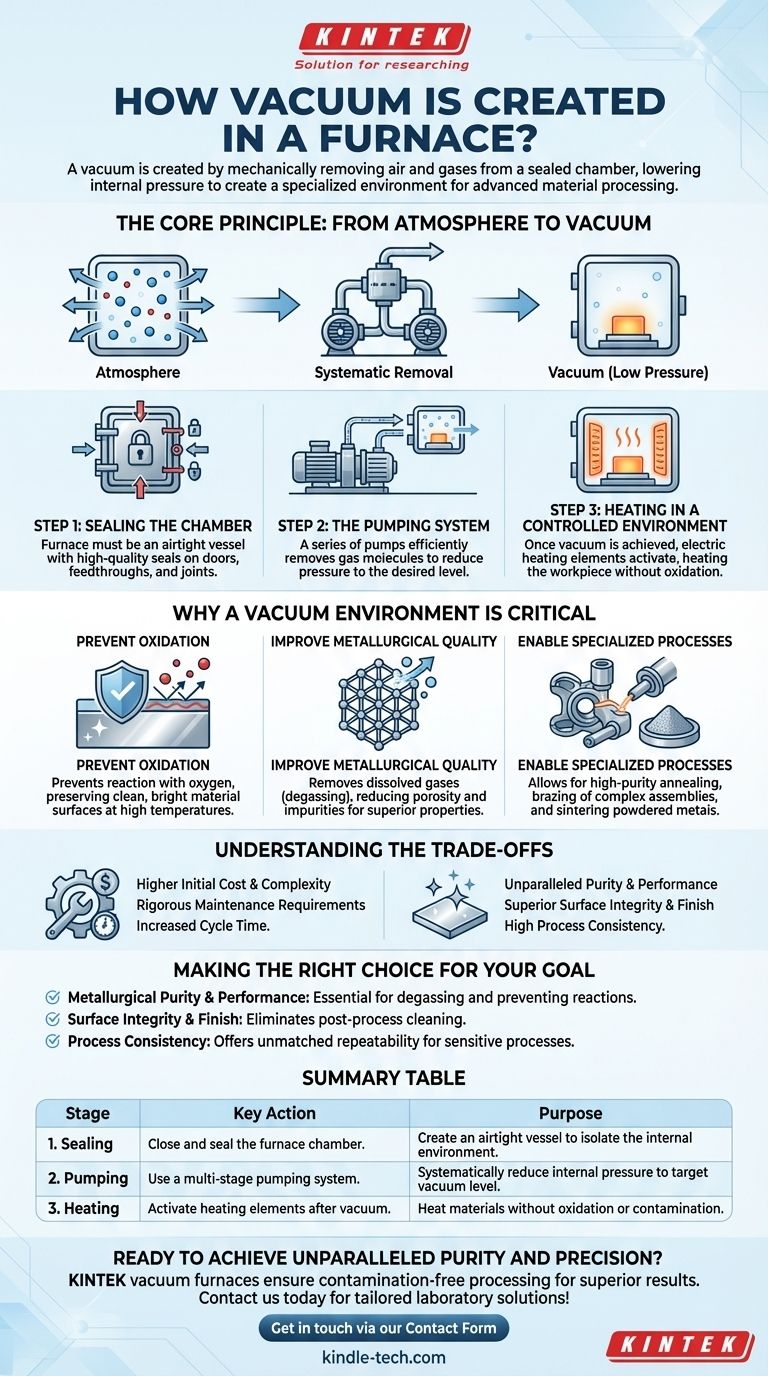
Step 1: Sealing the Chamber

Before a vacuum can be created, the furnace must be a completely airtight vessel. The furnace door, feedthroughs for power and sensors, and all joints are fitted with high-quality seals to prevent outside air from leaking back into the chamber once pumping begins.

Step 2: The Pumping System

A vacuum system, not a single pump, evacuates the chamber. This typically involves a series of pumps working in stages to efficiently remove gas molecules and reduce the internal pressure to the desired level.

Step 3: Heating in a Controlled Environment

Once the target vacuum level is reached, electric heating elements inside the furnace are activated. Because the oxygen and other reactive gases have been removed, the workpiece can be heated to very high temperatures without oxidizing, decarburizing, or becoming contaminated.

Why a Vacuum Environment is Critical

Operating under vacuum isn't just an alternative method; for many applications, it is the only way to achieve the required material properties and finish. It solves fundamental problems that occur when heating metals in the presence of air.

To Prevent Oxidation

Heating metals in air causes them to react with oxygen, forming a layer of oxide scale on the surface. A vacuum environment is virtually free of oxygen, which preserves the clean, bright surface of the material even at extreme temperatures.

To Improve Metallurgical Quality

A vacuum helps pull dissolved gases, like hydrogen and nitrogen, out of the metal itself—a process called degassing. This reduces internal porosity and impurities, leading to a final product with superior density, strength, and overall mechanical properties.

To Enable Specialized Processes

Certain advanced processes are only possible in a vacuum. These include high-purity annealing, the brazing of complex assemblies with filler metals that would otherwise oxidize, and sintering powdered metals into a solid mass.

Understanding the Trade-offs

While powerful, vacuum furnaces introduce their own set of operational complexities that must be managed. They are not a universal replacement for all heating applications.

Higher Initial Cost and Complexity

A vacuum furnace is inherently more complex than a standard atmospheric furnace. The vacuum pumps, sophisticated control systems, and the need for a perfectly sealed chamber result in higher initial equipment and installation costs.

Rigorous Maintenance Requirements

Maintaining the integrity of the vacuum system is critical. This involves regular checks of seals, pumps, and gauges to prevent leaks and ensure consistent performance. As the references note, strong operational discipline and detailed record-keeping are essential.

Increased Cycle Time

The process of pumping down the furnace chamber to the required vacuum level adds time to every cycle. This "pump-down time" must be factored into production scheduling and can impact overall throughput compared to simpler atmospheric furnaces.

Making the Right Choice for Your Goal

The decision to use a vacuum furnace should be driven by the specific technical requirements of your process and material.

  • If your primary focus is metallurgical purity and performance: A vacuum furnace is non-negotiable for degassing materials and preventing reactions that compromise mechanical integrity.
  • If your primary focus is surface integrity and finish: The vacuum environment eliminates the need for post-process acid cleaning or abrasive blasting by preventing oxidation from ever occurring.
  • If your primary focus is process consistency for high-value components: The tightly controlled, low-pressure environment offers unmatched repeatability for sensitive processes like brazing and heat treatment.

Ultimately, choosing a vacuum furnace is a strategic decision to control the process environment with the highest possible precision.

Summary Table:

Stage Key Action Purpose
1. Sealing Close and seal the furnace chamber. Create an airtight vessel to isolate the internal environment.
2. Pumping Use a multi-stage pumping system to evacuate air and gases. Systematically reduce internal pressure to the target vacuum level.
3. Heating Activate heating elements once vacuum is achieved. Heat materials without oxidation, decarburization, or contamination.

Ready to achieve unparalleled purity and precision in your heat treatment processes?

A vacuum furnace from KINTEK ensures your high-value materials are processed in a contamination-free environment, preventing oxidation and improving mechanical properties. Our expertise in lab equipment and consumables means we provide solutions tailored to your specific laboratory needs—from advanced brazing and sintering to high-purity annealing.

Contact us today to discuss how a KINTEK vacuum furnace can enhance your results and efficiency.

Get in touch via our Contact Form

Visual Guide
How is vacuum created in a furnace? A Guide to Achieving a Contamination-Free Heat Treatment Environment Visual Guide

Related Products

People Also Ask

Related Products

Vacuum Hot Press Furnace Heated Vacuum Press Machine Tube Furnace

Vacuum Hot Press Furnace Heated Vacuum Press Machine Tube Furnace

Reduce forming pressure & shorten sintering time with Vacuum Tube Hot Press Furnace for high-density, fine-grain materials. Ideal for refractory metals.

600T Vacuum Induction Hot Press Furnace for Heat Treat and Sintering

600T Vacuum Induction Hot Press Furnace for Heat Treat and Sintering

Discover the 600T Vacuum Induction Hot Press Furnace, designed for high-temperature sintering experiments in vacuum or protected atmospheres. Its precise temperature and pressure control, adjustable working pressure, and advanced safety features make it ideal for nonmetal materials, carbon composites, ceramics, and metal powders.

Vacuum Hot Press Furnace Machine Heated Vacuum Press

Vacuum Hot Press Furnace Machine Heated Vacuum Press

Discover the advantages of Vacuum Hot Press Furnace! Manufacture dense refractory metals & compounds, ceramics, and composites under high temp and pressure.

Vacuum Heat Treat Furnace and Levitation Induction Melting Furnace

Vacuum Heat Treat Furnace and Levitation Induction Melting Furnace

Experience precise melting with our Vacuum Levitation Melting Furnace. Ideal for high melting point metals or alloys, with advanced technology for effective smelting. Order now for high-quality results.

2200 ℃ Tungsten Vacuum Heat Treat and Sintering Furnace

2200 ℃ Tungsten Vacuum Heat Treat and Sintering Furnace

Experience the ultimate refractory metal furnace with our Tungsten vacuum furnace. Capable of reaching 2200℃, perfect for sintering advanced ceramics and refractory metals. Order now for high-quality results.

Vacuum Heat Treat and Pressure Sintering Furnace for High Temperature Applications

Vacuum Heat Treat and Pressure Sintering Furnace for High Temperature Applications

Vacuum pressure sintering furnaces are designed for high temperature hot pressing applications in metal and ceramic sintering. Its advanced features ensure precise temperature control, reliable pressure maintenance, and a robust design for seamless operation.

Molybdenum Vacuum Heat Treat Furnace

Molybdenum Vacuum Heat Treat Furnace

Discover the benefits of a high-configuration molybdenum vacuum furnace with heat shield insulation. Ideal for high-purity, vacuum environments like sapphire crystal growth and heat treatment.

Graphite Vacuum Furnace IGBT Experimental Graphitization Furnace

Graphite Vacuum Furnace IGBT Experimental Graphitization Furnace

IGBT experimental graphitization furnace, a tailored solution for universities and research institutions, with high heating efficiency, user-friendliness, and precise temperature control.

Vacuum Sealed Continuous Working Rotary Tube Furnace Rotating Tube Furnace

Vacuum Sealed Continuous Working Rotary Tube Furnace Rotating Tube Furnace

Experience efficient material processing with our vacuum-sealed rotary tube furnace. Perfect for experiments or industrial production, equipped with optional features for controlled feeding and optimized results. Order now.

2200 ℃ Graphite Vacuum Heat Treat Furnace

2200 ℃ Graphite Vacuum Heat Treat Furnace

Discover the power of the KT-VG Graphite Vacuum Furnace - with a maximum working temperature of 2200℃, it's perfect for vacuum sintering of various materials. Learn more now.

Lab-Scale Vacuum Induction Melting Furnace

Lab-Scale Vacuum Induction Melting Furnace

Get precise alloy composition with our Vacuum Induction Melting Furnace. Ideal for aerospace, nuclear energy, and electronic industries. Order now for effective smelting and casting of metals and alloys.

Vacuum Heat Treat Sintering Brazing Furnace

Vacuum Heat Treat Sintering Brazing Furnace

A vacuum brazing furnace is a type of industrial furnace used for brazing, a metalworking process that joins two pieces of metal using a filler metal that melts at a lower temperature than the base metals. Vacuum brazing furnaces are typically used for high-quality applications where a strong, clean joint is required.

Ultra-High Temperature Graphite Vacuum Graphitization Furnace

Ultra-High Temperature Graphite Vacuum Graphitization Furnace

The ultra-high temperature graphitization furnace utilizes medium frequency induction heating in a vacuum or inert gas environment. The induction coil generates an alternating magnetic field, inducing eddy currents in the graphite crucible, which heats up and radiates heat to the workpiece, bringing it to the desired temperature. This furnace is primarily used for graphitization and sintering of carbon materials, carbon fiber materials, and other composite materials.

Small Vacuum Heat Treat and Tungsten Wire Sintering Furnace

Small Vacuum Heat Treat and Tungsten Wire Sintering Furnace

The small vacuum tungsten wire sintering furnace is a compact experimental vacuum furnace specially designed for universities and scientific research institutes. The furnace features a CNC welded shell and vacuum piping to ensure leak-free operation. Quick-connect electrical connections facilitate relocation and debugging, and the standard electrical control cabinet is safe and convenient to operate.

Vacuum Heat Treat Furnace with Ceramic Fiber Liner

Vacuum Heat Treat Furnace with Ceramic Fiber Liner

Vacuum furnace with polycrystalline ceramic fiber insulation liner for excellent heat insulation and uniform temperature field. Choose from 1200℃ or 1700℃ max. working temperature with high vacuum performance and precise temperature control.

Vacuum Heat Treat and Molybdenum Wire Sintering Furnace for Vacuum Sintering

Vacuum Heat Treat and Molybdenum Wire Sintering Furnace for Vacuum Sintering

A vacuum molybdenum wire sintering furnace is a vertical or bedroom structure, which is suitable for withdrawal, brazing, sintering and degassing of metal materials under high vacuum and high temperature conditions. It is also suitable for dehydroxylation treatment of quartz materials.

Vacuum Arc Induction Melting Furnace

Vacuum Arc Induction Melting Furnace

Discover the power of Vacuum Arc Furnace for melting active & refractory metals. High-speed, remarkable degassing effect, and free of contamination. Learn more now!

Horizontal High Temperature Graphite Vacuum Graphitization Furnace

Horizontal High Temperature Graphite Vacuum Graphitization Furnace

Horizontal Graphitization Furnace: This type of furnace is designed with the heating elements placed horizontally, allowing for uniform heating of the sample. It's well-suited for graphitizing large or bulky samples that require precise temperature control and uniformity.

Non Consumable Vacuum Arc Induction Melting Furnace

Non Consumable Vacuum Arc Induction Melting Furnace

Explore the benefits of Non-Consumable Vacuum Arc Furnace with high melting point electrodes. Small, easy to operate & eco-friendly. Ideal for laboratory research on refractory metals & carbides.

Vacuum Dental Porcelain Sintering Furnace

Vacuum Dental Porcelain Sintering Furnace

Get precise and reliable results with KinTek's Vacuum Porcelain Furnace. Suitable for all porcelain powders, it features hyperbolic ceramic furnace function, voice prompt, and automatic temperature calibration.


Leave Your Message