Knowledge Vacuum Furnace Is an advantage of vacuum heat treatments reduced scaling and decarburization? Achieve Pristine, Clean Metal Parts
Author avatar

Tech Team · Kintek Solution

Updated 2 months ago

Is an advantage of vacuum heat treatments reduced scaling and decarburization? Achieve Pristine, Clean Metal Parts


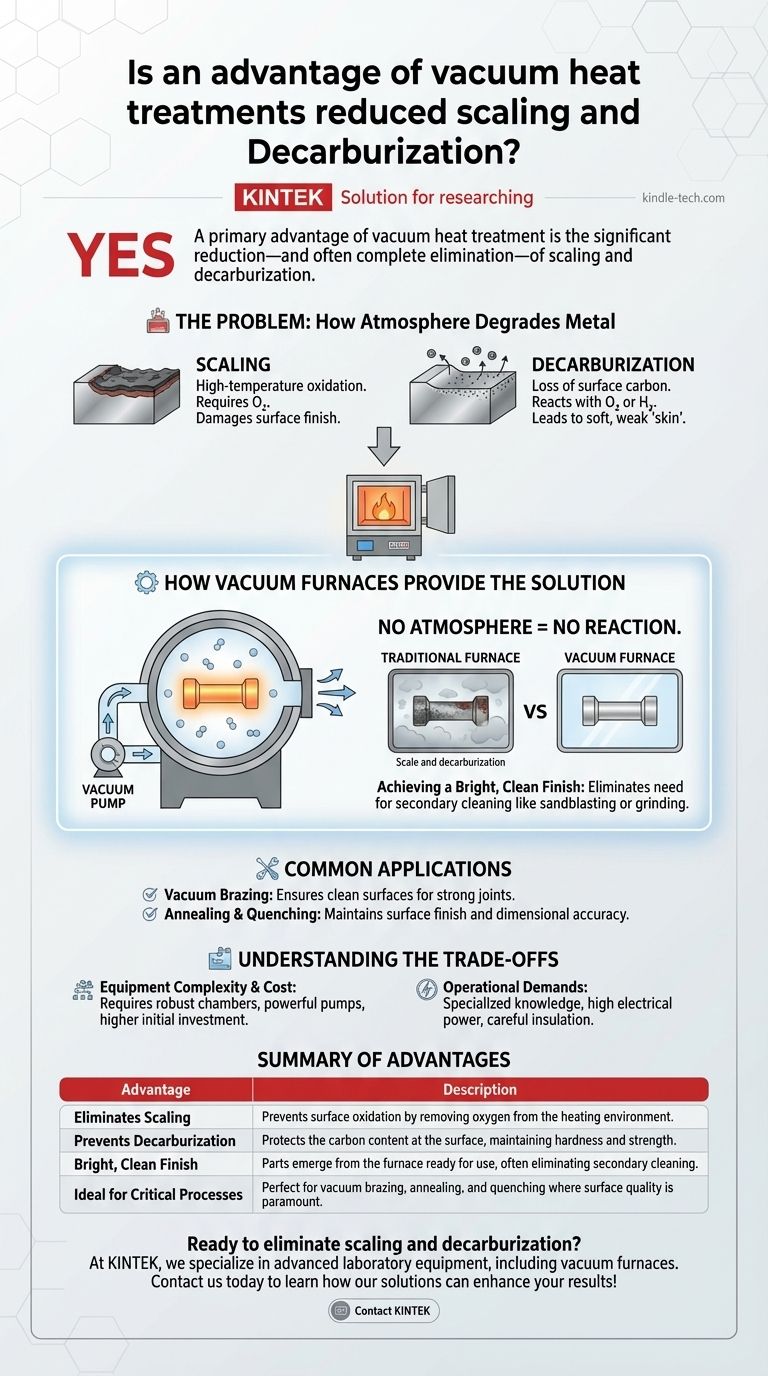
Yes, a primary advantage of vacuum heat treatment is the significant reduction—and often complete elimination—of scaling and decarburization. By conducting the heating process in a near-vacuum, the atmospheric gases like oxygen and carbon dioxide that cause these undesirable surface reactions are removed. This ensures the material's surface integrity is preserved throughout the thermal cycle.

The core value of vacuum heat treatment is its ability to create a chemically inert environment. By removing the atmosphere, you prevent the unwanted chemical reactions of scaling and decarburization from ever occurring, resulting in cleaner, higher-quality parts that require less post-processing.
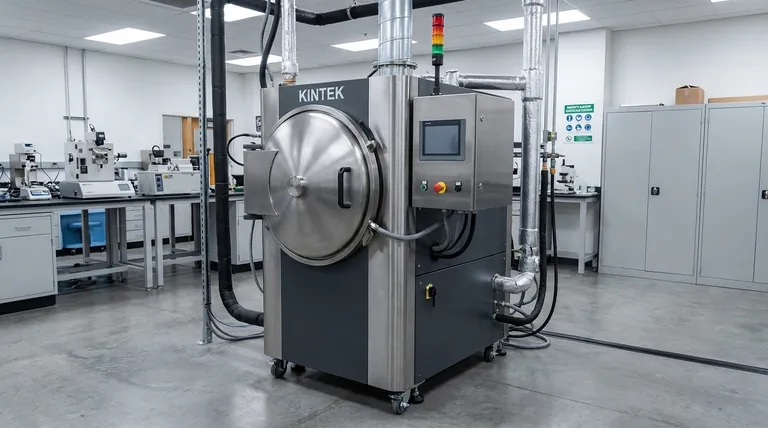
Is an advantage of vacuum heat treatments reduced scaling and decarburization? Achieve Pristine, Clean Metal Parts

The Problem: How Atmosphere Degrades Metal at High Temperatures

To understand the benefit of a vacuum, we must first understand the problem it solves. When steel and other alloys are heated, they become highly reactive with the gases in the surrounding air.

What is Scaling?

Scaling is simply high-temperature oxidation. It is the formation of a dark, flaky layer of metallic oxides on the surface of a part.

This reaction requires oxygen. The hotter the temperature and the longer the exposure, the thicker the scale becomes, damaging the surface finish and altering the part's dimensions.

What is Decarburization?

Decarburization is the loss of carbon content from the surface layer of steel. This is a critical issue because carbon is the primary element that gives steel its hardness and strength.

This process occurs when carbon atoms near the surface react with gases like oxygen or hydrogen in the furnace atmosphere. The result is a soft, weak outer "skin" on a component that should be hard, leading to premature wear or failure.

How Vacuum Furnaces Provide the Solution

A vacuum furnace directly addresses these issues by removing the root cause: the reactive atmosphere. This approach offers distinct advantages over traditional methods that must carefully control a mixture of gases.

Removing the Reactants

The fundamental principle is simple: no atmosphere, no reaction. By pumping the air out of the heating chamber, the concentration of oxygen and other reactive gases becomes too low to cause significant scaling or decarburization.

The workpiece is heated in a controlled, inert environment, ensuring that the only changes occurring are the intended metallurgical transformations within the material itself.

Achieving a Bright, Clean Finish

The direct result of preventing these surface reactions is a bright, clean part straight out of the furnace.

This is a major benefit, as it often eliminates the need for secondary cleaning operations like sandblasting, chemical pickling, or grinding that are required to remove scale from parts treated in atmosphere furnaces.

Common Applications

This pristine surface finish makes vacuum treatment ideal for a range of processes. It is particularly valuable for vacuum brazing, where perfectly clean surfaces are essential for the brazing alloy to flow and form a strong joint.

It is also the preferred method for processes like annealing and quenching when maintaining the final surface finish and dimensional accuracy is critical.

Understanding the Trade-offs

While vacuum furnaces offer superior results in surface quality, they are not the default solution for every application. It's important to recognize the associated complexities.

Equipment Complexity and Cost

Vacuum furnaces are mechanically complex systems. They require robust chambers to withstand atmospheric pressure, as well as powerful pumping systems to create and maintain the vacuum.

This complexity leads to a higher initial investment cost compared to many traditional atmosphere furnaces.

Operational Demands

Operating a vacuum furnace requires specialized knowledge. The equipment demands significant electrical power, not only for heating but also for the vacuum pumps.

As noted in furnace design, these systems often require low-voltage, high-current power supplies and careful attention to electrical insulation to function safely and effectively under vacuum conditions.

Making the Right Choice for Your Goal

Selecting the correct heat treatment method depends entirely on your project's specific requirements for quality, cost, and volume.

  • If your primary focus is the highest possible surface quality: Vacuum heat treatment is the definitive choice, eliminating the risk of scaling and decarburization.
  • If your primary focus is processing high-volume, less critical components: A traditional, continuous-belt atmosphere furnace may be more cost-effective.
  • If your primary focus is minimizing post-treatment labor: The clean finish from vacuum treatment can significantly reduce or eliminate costly secondary cleaning steps.

Ultimately, choosing vacuum heat treatment is a decision to control the process environment completely, ensuring the final part meets its design intent without compromise.

Summary Table:

Advantage Description
Eliminates Scaling Prevents surface oxidation by removing oxygen from the heating environment.
Prevents Decarburization Protects the carbon content at the surface, maintaining hardness and strength.
Bright, Clean Finish Parts emerge from the furnace ready for use, often eliminating secondary cleaning.
Ideal for Critical Processes Perfect for vacuum brazing, annealing, and quenching where surface quality is paramount.

Ready to eliminate scaling and decarburization from your heat treatment process?

At KINTEK, we specialize in providing advanced laboratory equipment, including vacuum furnaces, designed to meet the stringent demands of modern labs. Our solutions ensure your metal parts achieve a pristine, high-quality finish without costly post-processing.

Contact us today to learn how our vacuum heat treatment equipment can enhance your results and efficiency!

Visual Guide
Is an advantage of vacuum heat treatments reduced scaling and decarburization? Achieve Pristine, Clean Metal Parts Visual Guide

Related Products

People Also Ask

Related Products

2200 ℃ Graphite Vacuum Heat Treat Furnace

2200 ℃ Graphite Vacuum Heat Treat Furnace

Discover the power of the KT-VG Graphite Vacuum Furnace - with a maximum working temperature of 2200℃, it's perfect for vacuum sintering of various materials. Learn more now.

Molybdenum Vacuum Heat Treat Furnace

Molybdenum Vacuum Heat Treat Furnace

Discover the benefits of a high-configuration molybdenum vacuum furnace with heat shield insulation. Ideal for high-purity, vacuum environments like sapphire crystal growth and heat treatment.

Vacuum Heat Treat Furnace with Ceramic Fiber Liner

Vacuum Heat Treat Furnace with Ceramic Fiber Liner

Vacuum furnace with polycrystalline ceramic fiber insulation liner for excellent heat insulation and uniform temperature field. Choose from 1200℃ or 1700℃ max. working temperature with high vacuum performance and precise temperature control.

600T Vacuum Induction Hot Press Furnace for Heat Treat and Sintering

600T Vacuum Induction Hot Press Furnace for Heat Treat and Sintering

Discover the 600T Vacuum Induction Hot Press Furnace, designed for high-temperature sintering experiments in vacuum or protected atmospheres. Its precise temperature and pressure control, adjustable working pressure, and advanced safety features make it ideal for nonmetal materials, carbon composites, ceramics, and metal powders.

Vacuum Heat Treat Sintering Brazing Furnace

Vacuum Heat Treat Sintering Brazing Furnace

A vacuum brazing furnace is a type of industrial furnace used for brazing, a metalworking process that joins two pieces of metal using a filler metal that melts at a lower temperature than the base metals. Vacuum brazing furnaces are typically used for high-quality applications where a strong, clean joint is required.

Vacuum Heat Treat and Pressure Sintering Furnace for High Temperature Applications

Vacuum Heat Treat and Pressure Sintering Furnace for High Temperature Applications

Vacuum pressure sintering furnaces are designed for high temperature hot pressing applications in metal and ceramic sintering. Its advanced features ensure precise temperature control, reliable pressure maintenance, and a robust design for seamless operation.

Vacuum Heat Treat and Molybdenum Wire Sintering Furnace for Vacuum Sintering

Vacuum Heat Treat and Molybdenum Wire Sintering Furnace for Vacuum Sintering

A vacuum molybdenum wire sintering furnace is a vertical or bedroom structure, which is suitable for withdrawal, brazing, sintering and degassing of metal materials under high vacuum and high temperature conditions. It is also suitable for dehydroxylation treatment of quartz materials.

2200 ℃ Tungsten Vacuum Heat Treat and Sintering Furnace

2200 ℃ Tungsten Vacuum Heat Treat and Sintering Furnace

Experience the ultimate refractory metal furnace with our Tungsten vacuum furnace. Capable of reaching 2200℃, perfect for sintering advanced ceramics and refractory metals. Order now for high-quality results.

Small Vacuum Heat Treat and Tungsten Wire Sintering Furnace

Small Vacuum Heat Treat and Tungsten Wire Sintering Furnace

The small vacuum tungsten wire sintering furnace is a compact experimental vacuum furnace specially designed for universities and scientific research institutes. The furnace features a CNC welded shell and vacuum piping to ensure leak-free operation. Quick-connect electrical connections facilitate relocation and debugging, and the standard electrical control cabinet is safe and convenient to operate.

1400℃ Controlled Atmosphere Furnace with Nitrogen and Inert Atmosphere

1400℃ Controlled Atmosphere Furnace with Nitrogen and Inert Atmosphere

Achieve precise heat treatment with KT-14A controlled atmosphere furnace. Vacuum sealed with a smart controller, it's ideal for lab and industrial use up to 1400℃.

Vacuum Hot Press Furnace Heated Vacuum Press Machine Tube Furnace

Vacuum Hot Press Furnace Heated Vacuum Press Machine Tube Furnace

Reduce forming pressure & shorten sintering time with Vacuum Tube Hot Press Furnace for high-density, fine-grain materials. Ideal for refractory metals.

1200℃ Controlled Atmosphere Furnace Nitrogen Inert Atmosphere Furnace

1200℃ Controlled Atmosphere Furnace Nitrogen Inert Atmosphere Furnace

Discover our KT-12A Pro Controlled atmosphere furnace - high precision, heavy duty vacuum chamber, versatile smart touch screen controller, and excellent temperature uniformity up to 1200C. Ideal for both laboratory and industrial application.

Vacuum Hot Press Furnace Machine Heated Vacuum Press

Vacuum Hot Press Furnace Machine Heated Vacuum Press

Discover the advantages of Vacuum Hot Press Furnace! Manufacture dense refractory metals & compounds, ceramics, and composites under high temp and pressure.

1700℃ Controlled Atmosphere Furnace Nitrogen Inert Atmosphere Furnace

1700℃ Controlled Atmosphere Furnace Nitrogen Inert Atmosphere Furnace

KT-17A Controlled atmosphere furnace: 1700℃ heating, vacuum sealing technology, PID temperature control, and versatile TFT smart touch screen controller for laboratory and industrial use.

Vacuum Arc Induction Melting Furnace

Vacuum Arc Induction Melting Furnace

Discover the power of Vacuum Arc Furnace for melting active & refractory metals. High-speed, remarkable degassing effect, and free of contamination. Learn more now!

Vacuum Sealed Continuous Working Rotary Tube Furnace Rotating Tube Furnace

Vacuum Sealed Continuous Working Rotary Tube Furnace Rotating Tube Furnace

Experience efficient material processing with our vacuum-sealed rotary tube furnace. Perfect for experiments or industrial production, equipped with optional features for controlled feeding and optimized results. Order now.

Ultra-High Temperature Graphite Vacuum Graphitization Furnace

Ultra-High Temperature Graphite Vacuum Graphitization Furnace

The ultra-high temperature graphitization furnace utilizes medium frequency induction heating in a vacuum or inert gas environment. The induction coil generates an alternating magnetic field, inducing eddy currents in the graphite crucible, which heats up and radiates heat to the workpiece, bringing it to the desired temperature. This furnace is primarily used for graphitization and sintering of carbon materials, carbon fiber materials, and other composite materials.

Lab-Scale Vacuum Induction Melting Furnace

Lab-Scale Vacuum Induction Melting Furnace

Get precise alloy composition with our Vacuum Induction Melting Furnace. Ideal for aerospace, nuclear energy, and electronic industries. Order now for effective smelting and casting of metals and alloys.

Vertical High Temperature Graphite Vacuum Graphitization Furnace

Vertical High Temperature Graphite Vacuum Graphitization Furnace

Vertical high temperature graphitization furnace for carbonization and graphitization of carbon materials up to 3100℃.Suitable for shaped graphitization of carbon fiber filaments and other materials sintered in a carbon environment.Applications in metallurgy, electronics, and aerospace for producing high-quality graphite products like electrodes and crucibles.

Horizontal High Temperature Graphite Vacuum Graphitization Furnace

Horizontal High Temperature Graphite Vacuum Graphitization Furnace

Horizontal Graphitization Furnace: This type of furnace is designed with the heating elements placed horizontally, allowing for uniform heating of the sample. It's well-suited for graphitizing large or bulky samples that require precise temperature control and uniformity.


Leave Your Message



















