Knowledge Vacuum Furnace Is calcination done in a blast furnace? Clarifying the Purpose of Industrial Furnaces
Author avatar

Tech Team · Kintek Solution

Updated 2 months ago

Is calcination done in a blast furnace? Clarifying the Purpose of Industrial Furnaces


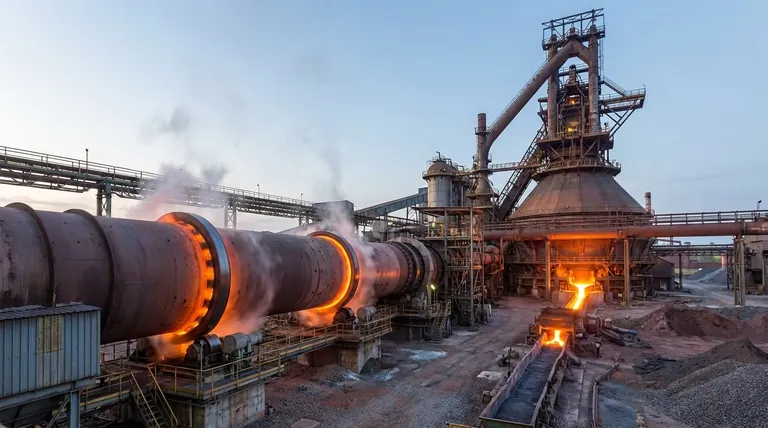
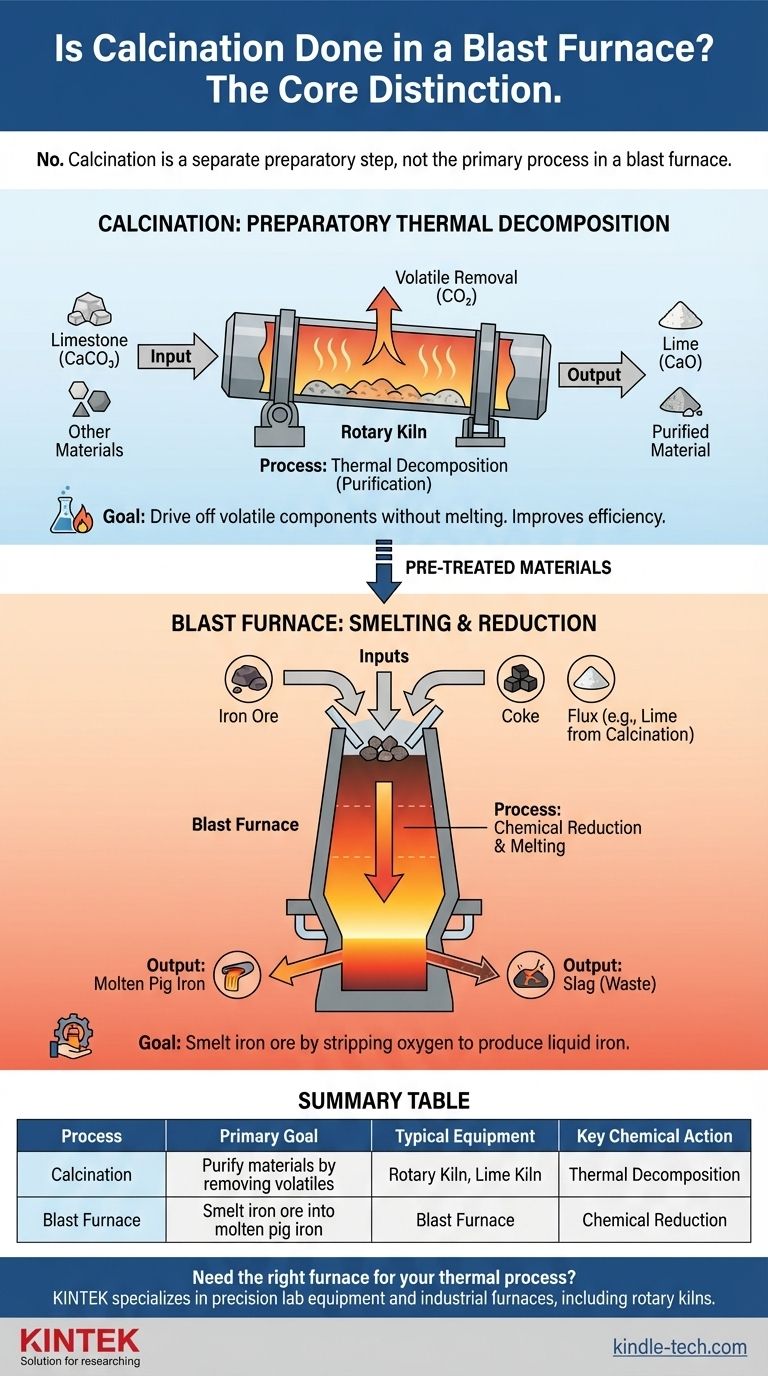
No, calcination is not the primary process performed in a blast furnace. While some decomposition occurs, a blast furnace's main purpose is smelting. Calcination is a distinct preparatory step that typically happens in a separate vessel before materials enter the blast furnace.

The core distinction is one of purpose. Calcination is a thermal pre-treatment to purify materials by removing volatile substances like carbon dioxide. A blast furnace is a massive chemical reactor designed for smelting—the reduction of iron ore into molten iron.
Is calcination done in a blast furnace? Clarifying the Purpose of Industrial Furnaces

What is the True Purpose of a Blast Furnace?

A blast furnace is not merely an oven; it is a highly specialized, counter-current reactor at the heart of primary iron production. Its function is far more complex than simple heating.

The Goal: Smelting and Reduction

The exclusive goal of a blast furnace is to smelt iron ore. This involves a chemical reduction process, where oxygen is stripped away from iron oxides (the ore) to produce liquid iron, often called pig iron.

This is achieved by using coke (a high-carbon fuel) as both a heat source and a reducing agent. The intense heat facilitates the chemical reactions that transform solid ore into molten metal.

Key Inputs and Outputs

To achieve this, three primary materials are fed into the top of the furnace: iron ore, coke, and a flux (typically limestone). Hot air is blasted into the bottom.

The primary outputs are molten pig iron and a liquid waste product called slag, which is formed from the flux and impurities. These are drained from the bottom of the furnace.

Defining Calcination as a Separate Process

The confusion between these processes often arises because both involve high temperatures. However, their chemical goals are fundamentally different.

The Goal: Thermal Decomposition

Calcination is the process of heating a solid material to a high temperature to drive off volatile components, without melting the substance itself. It is a purification or activation step.

The classic example is heating limestone (calcium carbonate, CaCO₃) in a kiln. This drives off carbon dioxide (CO₂) and leaves behind lime (calcium oxide, CaO), which is a more effective flux.

Where Calcination Occurs

This pre-treatment is done in dedicated furnaces, such as a rotary kiln or lime kiln, before the materials are charged into the blast furnace. Performing calcination beforehand makes the blast furnace operation more efficient and controllable.

By pre-calcining the limestone and ore, the blast furnace does not have to expend energy on this initial decomposition. This allows it to dedicate all its energy to the main task of smelting.

Common Pitfalls and Clarifications

Understanding why these processes are distinct is crucial for grasping the logic of industrial metallurgy. The confusion is common but easily clarified.

Heat is the Common Denominator

Both processes rely on extreme heat. This shared characteristic is the primary source of confusion. However, the application of that heat is what defines the process—decomposition for calcination versus reduction and melting for smelting.

Process vs. Pre-treatment

Think of it as cooking a complex meal. Calcination is the prep work—like roasting garlic to mellow its flavor before adding it to a sauce. Smelting is the main event where all the prepared ingredients are combined and transformed into the final dish.

A Point of Nuance: Flux Decomposition

To be precise, some decomposition does occur inside a blast furnace. When limestone is added as a flux, the heat in the upper part of the furnace causes it to break down into lime and carbon dioxide.

However, this is a secondary reaction, not the furnace's primary purpose. The blast furnace is designed and optimized for smelting, not calcination.

Making the Right Choice for Your Goal

To apply this knowledge correctly, always focus on the primary objective of the equipment and the stage in the production chain.

  • If your primary focus is on iron production: View calcination as an optional but highly efficient preparatory step, and see the blast furnace as the non-negotiable heart of the smelting process.
  • If your primary focus is on defining thermal processes: Remember that calcination purifies by removing volatiles without melting, while smelting uses a reducing agent to transform an ore into a molten metal.

Distinguishing between a preparatory treatment and the main industrial event is fundamental to understanding any complex manufacturing process.

Summary Table:

Process Primary Goal Typical Equipment Key Chemical Action
Calcination Purify materials by removing volatile substances Rotary Kiln, Lime Kiln Thermal Decomposition
Blast Furnace Smelt iron ore into molten pig iron Blast Furnace Chemical Reduction

Need the right furnace for your specific thermal process? KINTEK specializes in precision lab equipment and industrial furnaces, including rotary kilns for calcination. Our experts can help you select the ideal equipment to optimize your material purification or smelting operations. Contact our team today to discuss your application and receive a tailored solution!

Visual Guide
Is calcination done in a blast furnace? Clarifying the Purpose of Industrial Furnaces Visual Guide

Related Products

People Also Ask

Related Products

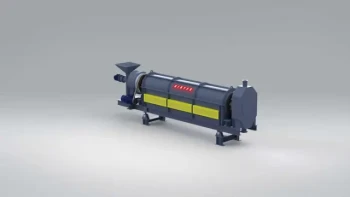
Electric Rotary Kiln Pyrolysis Furnace Plant Machine Calciner Small Rotary Kiln Rotating Furnace

Electric Rotary Kiln Pyrolysis Furnace Plant Machine Calciner Small Rotary Kiln Rotating Furnace

Electric rotary kiln - precisely controlled, it's ideal for calcination and drying of materials like lithium cobalate, rare earths, and non-ferrous metals.

Electric Rotary Kiln Continuous Working Small Rotary Furnace Heating Pyrolysis Plant

Electric Rotary Kiln Continuous Working Small Rotary Furnace Heating Pyrolysis Plant

Efficiently calcine and dry bulk powder and lump fluid materials with an electric heating rotary furnace. Ideal for processing lithium ion battery materials and more.

Graphite Vacuum Continuous Graphitization Furnace

Graphite Vacuum Continuous Graphitization Furnace

High-temperature graphitization furnace is a professional equipment for graphitization treatment of carbon materials. It is a key equipment for the production of high-quality graphite products. It has high temperature, high efficiency and uniform heating. It is suitable for various high-temperature treatments and graphitization treatments. It is widely used in metallurgy, electronics, aerospace, etc. industry.

Vertical High Temperature Graphite Vacuum Graphitization Furnace

Vertical High Temperature Graphite Vacuum Graphitization Furnace

Vertical high temperature graphitization furnace for carbonization and graphitization of carbon materials up to 3100℃.Suitable for shaped graphitization of carbon fiber filaments and other materials sintered in a carbon environment.Applications in metallurgy, electronics, and aerospace for producing high-quality graphite products like electrodes and crucibles.

Graphite Vacuum Furnace Bottom Discharge Graphitization Furnace for Carbon Materials

Graphite Vacuum Furnace Bottom Discharge Graphitization Furnace for Carbon Materials

Bottom-out graphitization furnace for carbon materials, ultra-high temperature furnace up to 3100°C, suitable for graphitization and sintering of carbon rods and carbon blocks. Vertical design, bottom discharging, convenient feeding and discharging, high temperature uniformity, low energy consumption, good stability, hydraulic lifting system, convenient loading and unloading.

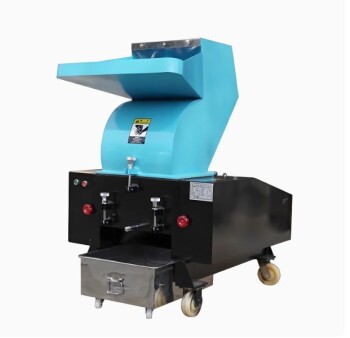
Powerful Plastic Crusher Machine

Powerful Plastic Crusher Machine

KINTEK's powerful plastic crusher machines process 60-1350 KG/H of diverse plastics, ideal for labs and recycling. Durable, efficient, and customizable.

Cylindrical Press Mold with Scale for Lab

Cylindrical Press Mold with Scale for Lab

Discover precision with our Cylindrical Press Mold. Ideal for high-pressure applications, it molds various shapes and sizes, ensuring stability and uniformity. Perfect for lab use.

Ultra-High Temperature Graphite Vacuum Graphitization Furnace

Ultra-High Temperature Graphite Vacuum Graphitization Furnace

The ultra-high temperature graphitization furnace utilizes medium frequency induction heating in a vacuum or inert gas environment. The induction coil generates an alternating magnetic field, inducing eddy currents in the graphite crucible, which heats up and radiates heat to the workpiece, bringing it to the desired temperature. This furnace is primarily used for graphitization and sintering of carbon materials, carbon fiber materials, and other composite materials.

High Temperature Muffle Oven Furnace for Laboratory Debinding and Pre Sintering

High Temperature Muffle Oven Furnace for Laboratory Debinding and Pre Sintering

KT-MD High temperature debinding and pre-sintering furnace for ceramic materials with various molding processes. Ideal for electronic components such as MLCC and NFC.

Dental Porcelain Zirconia Sintering Ceramic Vacuum Press Furnace

Dental Porcelain Zirconia Sintering Ceramic Vacuum Press Furnace

Get precise dental results with Dental Vacuum Press Furnace. Automatic temperature calibration, low noise tray, and touch screen operation. Order now!

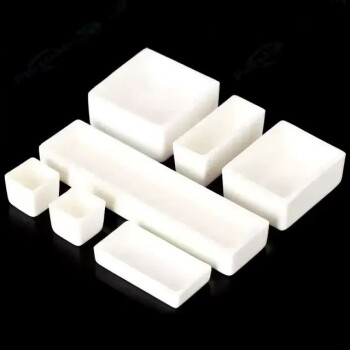
Engineering Advanced Fine Alumina Al2O3 Ceramic Crucible for Laboratory Muffle Furnace

Engineering Advanced Fine Alumina Al2O3 Ceramic Crucible for Laboratory Muffle Furnace

Alumina ceramic crucibles are used in some materials and metal melting tools, and flat-bottomed crucibles are suitable for melting and processing larger batches of materials with better stability and uniformity.

Horizontal High Temperature Graphite Vacuum Graphitization Furnace

Horizontal High Temperature Graphite Vacuum Graphitization Furnace

Horizontal Graphitization Furnace: This type of furnace is designed with the heating elements placed horizontally, allowing for uniform heating of the sample. It's well-suited for graphitizing large or bulky samples that require precise temperature control and uniformity.

Electric Rotary Kiln Small Rotary Furnace for Activated Carbon Regeneration

Electric Rotary Kiln Small Rotary Furnace for Activated Carbon Regeneration

Revitalize your activated carbon with KinTek's Electric Regeneration Furnace. Achieve efficient and cost-effective regeneration with our highly automated rotary kiln and intelligent thermal controller.

Vacuum Arc Induction Melting Furnace

Vacuum Arc Induction Melting Furnace

Discover the power of Vacuum Arc Furnace for melting active & refractory metals. High-speed, remarkable degassing effect, and free of contamination. Learn more now!

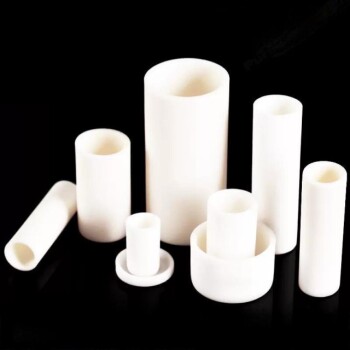
Engineering Advanced Fine Ceramics Alumina Al2O3 Crucible With Lid Cylindrical Laboratory Crucible

Engineering Advanced Fine Ceramics Alumina Al2O3 Crucible With Lid Cylindrical Laboratory Crucible

Cylindrical Crucibles Cylindrical crucibles are one of the most common crucible shapes, suitable for melting and processing a wide variety of materials, and are easy to handle and clean.

Ceramic Evaporation Boat Set Alumina Crucible for Laboratory Use

Ceramic Evaporation Boat Set Alumina Crucible for Laboratory Use

It can be used for vapor deposition of various metals and alloys. Most metals can be evaporated completely without loss. Evaporation baskets are reusable.1

10L Chilling Circulator Cooling Water Bath Low Temperature Constant Temperature Reaction Bath

10L Chilling Circulator Cooling Water Bath Low Temperature Constant Temperature Reaction Bath

Get the KinTek KCP 10L Chilling Circulator for your lab needs. With a stable and quiet chilling power of up to -120℃, it also works as a one chilling bath for versatile applications.

Laboratory Muffle Oven Furnace Bottom Lifting Muffle Furnace

Laboratory Muffle Oven Furnace Bottom Lifting Muffle Furnace

Efficiently produce batches with excellent temperature uniformity using our Bottom Lifting Furnace. Features two electric lifting stages and advanced temperature control up to 1600℃.

High Purity Pure Graphite Crucible for Evaporation

High Purity Pure Graphite Crucible for Evaporation

Vessels for high temperature applications, where materials are kept at extremely high temperatures to evaporate, allowing thin films to be deposited on substrates.

600T Vacuum Induction Hot Press Furnace for Heat Treat and Sintering

600T Vacuum Induction Hot Press Furnace for Heat Treat and Sintering

Discover the 600T Vacuum Induction Hot Press Furnace, designed for high-temperature sintering experiments in vacuum or protected atmospheres. Its precise temperature and pressure control, adjustable working pressure, and advanced safety features make it ideal for nonmetal materials, carbon composites, ceramics, and metal powders.


Leave Your Message