Knowledge Is diffusion bonding the same as sintering? Key Differences in Solid-State Processes
Author avatar

Tech Team · Kintek Solution

Updated 5 days ago

Is diffusion bonding the same as sintering? Key Differences in Solid-State Processes


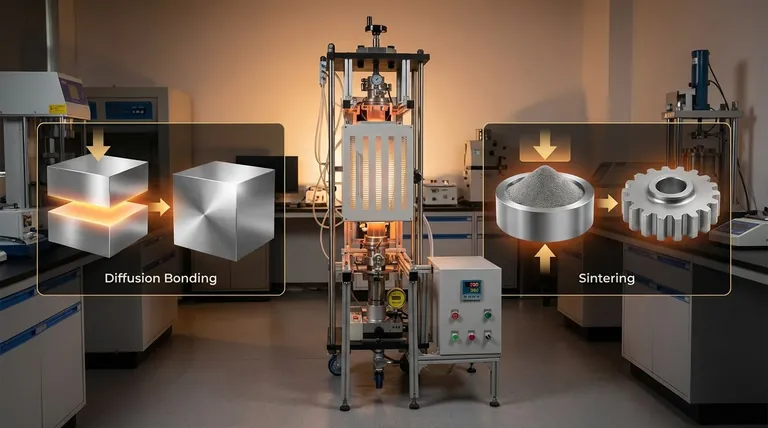
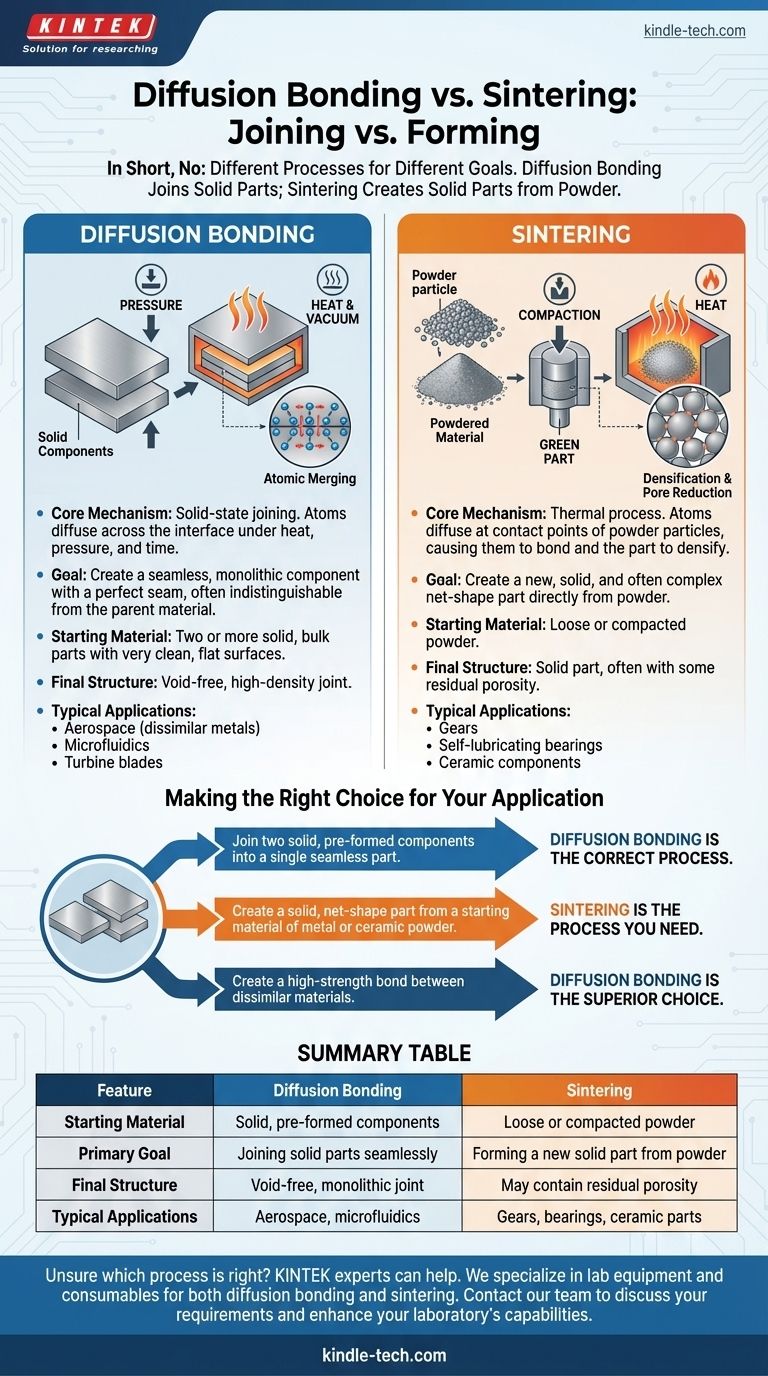
In short, no. Diffusion bonding and sintering are not the same process, although they share the foundational principles of using heat and pressure to bond materials without melting them. The critical difference lies in the starting form of the material: diffusion bonding joins solid, pre-formed components, whereas sintering creates a solid mass from a collection of powders.

The core distinction is one of purpose: diffusion bonding is a joining process used to weld solid parts together at an atomic level, while sintering is a forming process used to create a new solid part from a powdered material.
Is diffusion bonding the same as sintering? Key Differences in Solid-State Processes

What is Diffusion Bonding? The Science of Atomic Merging

Diffusion bonding is a highly precise solid-state joining method. It creates a bond between two components that is often indistinguishable from the parent materials themselves.

The Core Mechanism

The process involves bringing two very clean, flat surfaces into contact under high pressure and temperature in a vacuum or inert atmosphere. The heat provides the energy for atoms at the interface to vibrate and move across the boundary, "diffusing" into the opposite piece and forming a single, continuous grain structure.

Key Parameters

Success depends on three factors: temperature, pressure, and time. The temperature is kept below the material's melting point, while the pressure is just enough to ensure intimate contact without causing large-scale deformation.

The Goal: A Perfect Seam

The objective is to eliminate the original interface between two solid parts, creating a monolithic component. It is a true metallurgical weld, created without any filler material.

What is Sintering? Building from the Ground Up

Sintering is a cornerstone of powder metallurgy and ceramics manufacturing. It is a thermal process that transforms a compacted powder into a dense, solid object.

The Core Mechanism

Sintering begins with a "green part," which is a loosely held-together shape made of compressed powder. When heated, atoms diffuse across the contact points of adjacent particles. This atomic transport causes the necks between particles to grow, reducing the empty space (porosity) and densifying the component.

The Role of Porosity

A key characteristic of sintering is the reduction of porosity. While the goal is often to achieve near-full density, some level of residual porosity can remain, which affects the final mechanical properties of the part.

The Goal: A Net-Shape Part

The objective of sintering is to create a new, solid, and often complex shape directly from powder. This can be more economical than machining the same shape from a solid block of material.

Understanding the Trade-offs and Key Distinctions

Choosing between these processes requires understanding their fundamentally different applications and limitations.

Starting Material

Diffusion bonding begins with two or more solid, bulk parts with precisely prepared surfaces. Sintering begins with a mass of loose or compacted powder.

Final Structure

Diffusion bonding produces a component with a nearly imperceptible, void-free joint, maintaining the high density of the original materials. A sintered part is formed from countless individual bonds and may contain some level of residual porosity.

Common Applications

You will see diffusion bonding used for high-performance applications like joining dissimilar or refractory metals in aerospace, creating microfluidic channels, and manufacturing turbine blades. Sintering is used for mass production of items like self-lubricating bearings, automotive gears, and ceramic components.

Making the Right Choice for Your Application

Your final decision depends entirely on your starting point and your desired outcome.

  • If your primary focus is to join two solid, pre-formed components into a single seamless part: Diffusion bonding is the correct process.
  • If your primary focus is to create a solid, net-shape part from a starting material of metal or ceramic powder: Sintering is the process you need.
  • If your primary focus is creating a high-strength bond between dissimilar materials that cannot be conventionally welded: Diffusion bonding is the superior choice.

Ultimately, mastering these techniques begins with recognizing whether your task is to join existing structures or to form a new one entirely.

Summary Table:

Feature Diffusion Bonding Sintering
Starting Material Solid, pre-formed components Loose or compacted powder
Primary Goal Joining solid parts seamlessly Forming a new solid part from powder
Final Structure Void-free, monolithic joint May contain residual porosity
Typical Applications Aerospace components, microfluidics Gears, bearings, ceramic parts

Unsure which process is right for your application? The experts at KINTEK can help. We specialize in providing the precise lab equipment and consumables needed for both diffusion bonding and sintering processes. Whether you are joining high-performance alloys or forming complex components from powder, our solutions ensure optimal results. Contact our team today to discuss your specific requirements and enhance your laboratory's capabilities.

Visual Guide
Is diffusion bonding the same as sintering? Key Differences in Solid-State Processes Visual Guide

Related Products

People Also Ask

Related Products

Vacuum Hot Press Furnace Heated Vacuum Press Machine Tube Furnace

Vacuum Hot Press Furnace Heated Vacuum Press Machine Tube Furnace

Reduce forming pressure & shorten sintering time with Vacuum Tube Hot Press Furnace for high-density, fine-grain materials. Ideal for refractory metals.

600T Vacuum Induction Hot Press Furnace for Heat Treat and Sintering

600T Vacuum Induction Hot Press Furnace for Heat Treat and Sintering

Discover the 600T Vacuum Induction Hot Press Furnace, designed for high-temperature sintering experiments in vacuum or protected atmospheres. Its precise temperature and pressure control, adjustable working pressure, and advanced safety features make it ideal for nonmetal materials, carbon composites, ceramics, and metal powders.

High Pressure Laboratory Vacuum Tube Furnace Quartz Tubular Furnace

High Pressure Laboratory Vacuum Tube Furnace Quartz Tubular Furnace

KT-PTF High Pressure Tube Furnace: Compact split tube furnace with strong positive pressure resistance. Working temp up to 1100°C and pressure up to 15Mpa. Also works under controller atmosphere or high vacuum.

Vacuum Heat Treat Furnace with Ceramic Fiber Liner

Vacuum Heat Treat Furnace with Ceramic Fiber Liner

Vacuum furnace with polycrystalline ceramic fiber insulation liner for excellent heat insulation and uniform temperature field. Choose from 1200℃ or 1700℃ max. working temperature with high vacuum performance and precise temperature control.

Vacuum Heat Treat Sintering Brazing Furnace

Vacuum Heat Treat Sintering Brazing Furnace

A vacuum brazing furnace is a type of industrial furnace used for brazing, a metalworking process that joins two pieces of metal using a filler metal that melts at a lower temperature than the base metals. Vacuum brazing furnaces are typically used for high-quality applications where a strong, clean joint is required.

Vacuum Heat Treat and Sintering Furnace with 9MPa Air Pressure

Vacuum Heat Treat and Sintering Furnace with 9MPa Air Pressure

The air pressure sintering furnace is a high-tech equipment commonly used for the sintering of advanced ceramic materials. It combines vacuum sintering and pressure sintering techniques to achieve high-density and high-strength ceramics.

Molybdenum Vacuum Heat Treat Furnace

Molybdenum Vacuum Heat Treat Furnace

Discover the benefits of a high-configuration molybdenum vacuum furnace with heat shield insulation. Ideal for high-purity, vacuum environments like sapphire crystal growth and heat treatment.

Vacuum Heat Treat Furnace and Levitation Induction Melting Furnace

Vacuum Heat Treat Furnace and Levitation Induction Melting Furnace

Experience precise melting with our Vacuum Levitation Melting Furnace. Ideal for high melting point metals or alloys, with advanced technology for effective smelting. Order now for high-quality results.

Vacuum Heat Treat and Molybdenum Wire Sintering Furnace for Vacuum Sintering

Vacuum Heat Treat and Molybdenum Wire Sintering Furnace for Vacuum Sintering

A vacuum molybdenum wire sintering furnace is a vertical or bedroom structure, which is suitable for withdrawal, brazing, sintering and degassing of metal materials under high vacuum and high temperature conditions. It is also suitable for dehydroxylation treatment of quartz materials.

Dental Porcelain Zirconia Sintering Ceramic Vacuum Press Furnace

Dental Porcelain Zirconia Sintering Ceramic Vacuum Press Furnace

Get precise dental results with Dental Vacuum Press Furnace. Automatic temperature calibration, low noise tray, and touch screen operation. Order now!

2200 ℃ Tungsten Vacuum Heat Treat and Sintering Furnace

2200 ℃ Tungsten Vacuum Heat Treat and Sintering Furnace

Experience the ultimate refractory metal furnace with our Tungsten vacuum furnace. Capable of reaching 2200℃, perfect for sintering advanced ceramics and refractory metals. Order now for high-quality results.

1800℃ Muffle Oven Furnace for Laboratory

1800℃ Muffle Oven Furnace for Laboratory

KT-18 muffle furnace with Japan Al2O3 polycrystalline fibe and Silicon Molybdenum heating element, up to 1900℃, PID temperature control and 7" smart touch screen. Compact design, low heat loss, and high energy efficiency. Safety interlock system and versatile functions.

High Temperature Muffle Oven Furnace for Laboratory Debinding and Pre Sintering

High Temperature Muffle Oven Furnace for Laboratory Debinding and Pre Sintering

KT-MD High temperature debinding and pre-sintering furnace for ceramic materials with various molding processes. Ideal for electronic components such as MLCC and NFC.

2200 ℃ Graphite Vacuum Heat Treat Furnace

2200 ℃ Graphite Vacuum Heat Treat Furnace

Discover the power of the KT-VG Graphite Vacuum Furnace - with a maximum working temperature of 2200℃, it's perfect for vacuum sintering of various materials. Learn more now.

1700℃ Muffle Oven Furnace for Laboratory

1700℃ Muffle Oven Furnace for Laboratory

Get superior heat control with our 1700℃ Muffle Furnace. Equipped with intelligent temperature microprocessor, TFT touch screen controller & advanced insulation materials for precise heating up to 1700C. Order now!

Ultra-High Temperature Graphite Vacuum Graphitization Furnace

Ultra-High Temperature Graphite Vacuum Graphitization Furnace

The ultra-high temperature graphitization furnace utilizes medium frequency induction heating in a vacuum or inert gas environment. The induction coil generates an alternating magnetic field, inducing eddy currents in the graphite crucible, which heats up and radiates heat to the workpiece, bringing it to the desired temperature. This furnace is primarily used for graphitization and sintering of carbon materials, carbon fiber materials, and other composite materials.

Vacuum Dental Porcelain Sintering Furnace

Vacuum Dental Porcelain Sintering Furnace

Get precise and reliable results with KinTek's Vacuum Porcelain Furnace. Suitable for all porcelain powders, it features hyperbolic ceramic furnace function, voice prompt, and automatic temperature calibration.

Vertical Laboratory Quartz Tube Furnace Tubular Furnace

Vertical Laboratory Quartz Tube Furnace Tubular Furnace

Elevate your experiments with our Vertical Tube Furnace. Versatile design allows for operation under various environments and heat treatment applications. Order now for precise results!

Laboratory Vacuum Tilt Rotary Tube Furnace Rotating Tube Furnace

Laboratory Vacuum Tilt Rotary Tube Furnace Rotating Tube Furnace

Discover the versatility of Laboratory Rotary Furnace: Ideal for calcination, drying, sintering, and high-temperature reactions. Adjustable rotating and tilting functions for optimal heating. Suitable for vacuum and controlled atmosphere environments. Learn more now!

1400℃ Controlled Atmosphere Furnace with Nitrogen and Inert Atmosphere

1400℃ Controlled Atmosphere Furnace with Nitrogen and Inert Atmosphere

Achieve precise heat treatment with KT-14A controlled atmosphere furnace. Vacuum sealed with a smart controller, it's ideal for lab and industrial use up to 1400℃.


Leave Your Message