Knowledge Is vacuum hardening better than normal hardening? A Guide to Precision vs. Cost-Effectiveness
Author avatar

Tech Team · Kintek Solution

Updated 5 days ago

Is vacuum hardening better than normal hardening? A Guide to Precision vs. Cost-Effectiveness


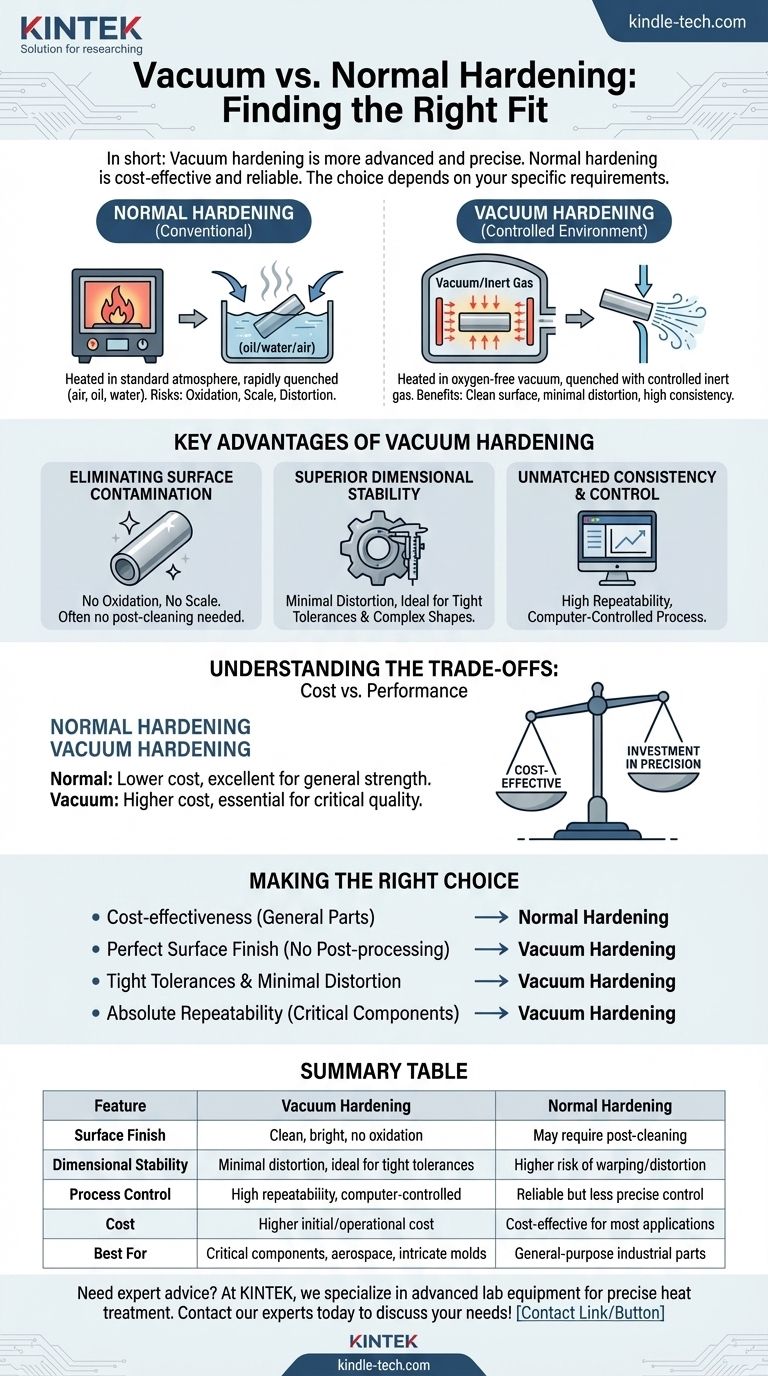
In short, vacuum hardening is not inherently "better," but it is a more advanced and precise process. It excels at producing parts with a perfectly clean surface finish and minimal distortion, which is critical for high-specification applications. Standard hardening, however, is a cost-effective and highly reliable method that provides the necessary strength and durability for the vast majority of industrial components.

The decision between vacuum and normal hardening is not about choosing a superior method, but about aligning the process with your specific requirements. Vacuum hardening is an investment in precision and surface integrity, while normal hardening is the practical choice for general-purpose strength and cost-efficiency.
Is vacuum hardening better than normal hardening? A Guide to Precision vs. Cost-Effectiveness

What is the Fundamental Difference in Process?

To understand the trade-offs, you must first understand the core difference in how each process works. The key distinction is the environment in which the metal is heated.

Normal Hardening: The Conventional Approach

Normal hardening is the most common form of heat treatment. A metal part is heated to a critical temperature in a furnace with a standard or controlled atmosphere. After being held at this temperature, it is rapidly cooled—or quenched—in a medium like air, oil, or water to lock in a new, harder microstructure.

Vacuum Hardening: The Controlled Environment

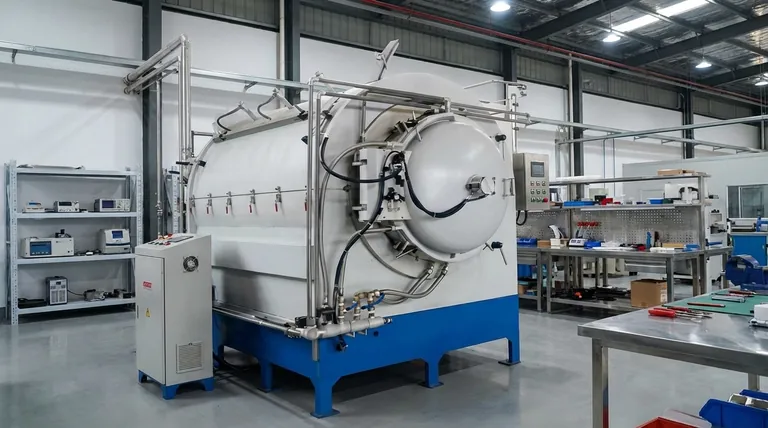
Vacuum hardening places the metal part inside a sealed chamber from which all air is removed, creating a vacuum. The part is then heated using convection with an inert gas (like nitrogen) or thermal radiation.

Crucially, quenching also occurs under controlled conditions, typically using a high-pressure stream of inert gas. This gives operators precise control over the cooling rate.

Key Advantages of the Vacuum Process

The controlled, oxygen-free environment of vacuum hardening provides distinct benefits that are essential for certain applications.

Eliminating Surface Contamination

Because there is no oxygen in the chamber, oxidation cannot occur. This prevents the formation of scale on the metal's surface.

The process also prevents other surface reactions like carburization or decarburization, resulting in a part that emerges from the furnace clean, bright, and free of contamination. This often eliminates the need for costly secondary cleaning operations.

Superior Dimensional Stability

The combination of uniform heating and precisely managed gas quenching significantly reduces internal stresses. This results in minimal distortion, warping, and dimensional change.

This level of stability is critical for components with complex geometries or extremely tight tolerances, such as those used in the aerospace industry or for intricate molds and dies.

Unmatched Consistency and Control

Modern vacuum furnaces are computer-controlled, allowing for extremely high process repeatability. Every parameter—from heating rate to quench pressure—is precisely regulated. This ensures that every part in a batch receives the exact same treatment, leading to highly consistent and predictable final properties.

Understanding the Trade-offs: Cost vs. Performance

The advanced capabilities of vacuum hardening come at a price, making normal hardening the right choice for many situations.

The Case for Normal Hardening: Cost-Effectiveness

Standard hardening equipment is less complex and expensive to operate. For applications where a perfect surface finish is not required and minor dimensional changes are acceptable, it delivers excellent strength and wear resistance at a much lower cost. It is the workhorse of the heat-treating industry for a reason.

The Investment in Vacuum Hardening: When it's Justified

The higher cost of vacuum hardening is an investment in quality and precision. It is justified when the component's requirements demand it.

This includes parts where post-treatment grinding or cleaning would be too costly or complex, or for critical components where any distortion could lead to failure, such as turbine blades or high-performance gears.

Making the Right Choice for Your Goal

Select the process that aligns directly with your project's most critical outcome.

  • If your primary focus is cost-effectiveness for general-purpose parts: Normal hardening is the clear and logical choice.
  • If your primary focus is a perfect surface finish with no post-processing: Vacuum hardening is essential to prevent oxidation and scaling.
  • If your primary focus is maintaining tight tolerances and minimizing distortion: Vacuum hardening's uniform heating and controlled cooling are superior.
  • If your primary focus is absolute process repeatability for critical components: The computer control of vacuum hardening provides unmatched consistency.

By understanding this distinction, you can invest in precision only when necessary, ensuring both the performance of your components and the efficiency of your budget.

Summary Table:

Feature Vacuum Hardening Normal Hardening
Surface Finish Clean, bright, no oxidation May require post-cleaning for scale removal
Dimensional Stability Minimal distortion, ideal for tight tolerances Higher risk of warping/distortion
Process Control High repeatability, computer-controlled Reliable but less precise control
Cost Higher initial and operational cost Cost-effective for most applications
Best For Critical components, aerospace, intricate molds General-purpose industrial parts

Need expert advice on selecting the right hardening process for your components? At KINTEK, we specialize in providing advanced lab equipment and consumables for precise heat treatment applications. Whether you're working on high-specification aerospace components or general industrial parts, our solutions ensure optimal performance and efficiency. Contact our experts today to discuss how we can support your laboratory's specific hardening needs!

Visual Guide
Is vacuum hardening better than normal hardening? A Guide to Precision vs. Cost-Effectiveness Visual Guide

Related Products

People Also Ask

Related Products

Vacuum Heat Treat Sintering Brazing Furnace

Vacuum Heat Treat Sintering Brazing Furnace

A vacuum brazing furnace is a type of industrial furnace used for brazing, a metalworking process that joins two pieces of metal using a filler metal that melts at a lower temperature than the base metals. Vacuum brazing furnaces are typically used for high-quality applications where a strong, clean joint is required.

Molybdenum Vacuum Heat Treat Furnace

Molybdenum Vacuum Heat Treat Furnace

Discover the benefits of a high-configuration molybdenum vacuum furnace with heat shield insulation. Ideal for high-purity, vacuum environments like sapphire crystal growth and heat treatment.

Vacuum Heat Treat Furnace with Ceramic Fiber Liner

Vacuum Heat Treat Furnace with Ceramic Fiber Liner

Vacuum furnace with polycrystalline ceramic fiber insulation liner for excellent heat insulation and uniform temperature field. Choose from 1200℃ or 1700℃ max. working temperature with high vacuum performance and precise temperature control.

2200 ℃ Tungsten Vacuum Heat Treat and Sintering Furnace

2200 ℃ Tungsten Vacuum Heat Treat and Sintering Furnace

Experience the ultimate refractory metal furnace with our Tungsten vacuum furnace. Capable of reaching 2200℃, perfect for sintering advanced ceramics and refractory metals. Order now for high-quality results.

Vacuum Heat Treat and Molybdenum Wire Sintering Furnace for Vacuum Sintering

Vacuum Heat Treat and Molybdenum Wire Sintering Furnace for Vacuum Sintering

A vacuum molybdenum wire sintering furnace is a vertical or bedroom structure, which is suitable for withdrawal, brazing, sintering and degassing of metal materials under high vacuum and high temperature conditions. It is also suitable for dehydroxylation treatment of quartz materials.

Graphite Vacuum Furnace High Thermal Conductivity Film Graphitization Furnace

Graphite Vacuum Furnace High Thermal Conductivity Film Graphitization Furnace

The high thermal conductivity film graphitization furnace has uniform temperature, low energy consumption and can operate continuously.

Vacuum Hot Press Furnace Heated Vacuum Press Machine Tube Furnace

Vacuum Hot Press Furnace Heated Vacuum Press Machine Tube Furnace

Reduce forming pressure & shorten sintering time with Vacuum Tube Hot Press Furnace for high-density, fine-grain materials. Ideal for refractory metals.

600T Vacuum Induction Hot Press Furnace for Heat Treat and Sintering

600T Vacuum Induction Hot Press Furnace for Heat Treat and Sintering

Discover the 600T Vacuum Induction Hot Press Furnace, designed for high-temperature sintering experiments in vacuum or protected atmospheres. Its precise temperature and pressure control, adjustable working pressure, and advanced safety features make it ideal for nonmetal materials, carbon composites, ceramics, and metal powders.

Vacuum Dental Porcelain Sintering Furnace

Vacuum Dental Porcelain Sintering Furnace

Get precise and reliable results with KinTek's Vacuum Porcelain Furnace. Suitable for all porcelain powders, it features hyperbolic ceramic furnace function, voice prompt, and automatic temperature calibration.

Vacuum Hot Press Furnace Machine for Lamination and Heating

Vacuum Hot Press Furnace Machine for Lamination and Heating

Experience clean and precise lamination with Vacuum Lamination Press. Perfect for wafer bonding, thin-film transformations, and LCP lamination. Order now!

Small Vacuum Heat Treat and Tungsten Wire Sintering Furnace

Small Vacuum Heat Treat and Tungsten Wire Sintering Furnace

The small vacuum tungsten wire sintering furnace is a compact experimental vacuum furnace specially designed for universities and scientific research institutes. The furnace features a CNC welded shell and vacuum piping to ensure leak-free operation. Quick-connect electrical connections facilitate relocation and debugging, and the standard electrical control cabinet is safe and convenient to operate.

1700℃ Laboratory Quartz Tube Furnace with Alumina Tube Tubular Furnace

1700℃ Laboratory Quartz Tube Furnace with Alumina Tube Tubular Furnace

Looking for a high-temperature tube furnace? Check out our 1700℃ Tube Furnace with Alumina Tube. Perfect for research and industrial applications up to 1700C.

Ultra-High Temperature Graphite Vacuum Graphitization Furnace

Ultra-High Temperature Graphite Vacuum Graphitization Furnace

The ultra-high temperature graphitization furnace utilizes medium frequency induction heating in a vacuum or inert gas environment. The induction coil generates an alternating magnetic field, inducing eddy currents in the graphite crucible, which heats up and radiates heat to the workpiece, bringing it to the desired temperature. This furnace is primarily used for graphitization and sintering of carbon materials, carbon fiber materials, and other composite materials.

Graphite Vacuum Furnace IGBT Experimental Graphitization Furnace

Graphite Vacuum Furnace IGBT Experimental Graphitization Furnace

IGBT experimental graphitization furnace, a tailored solution for universities and research institutions, with high heating efficiency, user-friendliness, and precise temperature control.

High Temperature Muffle Oven Furnace for Laboratory Debinding and Pre Sintering

High Temperature Muffle Oven Furnace for Laboratory Debinding and Pre Sintering

KT-MD High temperature debinding and pre-sintering furnace for ceramic materials with various molding processes. Ideal for electronic components such as MLCC and NFC.

1700℃ Muffle Oven Furnace for Laboratory

1700℃ Muffle Oven Furnace for Laboratory

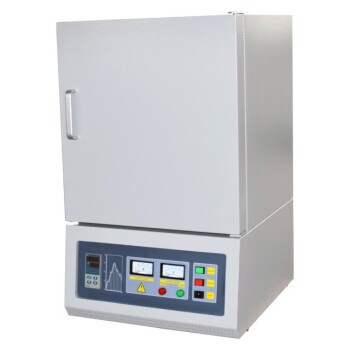
Get superior heat control with our 1700℃ Muffle Furnace. Equipped with intelligent temperature microprocessor, TFT touch screen controller & advanced insulation materials for precise heating up to 1700C. Order now!

Dental Porcelain Zirconia Sintering Ceramic Furnace Chairside with Transformer

Dental Porcelain Zirconia Sintering Ceramic Furnace Chairside with Transformer

Experience top-notch sintering with Chairside Sintering Furnace with Transformer. Easy to operate, noise-free pallet, and automatic temperature calibration. Order now!

Laboratory Sterilizer Lab Autoclave Pulse Vacuum Lifting Sterilizer

Laboratory Sterilizer Lab Autoclave Pulse Vacuum Lifting Sterilizer

The pulse vacuum lifting sterilizer is a state-of-the-art equipment for efficient and precise sterilization. It uses pulsating vacuum technology, customizable cycles, and a user-friendly design for easy operation and safety.

HFCVD Machine System Equipment for Drawing Die Nano-Diamond Coating

HFCVD Machine System Equipment for Drawing Die Nano-Diamond Coating

The nano-diamond composite coating drawing die uses cemented carbide (WC-Co) as the substrate, and uses the chemical vapor phase method ( CVD method for short ) to coat the conventional diamond and nano-diamond composite coating on the surface of the inner hole of the mold.

Benchtop Laboratory Vacuum Freeze Dryer

Benchtop Laboratory Vacuum Freeze Dryer

Benchtop laboratory freeze dryer for efficient lyophilization of biological, pharmaceutical, and food samples. Features intuitive touchscreen, high-performance refrigeration, and durable design. Preserve sample integrity—consult now!


Leave Your Message