Knowledge Should I use flux when brazing aluminum? The Critical Role of Flux in Achieving a Strong Bond
Author avatar

Tech Team · Kintek Solution

Updated 6 days ago

Should I use flux when brazing aluminum? The Critical Role of Flux in Achieving a Strong Bond


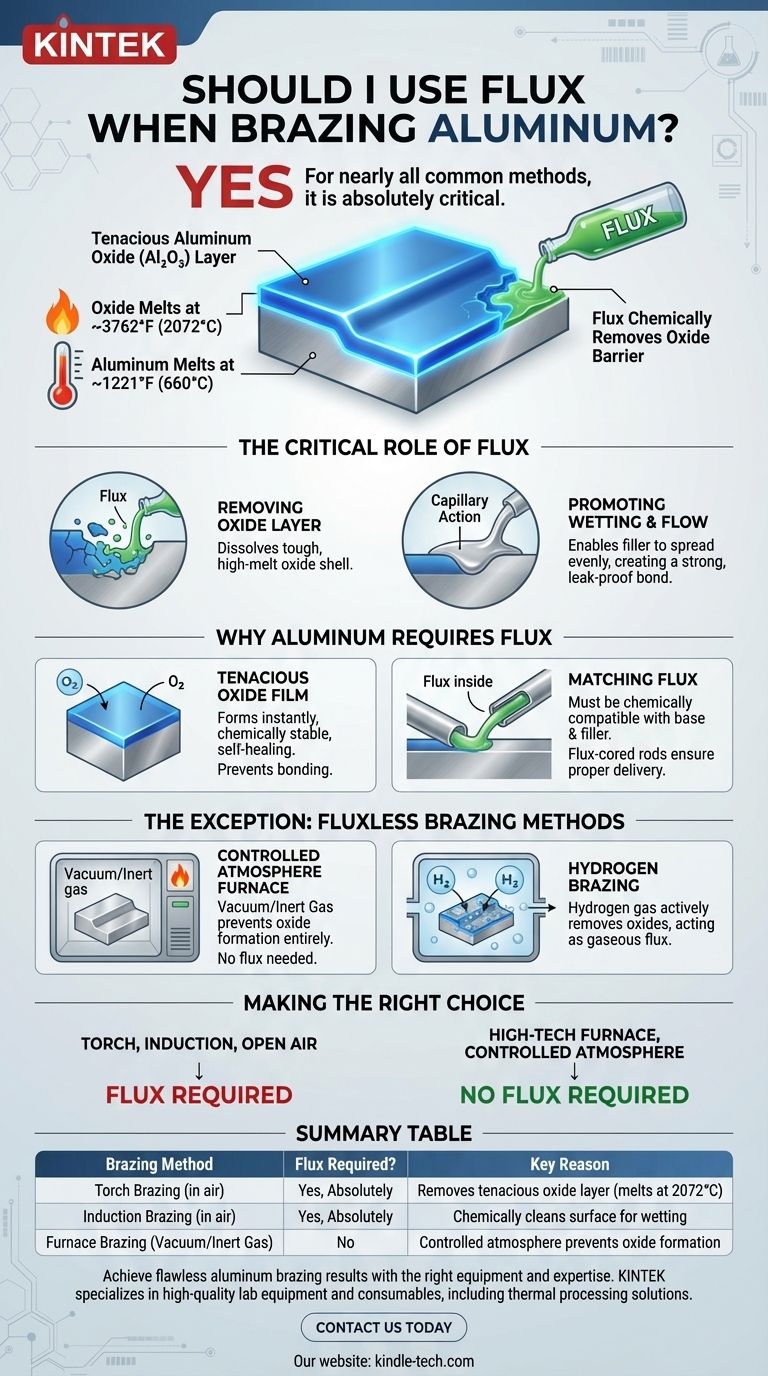
Yes, for nearly all common methods of brazing aluminum, using the correct flux is absolutely critical. Aluminum's unique chemical properties create a stubborn surface barrier that will prevent a successful braze joint from forming unless it is chemically removed by a flux. Without it, the filler metal will not bond with the base metal.

The core challenge in brazing aluminum is its tenacious, self-healing oxide layer, which has a much higher melting point than the aluminum itself. Flux is the essential chemical agent required to break down this oxide barrier, enabling the filler metal to wet the surface and create a strong, permanent bond.
Should I use flux when brazing aluminum? The Critical Role of Flux in Achieving a Strong Bond

The Critical Role of Flux in Brazing

Flux is not merely a cleaning agent; it is an active chemical component in the brazing process. Its primary functions are to prepare the metal surfaces and protect the joint as it forms.

Removing the Oxide Layer

All metals react with oxygen in the air to form an oxide layer. For a brazing filler metal to bond to a base metal, this layer must be completely removed at brazing temperatures.

Flux is designed to dissolve these metal oxides, exposing the pure, clean metal underneath.

Promoting Wetting and Flow

Once the oxide is gone, the flux creates a clean, protected surface. This allows the molten filler metal to "wet" the base metal, meaning it can spread evenly and thinly across the joint surfaces through capillary action.

This wetting action is what ensures a strong, continuous, and leak-proof joint.

Why Aluminum Requires a Specialized Approach

While flux is common in brazing many metals, it is non-negotiable for aluminum due to the unique nature of its oxide layer.

The Tenacious Aluminum Oxide Film

Aluminum instantly forms a layer of aluminum oxide (Al₂O₃) when exposed to air. This layer is extremely tough, chemically stable, and self-healing if scratched.

Crucially, aluminum oxide melts at about 3762°F (2072°C), while aluminum metal itself melts around 1221°F (660°C). The oxide layer will remain a solid shell, preventing the molten filler metal from ever touching the liquid aluminum beneath it.

A specialized aluminum brazing flux is required to chemically break down this high-temperature oxide shell at the much lower brazing temperature.

Matching Flux to the Material

The flux must be chemically compatible with both the aluminum base alloy and the aluminum-silicon filler metal. Using the wrong flux, or a flux intended for other metals like copper, will fail.

This is why many aluminum brazing rods are "flux-cored," ensuring the proper ratio and type of flux is delivered directly to the joint.

The Exception: Fluxless Brazing Methods

In certain industrial settings, it is possible to braze aluminum without flux, but this requires highly specialized equipment. These methods work by preventing the oxide from ever forming in the first place.

Furnace Brazing in a Controlled Atmosphere

When parts are heated in a furnace with a controlled atmosphere (such as a vacuum or an inert gas like argon), there is no oxygen available to form the oxide layer.

In this environment, the surfaces remain clean, allowing the filler metal to wet the joint without the need for a chemical flux.

Hydrogen Brazing

In some advanced applications, parts are brazed in a pure hydrogen atmosphere. At brazing temperatures, the hydrogen gas actively reacts with and removes any metal oxides on the surface.

In this case, the hydrogen atmosphere itself effectively acts as a gaseous flux.

Making the Right Choice for Your Application

Your brazing method dictates whether you need flux.

  • If you are using a torch, induction, or another common heating method in open air: You absolutely must use a flux specifically designed for aluminum.
  • If you are using a high-tech industrial furnace with a vacuum or controlled atmosphere: You can perform fluxless brazing, as the equipment's environment prevents oxide formation.

Ultimately, understanding the function of flux moves you from simply following steps to controlling the outcome of your work.

Summary Table:

Brazing Method Flux Required? Key Reason
Torch Brazing (in air) Yes, Absolutely Removes the tenacious aluminum oxide layer (melts at 2072°C)
Induction Brazing (in air) Yes, Absolutely Chemically cleans the surface for proper filler metal wetting
Furnace Brazing (Vacuum/Inert Gas) No Controlled atmosphere prevents oxide formation entirely

Achieve flawless aluminum brazing results with the right equipment and expertise.

Brazing aluminum presents unique challenges, but with the correct tools and knowledge, you can create strong, reliable joints every time. KINTEK specializes in providing high-quality lab equipment and consumables, including solutions for thermal processing applications.

Whether you are working in a research lab or a production environment, we can help you select the right furnace or supplies for your specific brazing needs. Let our experts guide you to success—contact us today to discuss your project!

Visual Guide
Should I use flux when brazing aluminum? The Critical Role of Flux in Achieving a Strong Bond Visual Guide

Related Products

People Also Ask

Related Products

Conductive Carbon Fiber Brush for Static Removal and Cleaning

Conductive Carbon Fiber Brush for Static Removal and Cleaning

Discover the benefits of using conductive carbon fiber brush for microbial cultivation and electrochemical testing. Improve your anode's performance.

Copper Foam

Copper Foam

Copper foam has good thermal conductivity and can be widely used for heat conduction and heat dissipation of motors/electrical appliances and electronic components.

Aluminum Foil Current Collector for Lithium Battery

Aluminum Foil Current Collector for Lithium Battery

The surface of aluminum foil is extremely clean and hygienic, and no bacteria or microorganisms can grow on it. It is a non-toxic, tasteless and plastic packaging material.

No Demolding Lab Infrared Press Mold for Laboratory Applications

No Demolding Lab Infrared Press Mold for Laboratory Applications

Effortlessly test your samples with no demolding required using our lab infrared press mold. Enjoy high transmittance and customizable sizes for your convenience.

Warm Isostatic Press for Solid State Battery Research

Warm Isostatic Press for Solid State Battery Research

Discover the advanced Warm Isostatic Press (WIP) for semiconductor lamination. Ideal for MLCC, hybrid chips, and medical electronics. Enhance strength and stability with precision.

Vacuum Sealed Continuous Working Rotary Tube Furnace Rotating Tube Furnace

Vacuum Sealed Continuous Working Rotary Tube Furnace Rotating Tube Furnace

Experience efficient material processing with our vacuum-sealed rotary tube furnace. Perfect for experiments or industrial production, equipped with optional features for controlled feeding and optimized results. Order now.

Automatic Lab Cold Isostatic Press CIP Machine Cold Isostatic Pressing

Automatic Lab Cold Isostatic Press CIP Machine Cold Isostatic Pressing

Efficiently prepare samples with our Automatic Lab Cold Isostatic Press. Widely used in material research, pharmacy, and electronic industries. Provides greater flexibility and control compared to electric CIPs.

Electric Lab Cold Isostatic Press CIP Machine for Cold Isostatic Pressing

Electric Lab Cold Isostatic Press CIP Machine for Cold Isostatic Pressing

Produce dense, uniform parts with improved mechanical properties with our Electric Lab Cold Isostatic Press. Widely used in material research, pharmacy, and electronic industries. Efficient, compact, and vacuum-compatible.

Warm Isostatic Press WIP Workstation 300Mpa for High Pressure Applications

Warm Isostatic Press WIP Workstation 300Mpa for High Pressure Applications

Discover Warm Isostatic Pressing (WIP) - A cutting-edge technology that enables uniform pressure to shape and press powdered products at a precise temperature. Ideal for complex parts and components in manufacturing.

High Pressure Laboratory Autoclave Reactor for Hydrothermal Synthesis

High Pressure Laboratory Autoclave Reactor for Hydrothermal Synthesis

Discover the applications of Hydrothermal Synthesis Reactor - a small, corrosion-resistant reactor for chemical labs. Achieve rapid digestion of insoluble substances in a safe and reliable way. Learn more now.

Custom PTFE Teflon Parts Manufacturer for Hollow Etching Flower Basket ITO FTO Developing Glue Removal

Custom PTFE Teflon Parts Manufacturer for Hollow Etching Flower Basket ITO FTO Developing Glue Removal

PTFE adjustable height flower basket (Teflon flower baskets) are made of high-purity experimental grade PTFE, with excellent chemical stability, corrosion resistance, sealing and high and low temperature resistance.

Metallographic Specimen Mounting Machine for Laboratory Materials and Analysis

Metallographic Specimen Mounting Machine for Laboratory Materials and Analysis

Precision metallographic mounting machines for labs—automated, versatile, and efficient. Ideal for sample prep in research and quality control. Contact KINTEK today!

Automatic Laboratory Heat Press Machine

Automatic Laboratory Heat Press Machine

Precision automatic heat press machines for labs—ideal for material testing, composites, and R&D. Customizable, safe, and efficient. Contact KINTEK today!

Custom PTFE Teflon Parts Manufacturer for PTFE Measuring Cylinder 10/50/100ml

Custom PTFE Teflon Parts Manufacturer for PTFE Measuring Cylinder 10/50/100ml

PTFE measuring cylinder are a rugged alternative to traditional glass cylinders. They are chemically inert over a wide temperature range (up to 260º C), have excellent corrosion resistance and maintain a low coefficient of friction, ensuring ease of use and cleaning.

Vacuum Hot Press Furnace Machine for Lamination and Heating

Vacuum Hot Press Furnace Machine for Lamination and Heating

Experience clean and precise lamination with Vacuum Lamination Press. Perfect for wafer bonding, thin-film transformations, and LCP lamination. Order now!

Graphite Vacuum Continuous Graphitization Furnace

Graphite Vacuum Continuous Graphitization Furnace

High-temperature graphitization furnace is a professional equipment for graphitization treatment of carbon materials. It is a key equipment for the production of high-quality graphite products. It has high temperature, high efficiency and uniform heating. It is suitable for various high-temperature treatments and graphitization treatments. It is widely used in metallurgy, electronics, aerospace, etc. industry.

Laboratory Hydraulic Press Lab Pellet Press for Button Battery

Laboratory Hydraulic Press Lab Pellet Press for Button Battery

Efficiently prepare samples with our 2T Button Battery Press. Ideal for material research labs and small-scale production. Small footprint, lightweight, and vacuum-compatible.

Custom PTFE Teflon Parts Manufacturer for PTFE Buchner Funnel and Triangular Funnel

Custom PTFE Teflon Parts Manufacturer for PTFE Buchner Funnel and Triangular Funnel

The PTFE funnel is a piece of laboratory equipment used primarily for filtration processes, particularly in the separation of solid and liquid phases in a mixture. This setup allows for efficient and rapid filtration, making it indispensable in various chemical and biological applications.

High-Purity Titanium Foil and Sheet for Industrial Applications

High-Purity Titanium Foil and Sheet for Industrial Applications

Titanium is chemically stable, with a density of 4.51g/cm3, which is higher than aluminum and lower than steel, copper, and nickel, but its specific strength ranks first among metals.

High Purity Zinc Foil for Battery Lab Applications

High Purity Zinc Foil for Battery Lab Applications

There are very few harmful impurities in the chemical composition of zinc foil, and the surface of the product is straight and smooth; it has good comprehensive properties, processability, electroplating colorability, oxidation resistance and corrosion resistance, etc.


Leave Your Message