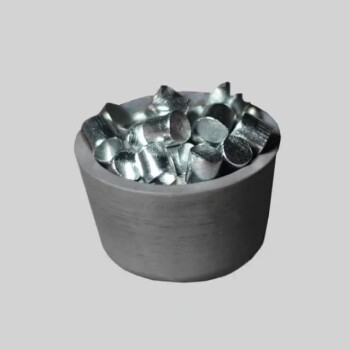
Cold Crucible Induction Melting (CCIM) is the superior choice for processing reactive metals like titanium when high purity is non-negotiable. Its primary advantage over traditional methods is the complete elimination of refractory contamination by using a water-cooled copper crucible to suspend the melt or create a solidified "skull" of the material itself.
The Core Takeaway Traditional ceramic crucibles react with titanium, re-introducing oxygen and impurities during the melting process. CCIM solves this by melting the alloy within a protective shell of its own solidified material, creating a pristine environment that allows deoxygenating agents like aluminum to reduce oxygen content to ultra-low levels effectively.
The Mechanics of Contamination Control
The "Self-Skull" Barrier
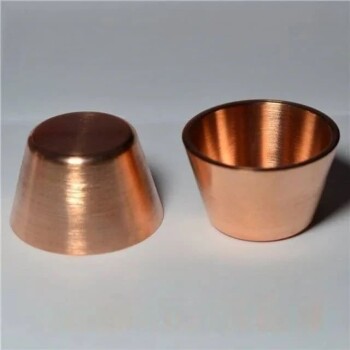
In traditional melting, the molten metal directly contacts a ceramic (refractory) liner. CCIM utilizes a water-cooled copper crucible combined with electromagnetic induction.
This cooling effect causes the outer layer of the titanium melt to freeze instantly against the crucible wall.
This forms a solid crust, or "skull," which acts as a protective container. Consequently, the molten titanium never touches the crucible itself, only its own solidified shell.
Eliminating Refractory Interaction
Titanium is highly reactive and tends to aggressively attack traditional refractory linings.
This interaction erodes the crucible and releases oxygen and ceramic particles into the melt.
By removing the ceramic liner entirely, CCIM stops this contamination at the source, ensuring the baseline purity of the melt is maintained before any processing begins.
Deoxygenation Efficiency
Maximizing Aluminum Effectiveness
To deoxygenate titanium, aluminum is often added to react with dissolved oxygen.
In a traditional setup, the melt constantly absorbs new oxygen from the ceramic crucible, counteracting the aluminum's effect.
In the inert environment of a CCIM furnace, the added aluminum consumes only the oxygen already present in the titanium. This makes the deoxygenation process significantly more efficient and predictable.
Promoting Inclusion Separation
Once the aluminum reacts with oxygen, it forms alumina ($Al_2O_3$).
The high-purity environment of CCIM facilitates the effective separation of these alumina reaction products from the melt.
This results in a final titanium-aluminum alloy that possesses ultra-low oxygen content and is free from the oxide inclusions that plague traditional melting methods.
Operational Advantages
Handling Higher Temperatures
The skull technique allows for processing temperatures that far exceed the limits of traditional ceramic-lined furnaces.
Because the containment vessel is water-cooled and protected by the skull, there is no risk of melting the crucible liner.
This enables the processing of highly refractory matrices without compromising equipment integrity.
Equipment Longevity
The solidified shell acts as a thermal insulator and chemical barrier.
It prevents the corrosive and high-temperature melt from directly contacting the induction coils or the copper structure.
This design significantly extends the service life of the melting equipment compared to traditional furnaces, where linings require frequent replacement.
Understanding the Trade-offs
System Complexity
While CCIM offers superior purity, the technology is inherently more complex than simple resistive or gas-fired melting.
It requires precise control over electromagnetic induction systems and robust water-cooling infrastructure to maintain the safety of the copper crucible.
Thermal Efficiency
A portion of the energy input is inevitably lost to the cooling water to maintain the solid skull.
This makes the process thermally less efficient than insulated ceramic furnaces, which are designed to retain heat.
However, for high-value titanium alloys, the cost of energy loss is generally outweighed by the value of the material purity.
Making the Right Choice for Your Goal
To determine if CCIM is the correct approach for your titanium processing, consider your specific purity requirements:
- If your primary focus is Ultra-Low Oxygen: CCIM is essential because it prevents the re-oxidation inherent in ceramic crucibles during the aluminum deoxygenation process.
- If your primary focus is Material Purity: The "self-skull" mechanism is the only way to guarantee zero contamination from containment materials.
- If your primary focus is Equipment Durability: CCIM offers a longer service life for processing highly corrosive or high-temperature melts.
Ultimately, CCIM converts the crucible from a source of contamination into a neutral tool, enabling the production of aerospace-grade titanium alloys that meet the strictest chemical standards.
Summary Table:
| Feature | Traditional Ceramic Melting | Cold Crucible Induction Melting (CCIM) |
|---|---|---|
| Contamination Risk | High (from refractory liners) | Zero (Self-skull barrier) |
| Oxygen Control | Constant re-oxidation from crucible | Precise reduction to ultra-low levels |
| Temp. Limits | Limited by ceramic melting point | Extremely high (water-cooled copper) |
| Inclusion Purity | High risk of ceramic particles | Clean melt with efficient separation |
| Equipment Life | Short (frequent liner replacement) | Long (protective skull insulation) |
Elevate Your Material Purity with KINTEK Advanced Solutions
Don't let crucible contamination compromise your high-performance alloys. KINTEK specializes in cutting-edge laboratory equipment designed for the most demanding research and production environments.
Whether you are processing reactive titanium, high-temperature ceramics, or advanced composites, our comprehensive portfolio offers the precision you need:
- Advanced Melting & Thermal Systems: High-temperature vacuum, induction melting, and specialized dental furnaces.
- Precision Processing: Crushing, milling, and hydraulic presses (isostatic and pellet) for material preparation.
- Research Essentials: High-pressure reactors, autoclaves, and electrolytic cells for chemical analysis.
- Laboratory Infrastructure: ULT freezers, freeze dryers, and high-purity consumables like PTFE and crucibles.
Ready to achieve ultra-low oxygen levels and superior material integrity? Our experts are here to help you select the perfect system for your specific application.
Contact KINTEK Today to Consult with Our Specialists
References
- Takayuki Narushima, Yasuaki Sugizaki. Recent activities of titanium research and development in Japan. DOI: 10.1051/matecconf/202032101004
This article is also based on technical information from Kintek Solution Knowledge Base .
Related Products
- Non Consumable Vacuum Arc Induction Melting Furnace
- Vacuum Arc Induction Melting Furnace
- Lab-Scale Vacuum Induction Melting Furnace
- Vacuum Heat Treat Furnace and Levitation Induction Melting Furnace
- Electron Beam Evaporation Coating Gold Plating Tungsten Molybdenum Crucible for Evaporation
People Also Ask
- What is the temperature range of the induction melting furnace? Find the Right Heat for Your Metals
- What is the use of induction melting furnace? Achieve Fast, Clean, and Precise Metal Melting
- What are the advantages of induction melting furnace? Achieve Purity, Efficiency, and Safety
- How do specialized industrial-grade small melting furnaces address challenges in precision jewelry casting? Expert Guide
- How do vacuum induction or arc melting furnaces facilitate the synthesis of U-Al-C MAX phases? Precision Heat & Purity