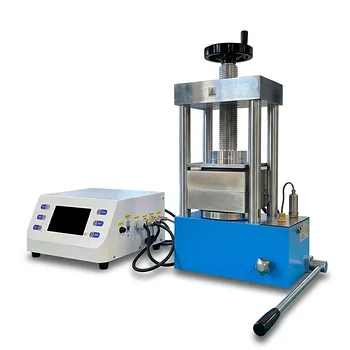
The primary advantage of a uniaxial hydraulic press in ceramic Laminated Object Manufacturing (LOM) is its ability to apply mechanical stress uniformly across the entire surface of the laminate simultaneously. Unlike a heated roller, which exerts a localized linear load, a uniaxial press distributes compression evenly to protect the part's internal geometry.
Core Takeaway For ceramic parts containing delicate support bridges or internal cavities, uniform surface compression is essential to maintain structural integrity. A uniaxial hydraulic press eliminates the shear and deflection risks associated with rollers, effectively preventing interlayer cracking and warping in complex builds.
The Physics of Applied Stress
Uniform vs. Localized Compression
A uniaxial hydraulic press applies force to the entire surface area of the laminate at once. This creates a consistent pressure environment for the material.
In contrast, a heated roller applies a localized linear load. This concentrates mechanical stress along a single moving line of contact, which changes as the roller moves across the part.
Stabilizing Delicate Architectures
When processing ceramic parts with internal cavities or thin support bridges, stability is paramount. The uniform compression of a press ensures that pressure is equalized across these fragile areas.
This prevents the material from shifting or collapsing during the lamination phase. It ensures that the downward force does not mechanically overload specific, weak points in the geometry.
Preventing Structural Failures
Mitigating Feature Deflection
The localized force of a roller can push or "deflect" small features, bending them out of alignment. Because the press applies force vertically and evenly, it significantly reduces the risk of deflection.
This allows for the fabrication of finer details and thinner walls. The support structures remain rigid and effectively support the overhanging layers without bowing.
Avoiding Cracking and Warping
Deflection and uneven stress often manifest as physical failures in the final ceramic part. The specific motion and force of a roller can introduce interlayer cracking due to the deformation of underlying layers.
By utilizing a uniaxial press, you eliminate the differential stress that causes this warping. The result is a more consistent, reliable bond between layers without introducing geometric distortion.
The Risks of Localized Loading
While rollers are common in lamination, their mechanical profile poses specific dangers for non-solid geometries. The localized linear load creates a wave of pressure that can be destructive to non-solid volumes.
If the underlying structure involves a void or a thin bridge, that specific point must bear the full force of the roller as it passes. This concentration of force is the primary driver of deformation in delicate ceramic LOM parts.
Making the Right Choice for Your Geometry
To ensure the success of your ceramic fabrication, assess the internal complexity of your design.
- If your primary focus is preserving thin support bridges: Choose a uniaxial hydraulic press to eliminate the deflection caused by linear rollers.
- If your primary focus is preventing interlayer cracking: Rely on the uniform stress distribution of the press to stop deformation and warping.
By aligning your processing method with the fragility of your features, you ensure high-fidelity results in complex ceramic laminates.
Summary Table:
| Feature | Uniaxial Hydraulic Press | Heated Roller |
|---|---|---|
| Compression Type | Uniform surface-wide pressure | Localized linear load (moving line) |
| Structural Impact | Prevents feature deflection | High risk of bending/shifting |
| Internal Geometry | Ideal for cavities & thin bridges | Can collapse non-solid volumes |
| Quality Outcome | Reduces cracking and warping | Potential for interlayer stress |
| Force Application | Simultaneous vertical force | Sequential/Differential stress |
Elevate Your Ceramic Fabrication Precision with KINTEK
Don't let localized stress compromise your complex ceramic designs. KINTEK specializes in advanced laboratory solutions, providing high-performance hydraulic presses (pellet, hot, isostatic) engineered for uniform pressure distribution and structural integrity. Whether you are developing delicate LOM parts or conducting rigorous material research, our comprehensive range—from high-temperature furnaces and crushing systems to PTFE consumables—ensures your lab achieves high-fidelity results every time.
Ready to optimize your lamination process? Contact our technical experts today to find the perfect equipment tailored to your research needs.
References
- Benjamin Dermeik, Nahum Travitzky. Laminated Object Manufacturing of Ceramic‐Based Materials. DOI: 10.1002/adem.202000256
This article is also based on technical information from Kintek Solution Knowledge Base .
Related Products
- Laboratory Hydraulic Press Split Electric Lab Pellet Press
- Automatic Laboratory Hydraulic Press for XRF & KBR Pellet Press
- Laboratory Hydraulic Pellet Press for XRF KBR FTIR Lab Applications
- 24T 30T 60T Heated Hydraulic Press Machine with Heated Plates for Laboratory Hot Press
- Laboratory Manual Hydraulic Pellet Press for Lab Use
People Also Ask
- What role does a laboratory hydraulic press play in platinum recovery research? Enhancing Sample Precision
- What are the specific applications of a lab hydraulic press in biochar evaluation? Optimize density and data accuracy.
- What are the roles of a laboratory hydraulic press and stainless steel molds in the preparation of graphite samples?
- What is the role of a laboratory hydraulic press in electrode prep? Maximize Energy Density & Sealing Precision
- Why must a laboratory hydraulic press equipped with cylindrical molds be used when preparing BZY green bodies? High Density