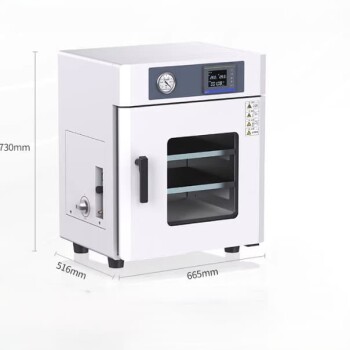
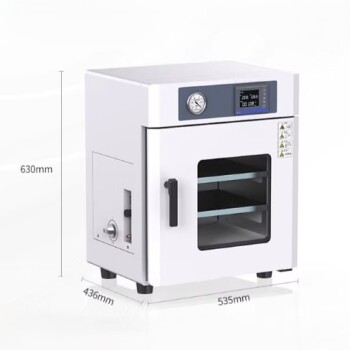
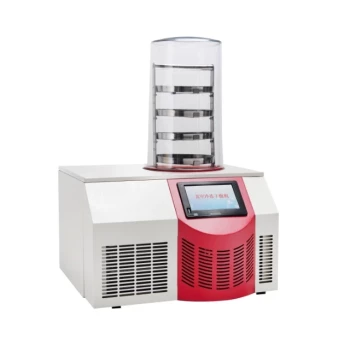
A vacuum drying oven creates a controlled low-pressure environment that significantly reduces the boiling point of water and residual solvents. This allows for rapid evaporation at much lower temperatures—typically around 50°C—compared to standard drying equipment. By removing moisture without excessive heat, you effectively prevent the thermal degradation and discoloration that often compromises the quality of fractionated rice husk components.
Core Takeaway Standard drying methods often "cook" biomass, altering its chemical makeup. Vacuum drying decouples heat from evaporation, allowing you to recover cellulose and hemicellulose sugars without triggering thermal oxidative degradation. This preserves the material's natural color, structural integrity, and functional utility.
Preserving Chemical Integrity
The Mechanism of Low-Temperature Evaporation
Standard drying relies on high heat to drive off moisture, which poses a risk to organic materials.
A vacuum drying oven lowers the system pressure, enabling solvents to boil off at temperatures as low as 50°C.
This allows you to achieve dryness without subjecting the fractionated rice husk to the destructive thermal stress of a standard oven.
Preventing Thermal Oxidative Degradation
When biomass is exposed to high heat in the presence of oxygen, it undergoes thermal oxidative degradation.
This reaction breaks down the chemical bonds of the recovered solids.
Vacuum drying mitigates this by operating at lower temperatures and reducing the oxygen content in the chamber, ensuring the chemical composition remains intact.
Avoiding Discoloration
One of the most visible signs of degradation in recovered sugars and cellulose is browning or darkening.
This discoloration indicates that unwanted chemical changes have occurred, potentially lowering the commercial value of the product.
Vacuum drying effectively avoids this, yielding a product that retains its natural appearance and purity.
Maintaining Structural and Functional Quality
Preservation of Natural Structure
For fractionated rice husk to be useful in downstream applications, its physical architecture must be preserved.
High heat can cause structures to collapse or denature.
The gentle conditions of a vacuum oven maximize the preservation of the natural structure of cellulose and hemicellulose components.
Retention of Functional Characteristics
The "functionality" of biomass—how it reacts or performs in subsequent chemical processes—depends on its structural integrity.
If the active groups or micropores are destroyed by heat, the material becomes less reactive.
Vacuum drying ensures that these functional characteristics are maintained, making the recovered components more effective for future use.
Prevention of Agglomeration
While standard drying can cause particles to sinter or clump together due to heat, vacuum drying helps maintain distinct particle morphology.
This ensures the material remains loose and porous rather than forming hard, unreactive clumps.
Understanding the Trade-offs
Equipment Complexity and Cost
While vacuum drying offers superior quality, it introduces complexity.
Standard ovens are often simple, continuous-flow systems. Vacuum ovens require vacuum pumps, airtight seals, and generally operate as batch processes.
This can increase initial capital expenditure and maintenance requirements compared to simple convection dryers.
Throughput Limitations
Because vacuum drying is typically a batch process, it may become a bottleneck in high-volume production lines.
If your process requires massive throughput speed over component purity, a vacuum system might be slower than a high-heat conveyor dryer.
Making the Right Choice for Your Goal
To determine if a vacuum drying oven is necessary for your specific rice husk application, consider your priorities:
- If your primary focus is High-Purity Recovery: Choose vacuum drying to prevent oxidation and discoloration, ensuring the chemical structure of sugars and cellulose remains unaltered.
- If your primary focus is Downstream Reactivity: Choose vacuum drying to preserve the microporous structure and functional groups necessary for efficient chemical conversion or adsorption.
- If your primary focus is Low-Cost Bulk Drying: Evaluate if standard drying provides acceptable quality, as vacuum drying involves higher equipment and operational complexity.
Summary: If the chemical activity and structural fidelity of your recovered rice husk components are critical to your success, vacuum drying is the only method that ensures preservation through low-temperature processing.
Summary Table:
| Feature | Vacuum Drying Oven | Standard Drying Equipment |
|---|---|---|
| Boiling Point | Lowered (approx. 50°C) | Higher (approx. 100°C+) |
| Thermal Stress | Minimal (Low Temperature) | High (Risk of Degradation) |
| Oxygen Content | Reduced (Prevents Oxidation) | High (Atmospheric) |
| Material Color | Preserved Natural Color | Risk of Browning/Darkening |
| Structural Integrity | High (Maintains Micropores) | Risk of Sintering/Clumping |
| Process Type | Batch Process | Often Continuous Flow |
Maximize the Purity of Your Biomass Recovery
Don't compromise the structural integrity or chemical reactivity of your fractionated rice husk. KINTEK specializes in advanced laboratory solutions designed for precision and reliability. Whether you require high-performance vacuum drying ovens, high-temperature furnaces, or specialized crushing and milling systems to prepare your samples, our equipment ensures your research and production meet the highest standards.
Our value to you:
- Preserve Quality: Prevent thermal oxidative degradation with precise pressure and temperature control.
- Comprehensive Solutions: From vacuum and atmosphere furnaces to rotary and tube furnaces, we provide the tools needed for complex material processing.
- Expert Support: Our team helps you select the right laboratory equipment and consumables, including ceramic crucibles, PTFE products, and hydraulic presses.
Ready to elevate your lab's efficiency and product quality? Contact KINTEK today for a consultation and quote!
References
- Sakurako Ishida, Jun‐ichiro Hayashi. Multi-step pre-treatment of rice husk for fractionation of components including silica. DOI: 10.3389/fchem.2025.1538797
This article is also based on technical information from Kintek Solution Knowledge Base .
Related Products
- 56L Vertical Laboratory Vacuum Drying Oven
- 23L Laboratory Vacuum Drying Oven
- Laboratory Scientific Electric Heating Blast Drying Oven
- Benchtop Laboratory Vacuum Freeze Dryer
- Dental Porcelain Zirconia Sintering Ceramic Vacuum Press Furnace
People Also Ask
- Why is a laboratory vacuum drying oven recommended for rice straw residues? Protect Your Biomass Integrity
- What role does a laboratory vacuum drying oven play in the preparation of modified multi-walled carbon nanotubes?
- What is the importance of using a laboratory vacuum drying oven? Preserving Slow-Release Microcapsule Integrity
- Why is a Laboratory Vacuum Drying Oven recommended for PBAT microspheres? Protect Sensitive Polymer Integrity
- What role does a laboratory vacuum drying oven play in processing nanoparticle powder samples? Protect Sample Integrity