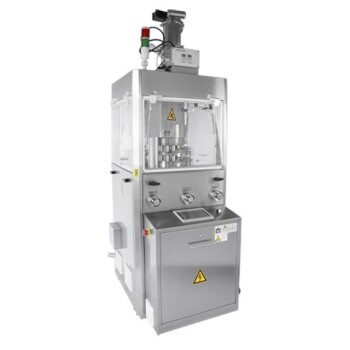
The belt press is the foundational machine of High Pressure High Temperature (HPHT) diamond growth, characterized by its massive scale and use of two opposing anvils to generate synthesis conditions. Historically significant as the first design to produce reproducible lab-grown diamonds, it operates by applying extreme pressure (>1.5 million PSI) and temperature (>2,000°C) to a cylindrical cell. While capable of growing multiple diamonds in a single cycle, it is currently utilized primarily for industrial diamond powder due to challenges in maintaining precise environmental control.
The belt press defined the early era of diamond synthesis, proving that lab-grown diamonds were possible. However, its modern utility is often limited by a lack of precision; while it offers high-volume batch processing, the difficulty in controlling internal conditions makes it less ideal for consistent, high-quality gem production compared to newer technologies.
The Mechanics of the Belt Press
Two-Piston Compression
Unlike cubic presses that utilize six anvils, the belt press relies on a dual-anvil system. Two massive pistons apply equal pressure from opposite directions (top and bottom) onto the growth cell.
Cylindrical Confinement
The "belt" in the name refers to the method of containment. The internal growth cell is cylindrical and is confined radially by a "belt" of pre-stressed steel bands. This prevents the cell from bursting under the immense vertical pressure applied by the anvils.
Simultaneous Heating and Pressure
The anvils serve a dual purpose: they act as the mechanical force to crush the cell and as electrodes to introduce electric current. This current generates temperatures exceeding 2,000 degrees Celsius, melting the carbon source around a starter seed.
Physical Scale and Capacity
Massive Infrastructure
These machines are exceptionally large examples of industrial engineering. A single belt press can be several stories tall and weigh thousands of pounds. They require significant facility space and robust infrastructure to operate safely.
High-Volume Batching
The sheer size of the reaction volume allows for a distinct advantage: multi-diamond growth. A belt press can synthesize multiple stones or large quantities of diamond grit in a single operational cycle.
Understanding the Trade-offs
The Precision Challenge
The primary drawback of the belt press is the lack of fine-tuned control. Because pressure is applied from only two directions (uniaxial) rather than from all sides (hydrostatic or multi-axial), gradients in pressure and temperature can occur within the cell.
Quality Variance
This lack of uniform conditions leads to inconsistent quality within a single batch. While one area of the cell might produce a gem-quality stone, another area might produce lower-quality material.
Industrial vs. Gem Utility
Because of these variances, the belt press is predominantly used for creating industrial diamonds and diamond powder. While it can create gem-quality stones, the yield is often less predictable than with more modern, compact press designs.
Assessing the Role of Belt Presses Today
While newer technologies like the BARS (split-sphere) or Cubic press offer more control, the belt press remains a workhorse for specific applications.
- If your primary focus is Industrial Applications: The belt press is highly effective for mass-producing diamond grit and powder due to its ability to process large batches simultaneously.
- If your primary focus is Gem-Quality Synthesis: You must account for higher failure rates or quality variance, as the two-anvil design struggles to maintain the homogeneous environment required for perfect crystal growth.
The belt press remains a titan of diamond synthesis history, trading the precision of modern compact units for the brute force capacity to process high volumes of carbon.
Summary Table:
| Feature | Specification/Characteristic |
|---|---|
| Mechanism | Dual-anvil (two-piston) compression |
| Containment | Radial pre-stressed steel belt |
| Temperature | > 2,000°C (via electrode anvils) |
| Pressure | > 1.5 million PSI |
| Primary Output | Industrial diamonds and diamond powders |
| Core Advantage | High-volume batch processing capability |
Elevate Your Material Research with KINTEK Precision
Whether you are scaling industrial diamond synthesis or conducting high-pressure material studies, KINTEK provides the robust laboratory equipment needed to achieve consistent results. From advanced high-temperature high-pressure reactors and autoclaves to precision hydraulic presses (pellet, hot, isostatic), our solutions are engineered for durability and extreme performance.
Unlock the full potential of your laboratory today. Contact our technical experts here to discover how our comprehensive range of high-temperature furnaces and material processing tools can enhance your research and production efficiency.
Related Products
- Laboratory Hydraulic Press Lab Pellet Press Machine for Glove Box
- Laboratory Hydraulic Pellet Press for XRF KBR FTIR Lab Applications
- Ring Press Mold for Lab Applications
- Automatic Laboratory Hydraulic Press for XRF & KBR Pellet Press
- Laboratory Manual Hydraulic Pellet Press for Lab Use
People Also Ask
- What is the function of a laboratory hydraulic press in W-Cu composites? Control Porosity and Material Ratio
- What is the role of a laboratory hydraulic press in the initial stages of Li6PS5Cl preparation? Key to Green Pellets
- What role does a laboratory hydraulic press play in triboelectric testing? Achieve Precision Alloy Sample Prep
- How can a laboratory hydraulic press be applied to chitosan for wastewater treatment? Optimize Pores & Strength
- How do a precision laboratory hydraulic press and specialized molds contribute to the fabrication of spherical ceramic samples? Achieving High-Density Material Precision