Knowledge vacuum induction melting furnace What are the disadvantages of coreless type induction furnace? Key Trade-offs in Flexibility vs. Efficiency
Author avatar

Tech Team · Kintek Solution

Updated 3 months ago

What are the disadvantages of coreless type induction furnace? Key Trade-offs in Flexibility vs. Efficiency


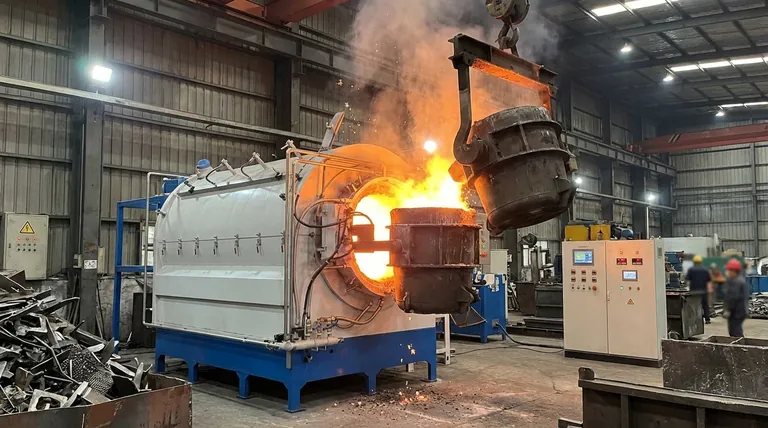
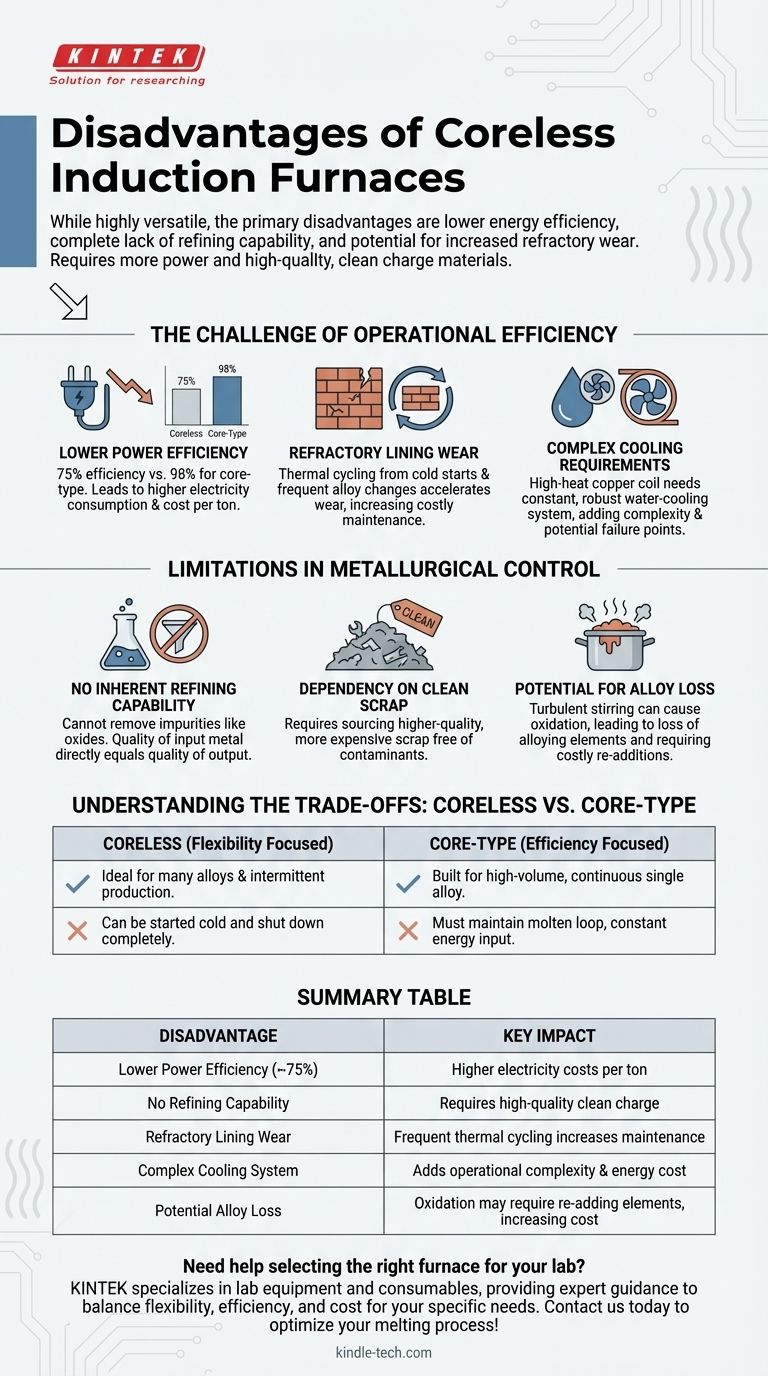
While highly versatile, the primary disadvantages of a coreless induction furnace are its lower energy efficiency, its complete lack of refining capability, and the potential for increased refractory wear. These factors mean it requires more power to operate and is dependent on high-quality, clean charge materials to produce a melt of known composition.

The coreless induction furnace trades high efficiency for high flexibility. Its key drawbacks—lower power efficiency and an inability to refine metals—are the direct trade-off for its valuable ability to start and stop quickly and handle frequent alloy changes.
What are the disadvantages of coreless type induction furnace? Key Trade-offs in Flexibility vs. Efficiency

The Challenge of Operational Efficiency

A coreless furnace's design prioritizes flexibility over raw power efficiency, leading to higher operational costs compared to alternatives. This is a critical financial consideration for any high-volume operation.

Lower Power Efficiency

A coreless induction furnace typically operates with a power efficiency of around 75%. This stands in stark contrast to a core-type furnace, which can achieve efficiencies up to 98%. This efficiency gap translates directly into higher electricity consumption and cost per ton of metal melted.

Refractory Lining Wear

The ability to shut down and start cold is a major advantage, but this thermal cycling places significant stress on the refractory lining. Frequent alloy changes can also accelerate wear, leading to more frequent, costly, and time-consuming relining procedures.

Complex Cooling Requirements

The high-conductivity copper coil is the heart of the furnace and generates immense heat. It requires a constant, robust water-cooling system to prevent overheating and failure. This system adds complexity, a point of potential failure, and an additional energy cost to the operation.

Limitations in Metallurgical Control

Perhaps the most significant operational drawback is the furnace's relationship with the metal it melts. It is a melter, not a refiner, which places strict constraints on the input materials.

No Inherent Refining Capability

The single most important metallurgical drawback is the lack of refining capacity. A coreless furnace cannot remove impurities like oxides from the charge material. The quality of the metal you put in is directly related to the quality you get out.

Dependency on Clean Scrap

Because the furnace cannot refine, charge materials must be clean, free of contaminants, and of a known composition. This often means sourcing higher-quality, more expensive scrap, which can significantly impact the overall cost of production.

Potential for Alloy Loss

During the melting process, the turbulent stirring action can expose the melt to the atmosphere, leading to the oxidation and loss of some alloying elements. These lost elements must be analyzed and re-added to the melt to meet final specifications, adding cost and an extra step to the process.

Understanding the Trade-offs: Coreless vs. Core-Type

The disadvantages of the coreless furnace are best understood when compared to its primary alternative, the core-type furnace. The choice between them is a classic engineering trade-off between flexibility and specialized efficiency.

Flexibility vs. Throughput

The coreless furnace excels in environments requiring flexibility. It is ideal for foundries producing many different alloys or those with intermittent production schedules. In contrast, the core-type furnace is built for high-volume, continuous throughput of a single, consistent alloy.

Startup and Shutdown

A coreless furnace can be started cold and shut down completely. A core-type furnace must maintain a continuous loop of molten metal to function and is rarely allowed to cool, requiring constant energy input even when idle.

Making the Right Choice for Your Operation

Selecting the correct furnace technology requires a clear understanding of your specific production goals and operational constraints.

  • If your primary focus is operational flexibility and varied alloys: The coreless furnace is the correct choice, as its ability to perform cold starts and handle frequent material changes outweighs its lower energy efficiency.
  • If your primary focus is high-volume, continuous production of a single alloy: The superior energy efficiency (~98%) of a core-type furnace will result in significantly lower long-term operational costs.
  • If your primary concern is managing raw material costs: Be prepared for the coreless furnace's demand for high-quality, clean scrap, which may be more expensive than the materials usable in other furnace types.

Understanding these fundamental trade-offs is the key to selecting the right furnace technology for your specific production goals.

Summary Table:

Disadvantage Key Impact
Lower Power Efficiency (~75%) Higher electricity costs per ton melted
No Refining Capability Requires high-quality, clean charge materials
Refractory Lining Wear Frequent thermal cycling increases maintenance costs
Complex Cooling System Adds operational complexity and energy cost
Potential Alloy Loss Oxidation may require re-adding elements, increasing cost

Need help selecting the right furnace for your lab? At KINTEK, we specialize in lab equipment and consumables, providing expert guidance to help you choose the ideal induction furnace that balances flexibility, efficiency, and cost for your specific laboratory needs. Contact us today to optimize your melting process and achieve superior results!

Visual Guide
What are the disadvantages of coreless type induction furnace? Key Trade-offs in Flexibility vs. Efficiency Visual Guide

Related Products

People Also Ask

Related Products

Non Consumable Vacuum Arc Induction Melting Furnace

Non Consumable Vacuum Arc Induction Melting Furnace

Explore the benefits of Non-Consumable Vacuum Arc Furnace with high melting point electrodes. Small, easy to operate & eco-friendly. Ideal for laboratory research on refractory metals & carbides.

600T Vacuum Induction Hot Press Furnace for Heat Treat and Sintering

600T Vacuum Induction Hot Press Furnace for Heat Treat and Sintering

Discover the 600T Vacuum Induction Hot Press Furnace, designed for high-temperature sintering experiments in vacuum or protected atmospheres. Its precise temperature and pressure control, adjustable working pressure, and advanced safety features make it ideal for nonmetal materials, carbon composites, ceramics, and metal powders.

Vacuum Arc Induction Melting Furnace

Vacuum Arc Induction Melting Furnace

Discover the power of Vacuum Arc Furnace for melting active & refractory metals. High-speed, remarkable degassing effect, and free of contamination. Learn more now!

Lab-Scale Vacuum Induction Melting Furnace

Lab-Scale Vacuum Induction Melting Furnace

Get precise alloy composition with our Vacuum Induction Melting Furnace. Ideal for aerospace, nuclear energy, and electronic industries. Order now for effective smelting and casting of metals and alloys.

Vacuum Heat Treat Furnace and Levitation Induction Melting Furnace

Vacuum Heat Treat Furnace and Levitation Induction Melting Furnace

Experience precise melting with our Vacuum Levitation Melting Furnace. Ideal for high melting point metals or alloys, with advanced technology for effective smelting. Order now for high-quality results.

Controlled Nitrogen Inert Hydrogen Atmosphere Furnace

Controlled Nitrogen Inert Hydrogen Atmosphere Furnace

KT-AH Hydrogen atmosphere furnace - induction gas furnace for sintering/annealing with built-in safety features, dual housing design, and energy-saving efficiency. Ideal for lab and industrial use.

High Temperature Muffle Oven Furnace for Laboratory Debinding and Pre Sintering

High Temperature Muffle Oven Furnace for Laboratory Debinding and Pre Sintering

KT-MD High temperature debinding and pre-sintering furnace for ceramic materials with various molding processes. Ideal for electronic components such as MLCC and NFC.

Graphite Vacuum Furnace High Thermal Conductivity Film Graphitization Furnace

Graphite Vacuum Furnace High Thermal Conductivity Film Graphitization Furnace

The high thermal conductivity film graphitization furnace has uniform temperature, low energy consumption and can operate continuously.

Multi Heating Zones CVD Tube Furnace Machine Chemical Vapor Deposition Chamber System Equipment

Multi Heating Zones CVD Tube Furnace Machine Chemical Vapor Deposition Chamber System Equipment

KT-CTF14 Multi Heating Zones CVD Furnace - Precise Temperature Control and Gas Flow for Advanced Applications. Max temp up to 1200℃, 4 channels MFC mass flow meter, and 7" TFT touch screen controller.

Laboratory Muffle Oven Furnace Bottom Lifting Muffle Furnace

Laboratory Muffle Oven Furnace Bottom Lifting Muffle Furnace

Efficiently produce batches with excellent temperature uniformity using our Bottom Lifting Furnace. Features two electric lifting stages and advanced temperature control up to 1600℃.

1700℃ Controlled Atmosphere Furnace Nitrogen Inert Atmosphere Furnace

1700℃ Controlled Atmosphere Furnace Nitrogen Inert Atmosphere Furnace

KT-17A Controlled atmosphere furnace: 1700℃ heating, vacuum sealing technology, PID temperature control, and versatile TFT smart touch screen controller for laboratory and industrial use.

1200℃ Controlled Atmosphere Furnace Nitrogen Inert Atmosphere Furnace

1200℃ Controlled Atmosphere Furnace Nitrogen Inert Atmosphere Furnace

Discover our KT-12A Pro Controlled atmosphere furnace - high precision, heavy duty vacuum chamber, versatile smart touch screen controller, and excellent temperature uniformity up to 1200C. Ideal for both laboratory and industrial application.

Mesh belt controlled atmosphere furnace

Mesh belt controlled atmosphere furnace

Discover our KT-MB mesh belt sintering furnace - perfect for high-temperature sintering of electronic components & glass insulators. Available for open air or controlled atmosphere environments.

Ultra-High Temperature Graphite Vacuum Graphitization Furnace

Ultra-High Temperature Graphite Vacuum Graphitization Furnace

The ultra-high temperature graphitization furnace utilizes medium frequency induction heating in a vacuum or inert gas environment. The induction coil generates an alternating magnetic field, inducing eddy currents in the graphite crucible, which heats up and radiates heat to the workpiece, bringing it to the desired temperature. This furnace is primarily used for graphitization and sintering of carbon materials, carbon fiber materials, and other composite materials.

Graphite Vacuum Furnace Bottom Discharge Graphitization Furnace for Carbon Materials

Graphite Vacuum Furnace Bottom Discharge Graphitization Furnace for Carbon Materials

Bottom-out graphitization furnace for carbon materials, ultra-high temperature furnace up to 3100°C, suitable for graphitization and sintering of carbon rods and carbon blocks. Vertical design, bottom discharging, convenient feeding and discharging, high temperature uniformity, low energy consumption, good stability, hydraulic lifting system, convenient loading and unloading.

Rotary Tube Furnace Split Multi Heating Zone Rotating Tube Furnace

Rotary Tube Furnace Split Multi Heating Zone Rotating Tube Furnace

Multi zone rotary furnace for high-precision temperature control with 2-8 independent heating zones. Ideal for lithium ion battery electrode materials and high-temperature reactions. Can work under vacuum and controlled atmosphere.

Vacuum Sealed Continuous Working Rotary Tube Furnace Rotating Tube Furnace

Vacuum Sealed Continuous Working Rotary Tube Furnace Rotating Tube Furnace

Experience efficient material processing with our vacuum-sealed rotary tube furnace. Perfect for experiments or industrial production, equipped with optional features for controlled feeding and optimized results. Order now.

Spark Plasma Sintering Furnace SPS Furnace

Spark Plasma Sintering Furnace SPS Furnace

Discover the benefits of Spark Plasma Sintering Furnaces for rapid, low-temperature material preparation. Uniform heating, low cost & eco-friendly.

1200℃ Split Tube Furnace with Quartz Tube Laboratory Tubular Furnace

1200℃ Split Tube Furnace with Quartz Tube Laboratory Tubular Furnace

KT-TF12 split tube furnace: high-purity insulation, embedded heating wire coils, and max. 1200C. Widely used for new materials and chemical vapour deposition.

Vacuum Heat Treat and Pressure Sintering Furnace for High Temperature Applications

Vacuum Heat Treat and Pressure Sintering Furnace for High Temperature Applications

Vacuum pressure sintering furnaces are designed for high temperature hot pressing applications in metal and ceramic sintering. Its advanced features ensure precise temperature control, reliable pressure maintenance, and a robust design for seamless operation.


Leave Your Message



















