Knowledge Vacuum Furnace What are the disadvantages of heat treatment? Managing the Risks of Distortion and Cost
Author avatar

Tech Team · Kintek Solution

Updated 3 months ago

What are the disadvantages of heat treatment? Managing the Risks of Distortion and Cost


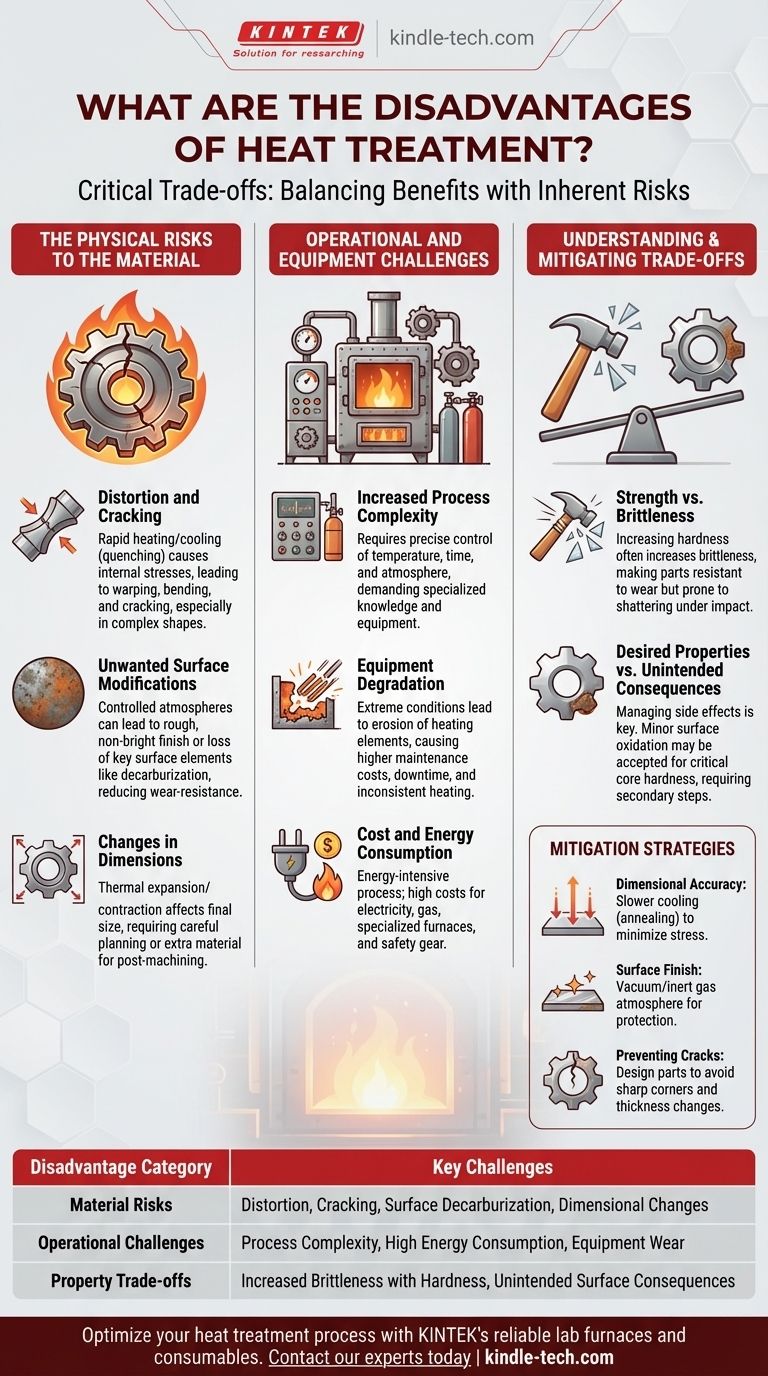
While incredibly beneficial, heat treatment is not a flawless process and introduces a series of critical trade-offs. The primary disadvantages are the risk of physical damage to the workpiece, such as distortion, cracking, and undesirable surface changes, alongside increased operational complexity, cost, and equipment wear.

Heat treatment's disadvantages are not failures of the process but inherent consequences of inducing massive structural change in a material. Understanding these trade-offs is essential for managing the process successfully to achieve a desired outcome without introducing unacceptable flaws.
What are the disadvantages of heat treatment? Managing the Risks of Distortion and Cost

The Physical Risks to the Material

Applying extreme temperatures fundamentally alters a material. While the goal is to improve properties, this change can also manifest in undesirable ways if not perfectly controlled.

Risk of Distortion and Cracking

Rapid or uneven heating and cooling are the primary culprits behind internal stresses.

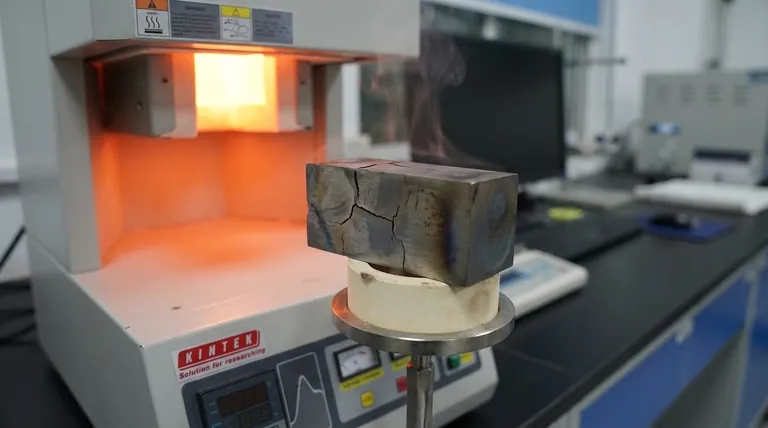
Processes like quenching, which involves rapid cooling in a liquid medium, are highly effective for hardening but put immense stress on the part. This can cause the material to warp, bend, or even crack, especially in complex geometries with both thick and thin sections.

Unwanted Surface Modifications

The interaction between high heat and the surrounding atmosphere can degrade the material's surface.

In a controlled atmosphere treatment, for example, the workpiece can emerge with a rough and non-bright surface. More critically, it can lead to the loss of key surface metal elements, such as the decarburization of steel, which leaves the surface softer and less wear-resistant than intended.

Changes in Dimensions

All materials expand when heated and contract when cooled. While predictable, this can lead to final dimensions that are outside of required tolerances.

This requires careful planning and, in some cases, leaving extra material on the part for a final machining pass after heat treatment, adding another step to the manufacturing process.

Operational and Equipment Challenges

Beyond the workpiece itself, heat treatment introduces significant logistical and financial considerations. These factors contribute to the overall cost and complexity of manufacturing.

Increased Process Complexity

Effective heat treatment is a precise science. It demands exact control over temperature, time, and atmospheric composition.

Managing the gasses used in a controlled atmosphere, for instance, presents challenges in both usage and recovery. This complexity requires specialized knowledge and equipment to execute correctly.

Equipment Degradation

The extreme conditions inside a furnace take a toll on the equipment itself.

The references note the erosion of electric heating elements as a significant issue. This leads to higher maintenance costs, potential downtime, and inconsistent heating if not addressed.

Cost and Energy Consumption

Heating large metal components to very high temperatures is an energy-intensive process. The cost of electricity or gas, combined with the expense of specialized furnaces and safety equipment, makes heat treatment a significant investment.

Understanding the Trade-offs

The disadvantages of heat treatment must be weighed against its powerful benefits. Nearly every desired property improvement comes with a corresponding risk that must be managed.

Strength vs. Brittleness

A common goal is to increase a material's hardness and strength. However, for many metals, particularly steel, increasing hardness also increases brittleness. A very hard part may be resistant to wear but could shatter under a sudden impact.

Desired Properties vs. Unintended Consequences

The decision to heat treat is a commitment to managing its side effects. You might accept minor surface oxidation to achieve a critical core hardness, knowing that a secondary cleaning or polishing step will be required. The goal is to control the process so the benefits—like stress relief or improved wear resistance—far outweigh the managed drawbacks.

How to Mitigate the Disadvantages

By anticipating the potential downsides, you can select the right process and build steps into your plan to counteract them.

  • If your primary focus is dimensional accuracy: Opt for slower cooling methods like normalizing or annealing instead of quenching to minimize the internal stresses that cause warping.
  • If your primary focus is surface finish: Use a vacuum furnace or a precisely controlled inert gas atmosphere to prevent surface oxidation and decarburization, or plan for post-treatment grinding or machining.
  • If your primary focus is preventing cracks: Ensure part designs avoid sharp internal corners and drastic changes in thickness, which act as stress concentrators during rapid cooling.

By understanding and planning for these potential drawbacks, you can harness the full power of heat treatment while controlling for its inherent risks.

Summary Table:

Disadvantage Category Key Challenges
Material Risks Distortion, cracking, surface decarburization, dimensional changes
Operational Challenges Process complexity, high energy consumption, equipment wear and tear
Property Trade-offs Increased brittleness with hardness, unintended surface consequences

Optimize your heat treatment process and protect your materials. The challenges of distortion, surface degradation, and equipment costs are significant, but they can be managed with the right expertise and equipment. KINTEK specializes in high-quality lab furnaces and consumables, providing the reliable, precise tools your laboratory needs to achieve successful heat treatment outcomes while minimizing risks.

Contact our experts today to discuss how our solutions can enhance your process efficiency and results.

Visual Guide
What are the disadvantages of heat treatment? Managing the Risks of Distortion and Cost Visual Guide

Related Products

People Also Ask

Related Products

Evaporation Boat for Organic Matter

Evaporation Boat for Organic Matter

The evaporation boat for organic matter is an important tool for precise and uniform heating during the deposition of organic materials.

5L Heating Chilling Circulator Cooling Water Bath Circulator for High and Low Temperature Constant Temperature Reaction

5L Heating Chilling Circulator Cooling Water Bath Circulator for High and Low Temperature Constant Temperature Reaction

KinTek KCBH 5L Heating Chilling Circulator - Ideal for labs and industrial conditions with multi-functional design and reliable performance.

Vacuum Heat Treat Furnace with Ceramic Fiber Liner

Vacuum Heat Treat Furnace with Ceramic Fiber Liner

Vacuum furnace with polycrystalline ceramic fiber insulation liner for excellent heat insulation and uniform temperature field. Choose from 1200℃ or 1700℃ max. working temperature with high vacuum performance and precise temperature control.

50L Heating Chilling Circulator Cooling Water Bath Circulator for High and Low Temperature Constant Temperature Reaction

50L Heating Chilling Circulator Cooling Water Bath Circulator for High and Low Temperature Constant Temperature Reaction

Experience versatile heating, chilling, and circulating capabilities with our KinTek KCBH 50L Heating Chilling Circulator. Ideal for labs and industrial settings, with efficient and reliable performance.

24T 30T 60T Heated Hydraulic Press Machine with Heated Plates for Laboratory Hot Press

24T 30T 60T Heated Hydraulic Press Machine with Heated Plates for Laboratory Hot Press

Looking for a reliable Hydraulic Heated Lab Press? Our 24T / 40T model is perfect for material research labs, pharmacy, ceramics, and more. With a small footprint and the ability to work inside a vacuum glove box, it's the efficient and versatile solution for your sample preparation needs.

Manual High Temperature Heated Hydraulic Press Machine with Heated Plates for Lab

Manual High Temperature Heated Hydraulic Press Machine with Heated Plates for Lab

The High Temperature Hot Press is a machine specifically designed for pressing, sintering and processing materials in a high temperature environment. It is capable of operating in the range of hundreds of degrees Celsius to thousands of degrees Celsius for a variety of high temperature process requirements.

Heated Hydraulic Press Machine with Heated Plates for Vacuum Box Laboratory Hot Press

Heated Hydraulic Press Machine with Heated Plates for Vacuum Box Laboratory Hot Press

Enhance your lab's precision with our lab press for vacuum box. Press pills and powders with ease and precision in a vacuum environment, reducing oxidation and improving consistency. Compact and easy to use with a digital pressure gauge.

Laboratory Scientific Electric Heating Blast Drying Oven

Laboratory Scientific Electric Heating Blast Drying Oven

The desktop fast autoclave sterilizer is a compact and reliable device used for rapid sterilization of medical, pharmaceutical, and research items.

Vertical Laboratory Tube Furnace

Vertical Laboratory Tube Furnace

Elevate your experiments with our Vertical Tube Furnace. Versatile design allows for operation under various environments and heat treatment applications. Order now for precise results!

Automatic High Temperature Heated Hydraulic Press Machine with Heated Plates for Lab

Automatic High Temperature Heated Hydraulic Press Machine with Heated Plates for Lab

The High Temperature Hot Press is a machine specifically designed for pressing, sintering and processing materials in a high temperature environment. It is capable of operating in the range of hundreds of degrees Celsius to thousands of degrees Celsius for a variety of high temperature process requirements.

Silicon Carbide (SIC) Ceramic Sheet Flat Corrugated Heat Sink for Engineering Advanced Fine Ceramics

Silicon Carbide (SIC) Ceramic Sheet Flat Corrugated Heat Sink for Engineering Advanced Fine Ceramics

Silicon carbide (sic) ceramic heat sink not only does not generate electromagnetic waves, but also can isolate electromagnetic waves and absorb part of electromagnetic waves.

Heated Hydraulic Press Machine with Integrated Manual Heated Plates for Lab Use

Heated Hydraulic Press Machine with Integrated Manual Heated Plates for Lab Use

Efficiently process heat-pressing samples with our Integrated Manual Heated Lab Press. With a heating range up to 500°C, it's perfect for various industries.

Silicon Carbide SiC Thermal Heating Elements for Electric Furnace

Silicon Carbide SiC Thermal Heating Elements for Electric Furnace

Experience the advantages of Silicon Carbide (SiC) Heating Element: Long service life, high corrosion and oxidation resistance, fast heating speed, and easy maintenance. Learn more now!

Laboratory Rapid Thermal Processing (RTP) Quartz Tube Furnace

Laboratory Rapid Thermal Processing (RTP) Quartz Tube Furnace

Get lightning-fast heating with our RTP Rapid Heating Tube Furnace. Designed for precise, high-speed heating and cooling with convenient sliding rail and TFT touch screen controller. Order now for ideal thermal processing!

Manual Heated Hydraulic Press Machine with Heated Plates for Laboratory Hot Press

Manual Heated Hydraulic Press Machine with Heated Plates for Laboratory Hot Press

The Manual Heat Press is a versatile piece of equipment suitable for a variety of applications, operated by a manual hydraulic system that applies controlled pressure and heat to the material placed on the piston.

Molybdenum Tungsten Tantalum Special Shape Evaporation Boat

Molybdenum Tungsten Tantalum Special Shape Evaporation Boat

Tungsten Evaporation Boat is ideal for vacuum coating industry and sintering furnace or vacuum annealing. we offers tungsten evaporation boats that are designed to be durable and robust, with long operating lifetimes and to ensure consistent smooth and even spreading of the molten metals.

30T 40T Split Automatic Heated Hydraulic Press Machine with Heated Plates for Laboratory Hot Press

30T 40T Split Automatic Heated Hydraulic Press Machine with Heated Plates for Laboratory Hot Press

Discover our split automatic heated lab press 30T/40T for precise sample preparation in material research, pharmacy, ceramics, and electronics industries. With a small footprint and heating up to 300°C, it's perfect for processing under vacuum environment.

Electric Rotary Kiln Pyrolysis Furnace Plant Machine Calciner Small Rotary Kiln Rotating Furnace

Electric Rotary Kiln Pyrolysis Furnace Plant Machine Calciner Small Rotary Kiln Rotating Furnace

Electric rotary kiln - precisely controlled, it's ideal for calcination and drying of materials like lithium cobalate, rare earths, and non-ferrous metals.

Electric Rotary Kiln Continuous Working Small Rotary Furnace Heating Pyrolysis Plant

Electric Rotary Kiln Continuous Working Small Rotary Furnace Heating Pyrolysis Plant

Efficiently calcine and dry bulk powder and lump fluid materials with an electric heating rotary furnace. Ideal for processing lithium ion battery materials and more.

20L Heating Chilling Circulator Cooling Water Bath Circulator for High and Low Temperature Constant Temperature Reaction

20L Heating Chilling Circulator Cooling Water Bath Circulator for High and Low Temperature Constant Temperature Reaction

Maximize lab productivity with KinTek KCBH 20L Heating Chilling Circulator. Its all-in-one design offers reliable heating, chilling, and circulating functions for industrial and lab use.


Leave Your Message