Knowledge What are the disadvantages of induction heating? High Cost & Geometric Limits Explained
Author avatar

Tech Team · Kintek Solution

Updated 1 week ago

What are the disadvantages of induction heating? High Cost & Geometric Limits Explained


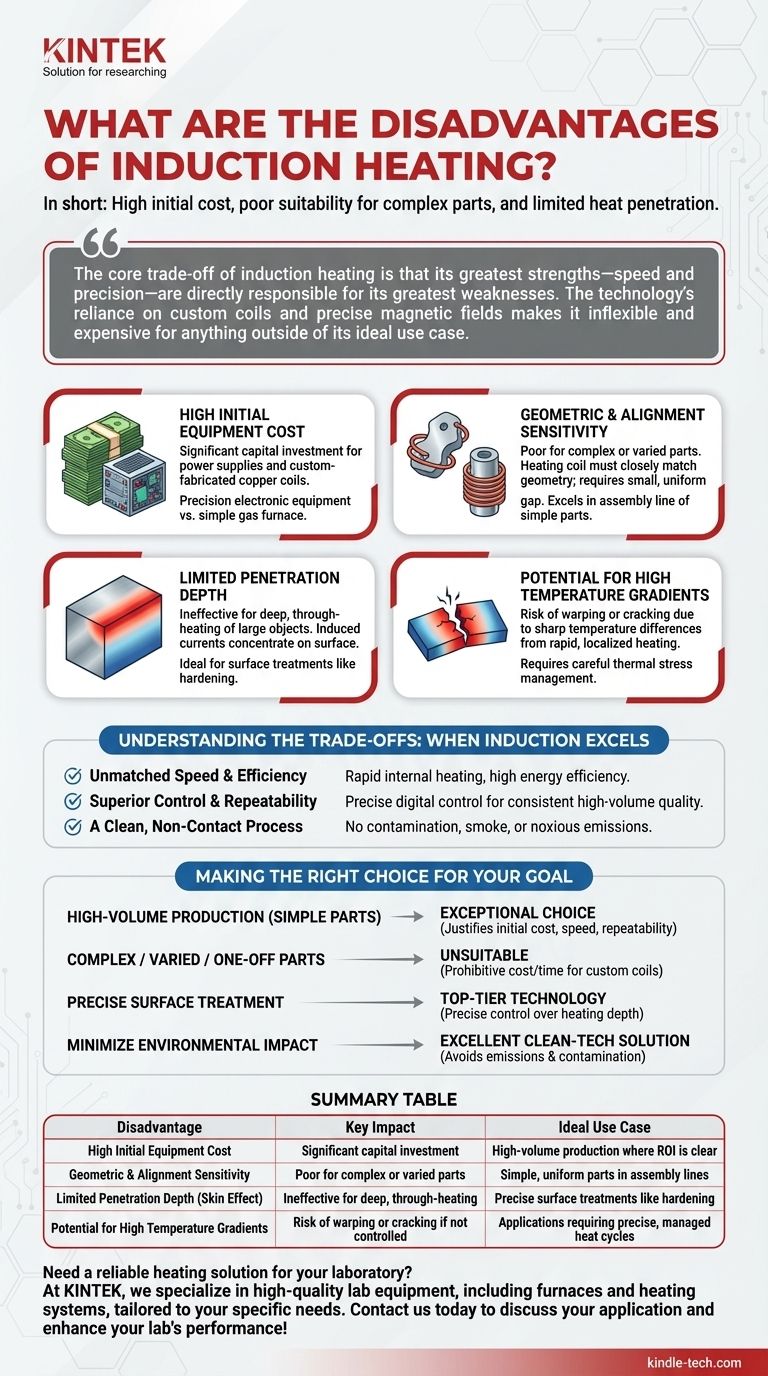
In short, the primary disadvantages of induction heating are its high initial equipment cost, its poor suitability for complex or irregularly shaped parts, and its limited heat penetration depth. These factors make it a highly specialized tool rather than a universal heating solution.

The core trade-off of induction heating is that its greatest strengths—speed and precision—are directly responsible for its greatest weaknesses. The technology's reliance on custom coils and precise magnetic fields makes it inflexible and expensive for anything outside of its ideal use case.
What are the disadvantages of induction heating? High Cost & Geometric Limits Explained

The Core Challenge: Precision Has a Price

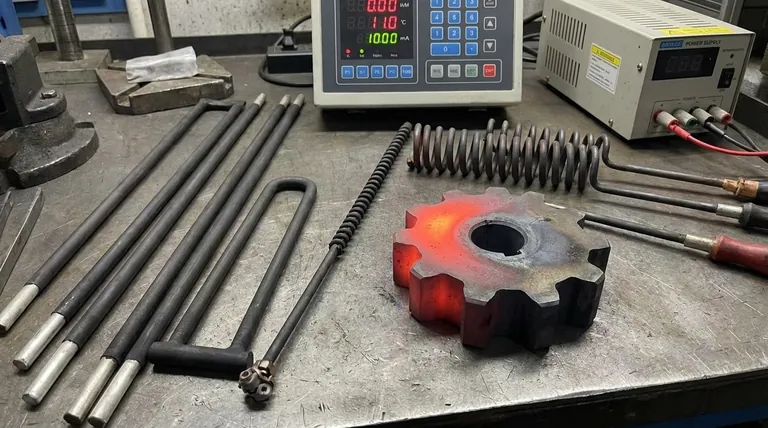
Induction heating works by generating an electromagnetic field that induces electrical currents directly within a conductive workpiece. While this method is incredibly efficient, its physical principles create several practical limitations.

High Initial Equipment Cost

The power supplies and custom-fabricated copper coils required for an induction system represent a significant capital investment. Unlike a simple gas furnace, an induction heater is a piece of precision electronic equipment, and its cost reflects that.

Geometric and Alignment Sensitivity

This is arguably the most significant operational drawback. The heating coil must be designed to closely match the geometry of the part being heated, and the gap between the coil and the part must be small and uniform.

This makes induction heating poorly suited for complicated mechanical workpieces. It excels in assembly line production of simple, uniform parts but lacks the adaptability for low-volume or varied jobs.

Limited Penetration Depth

The induced eddy currents naturally concentrate on the surface of the conductor, a phenomenon known as the "skin effect." This makes induction heating exceptional for surface hardening, brazing, or other treatments where only the outer layer needs heat.

However, it is not an effective method for deep, through-heating of very large or thick metal objects, as the core of the material will remain significantly cooler than the surface.

Potential for High Temperature Gradients

Because heating can be both rapid and highly localized, it can create sharp temperature differences within the workpiece. This thermal stress can lead to warping or even cracking if not carefully managed through proper coil design and power control.

Understanding the Trade-offs: When Induction Excels

To make an informed decision, you must weigh the disadvantages against the technology's profound benefits in the right context.

Unmatched Speed and Efficiency

The heat is generated inside the workpiece itself, not from an external source. This results in extremely rapid heating cycles and higher energy efficiency, as you are not wasting energy heating the surrounding atmosphere or furnace components.

Superior Control and Repeatability

Modern solid-state induction systems offer precise, digital control over the heating cycle. Once a process is dialed in, it can be repeated thousands oftimes with virtually no deviation, ensuring consistent product quality in high-volume manufacturing.

A Clean, Non-Contact Process

The workpiece never touches a flame or heating element, which eliminates product contamination. As a process, it produces no smoke, waste heat, or noxious emissions, making it a "green" technology that contributes to a safer and cleaner work environment.

Making the Right Choice for Your Goal

Ultimately, the choice to use induction heating depends entirely on your specific application and production goals.

  • If your primary focus is high-volume production of simple, uniform parts: Induction heating is an exceptional choice where the initial cost is justified by long-term speed and repeatability.
  • If your primary focus is heating complex, varied, or one-off parts: This technology is likely unsuitable, as the cost and time required for custom coils would be prohibitive.
  • If your primary focus is precise surface treatment (like hardening or brazing): Induction heating is a top-tier, often superior, technology due to its precise control over heating depth.
  • If your primary focus is minimizing environmental impact and contamination: Induction is an excellent clean-tech solution that avoids the emissions and contact-based contamination of alternatives.

Induction heating is a specialist's tool that offers unparalleled performance when applied to the right problem.

Summary Table:

Disadvantage Key Impact Ideal Use Case
High Initial Equipment Cost Significant capital investment High-volume production where ROI is clear
Geometric & Alignment Sensitivity Poor for complex or varied parts Simple, uniform parts in assembly lines
Limited Penetration Depth (Skin Effect) Ineffective for deep, through-heating Precise surface treatments like hardening
Potential for High Temperature Gradients Risk of warping or cracking if not controlled Applications requiring precise, managed heat cycles

Need a reliable heating solution for your laboratory? Choosing the right equipment is critical for efficiency and product quality. At KINTEK, we specialize in providing high-quality lab equipment, including furnaces and heating systems, tailored to your specific needs. Whether you're focused on high-volume production or complex, one-off projects, our experts can help you find the perfect solution to enhance your lab's performance and ensure consistent results. Contact us today to discuss your application and discover how KINTEK can support your laboratory's success!

Visual Guide
What are the disadvantages of induction heating? High Cost & Geometric Limits Explained Visual Guide

Related Products

People Also Ask

Related Products

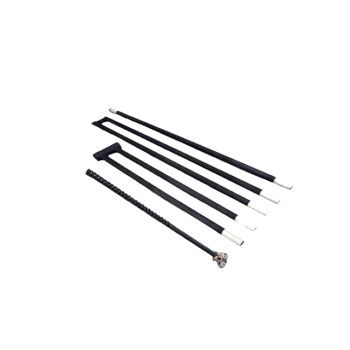
Silicon Carbide SiC Thermal Heating Elements for Electric Furnace

Silicon Carbide SiC Thermal Heating Elements for Electric Furnace

Experience the advantages of Silicon Carbide (SiC) Heating Element: Long service life, high corrosion and oxidation resistance, fast heating speed, and easy maintenance. Learn more now!

HFCVD Machine System Equipment for Drawing Die Nano-Diamond Coating

HFCVD Machine System Equipment for Drawing Die Nano-Diamond Coating

The nano-diamond composite coating drawing die uses cemented carbide (WC-Co) as the substrate, and uses the chemical vapor phase method ( CVD method for short ) to coat the conventional diamond and nano-diamond composite coating on the surface of the inner hole of the mold.

Anti-Cracking Press Mold for Lab Use

Anti-Cracking Press Mold for Lab Use

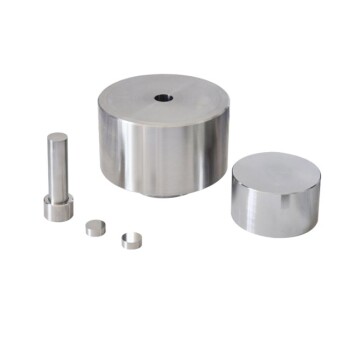
The anti-cracking press mold is a specialized equipment designed for molding various shapes and sizes of film using high pressure and electric heating.

Engineering Advanced Fine Ceramics Aluminum Oxide Al2O3 Heat Sink for Insulation

Engineering Advanced Fine Ceramics Aluminum Oxide Al2O3 Heat Sink for Insulation

The hole structure of the ceramic heat sink increases the heat dissipation area in contact with the air, which greatly enhances the heat dissipation effect, and the heat dissipation effect is better than that of super copper and aluminum.

Laboratory Test Sieves and Sieving Machines

Laboratory Test Sieves and Sieving Machines

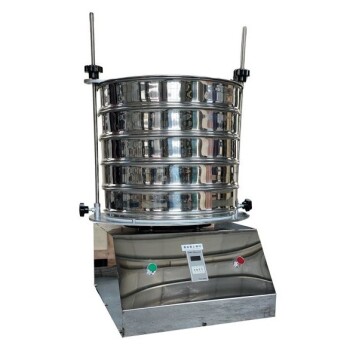
Precision lab test sieves & sieving machines for accurate particle analysis. Stainless steel, ISO-compliant, 20μm-125mm range. Request specs now!

915MHz MPCVD Diamond Machine Microwave Plasma Chemical Vapor Deposition System Reactor

915MHz MPCVD Diamond Machine Microwave Plasma Chemical Vapor Deposition System Reactor

915MHz MPCVD Diamond Machine and its multi-crystal effective growth, the maximum area can reach 8 inches, the maximum effective growth area of single crystal can reach 5 inches. This equipment is mainly used for the production of large-size polycrystalline diamond films, the growth of long single crystal diamonds, the low-temperature growth of high-quality graphene, and other materials that require energy provided by microwave plasma for growth.

Laboratory Sterilizer Lab Autoclave Vertical Pressure Steam Sterilizer for Liquid Crystal Display Automatic Type

Laboratory Sterilizer Lab Autoclave Vertical Pressure Steam Sterilizer for Liquid Crystal Display Automatic Type

Liquid crystal display automatic vertical sterilizer is a safe, reliable and automatic control sterilization equipment, which is composed of heating system, microcomputer control system and overheating and overvoltage protection system.

Laboratory Sterilizer Lab Autoclave Pulse Vacuum Lifting Sterilizer

Laboratory Sterilizer Lab Autoclave Pulse Vacuum Lifting Sterilizer

The pulse vacuum lifting sterilizer is a state-of-the-art equipment for efficient and precise sterilization. It uses pulsating vacuum technology, customizable cycles, and a user-friendly design for easy operation and safety.

High-Purity Titanium Foil and Sheet for Industrial Applications

High-Purity Titanium Foil and Sheet for Industrial Applications

Titanium is chemically stable, with a density of 4.51g/cm3, which is higher than aluminum and lower than steel, copper, and nickel, but its specific strength ranks first among metals.

Graphite Vacuum Furnace IGBT Experimental Graphitization Furnace

Graphite Vacuum Furnace IGBT Experimental Graphitization Furnace

IGBT experimental graphitization furnace, a tailored solution for universities and research institutions, with high heating efficiency, user-friendliness, and precise temperature control.

Benchtop Laboratory Vacuum Freeze Dryer

Benchtop Laboratory Vacuum Freeze Dryer

Benchtop laboratory freeze dryer for efficient lyophilization of biological, pharmaceutical, and food samples. Features intuitive touchscreen, high-performance refrigeration, and durable design. Preserve sample integrity—consult now!

Small Vacuum Heat Treat and Tungsten Wire Sintering Furnace

Small Vacuum Heat Treat and Tungsten Wire Sintering Furnace

The small vacuum tungsten wire sintering furnace is a compact experimental vacuum furnace specially designed for universities and scientific research institutes. The furnace features a CNC welded shell and vacuum piping to ensure leak-free operation. Quick-connect electrical connections facilitate relocation and debugging, and the standard electrical control cabinet is safe and convenient to operate.

Vacuum Hot Press Furnace Machine for Lamination and Heating

Vacuum Hot Press Furnace Machine for Lamination and Heating

Experience clean and precise lamination with Vacuum Lamination Press. Perfect for wafer bonding, thin-film transformations, and LCP lamination. Order now!

Laboratory Vibratory Sieve Shaker Machine Slap Vibrating Sieve

Laboratory Vibratory Sieve Shaker Machine Slap Vibrating Sieve

KT-T200TAP is a slapping and oscillating sieving instrument for laboratory desktop use, with 300 rpm horizontal circular motion and 300 vertical slapping motions to simulate manual sieving to help sample particles pass through better.

High Energy Planetary Ball Mill Milling Machine for Laboratory

High Energy Planetary Ball Mill Milling Machine for Laboratory

Experience fast and effective sample processing with the F-P2000 high-energy planetary ball mill. This versatile equipment offers precise control and excellent grinding capabilities. Perfect for laboratories, it features multiple grinding bowls for simultaneous testing and high output. Achieve optimal results with its ergonomic design, compact structure, and advanced features. Ideal for a wide range of materials, it ensures consistent particle size reduction and low maintenance.

Laboratory Planetary Ball Mill Cabinet Planetary Ball Milling Machine

Laboratory Planetary Ball Mill Cabinet Planetary Ball Milling Machine

The vertical cabinet structure combined with ergonomic design enables users to obtain the best comfortable experience in standing operation. The maximum processing capacity is 2000ml, and the speed is 1200 revolutions per minute.

High Energy Planetary Ball Mill Machine for Laboratory Horizontal Tank Type

High Energy Planetary Ball Mill Machine for Laboratory Horizontal Tank Type

The KT-P2000H uses a unique Y-axis planetary trajectory, and utilizes the collision, friction and gravity between the sample and the grinding ball.

Vacuum Dental Porcelain Sintering Furnace

Vacuum Dental Porcelain Sintering Furnace

Get precise and reliable results with KinTek's Vacuum Porcelain Furnace. Suitable for all porcelain powders, it features hyperbolic ceramic furnace function, voice prompt, and automatic temperature calibration.

High Energy Vibratory Laboratory Ball Mill Grinding Mill Single Tank Type

High Energy Vibratory Laboratory Ball Mill Grinding Mill Single Tank Type

High-energy vibration ball mill is a small desktop laboratory grinding instrument.It can be ball-milled or mixed with different particle sizes and materials by dry and wet methods.

Benchtop Laboratory Freeze Dryer for Lab Use

Benchtop Laboratory Freeze Dryer for Lab Use

Premium benchtop laboratory freeze dryer for lyophilization, preserving samples with ≤ -60°C cooling. Ideal for pharmaceuticals & research.


Leave Your Message