Knowledge What are the failures of heat treatment? Predict and Prevent Cracking, Warping, and Soft Spots
Author avatar

Tech Team · Kintek Solution

Updated 6 days ago

What are the failures of heat treatment? Predict and Prevent Cracking, Warping, and Soft Spots


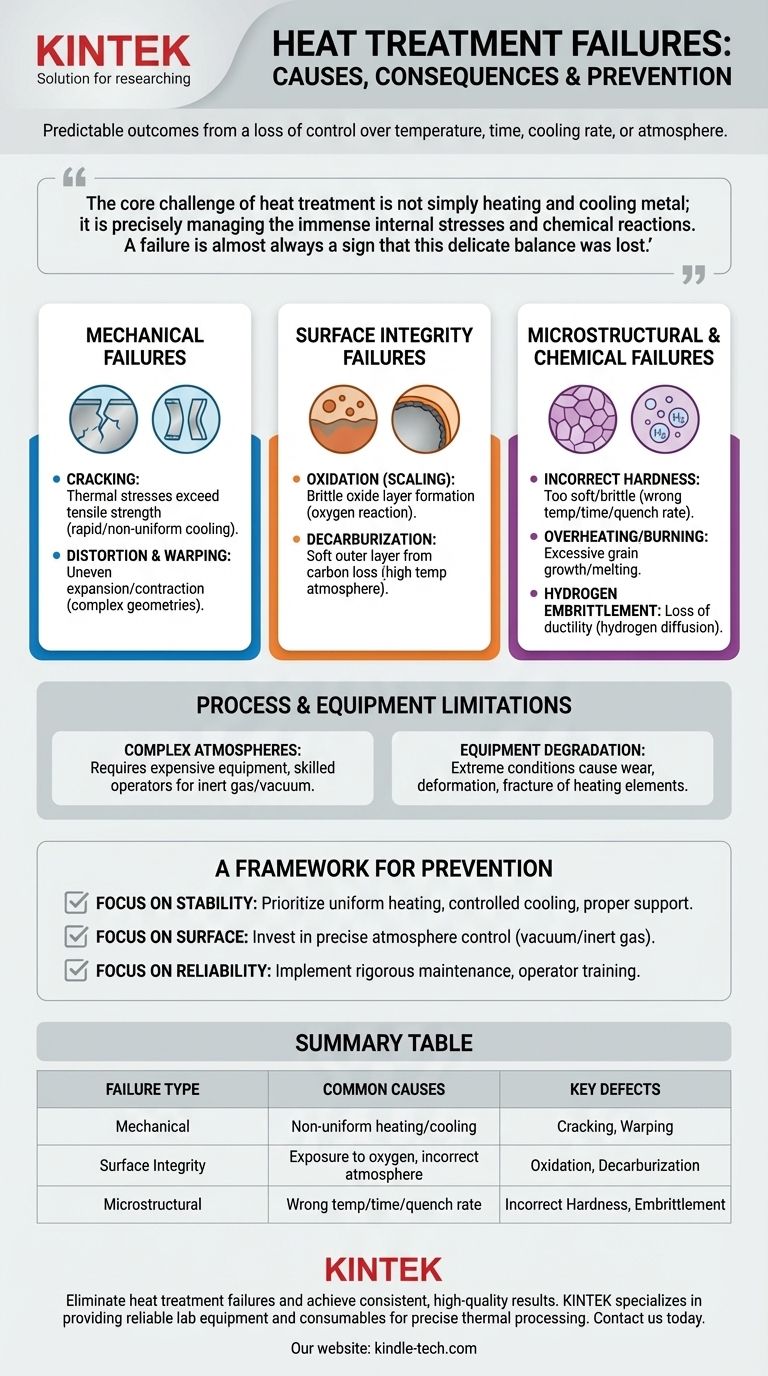
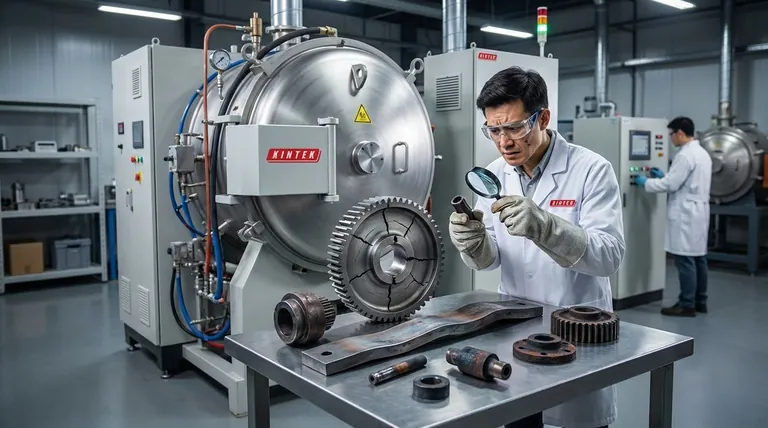
Ultimately, failures in heat treatment are not random occurrences but predictable outcomes resulting from a loss of control over temperature, time, cooling rate, or atmosphere. The most common failures manifest as physical defects like cracking and warping, or as metallurgical defects such as incorrect hardness, soft spots, and embrittlement, all of which compromise the integrity and performance of the final component.

The core challenge of heat treatment is not simply heating and cooling metal; it is precisely managing the immense internal stresses and chemical reactions that occur during the process. A failure is almost always a sign that this delicate balance was lost, leading to a component that fails to meet its engineering requirements.
What are the failures of heat treatment? Predict and Prevent Cracking, Warping, and Soft Spots

The Sources of Heat Treatment Failure

Heat treatment failures can be categorized into three main areas: mechanical, surface-level, and microstructural. Each stems from a specific deviation in the tightly controlled treatment process.

Mechanical Failures: Cracking and Distortion

Cracking is the most catastrophic failure. It occurs when thermal stresses, induced by rapid or non-uniform heating and cooling, exceed the material's tensile strength.

Distortion and warping are less severe but very common. This happens when different sections of a part expand or contract at different rates, creating internal stresses that permanently change the component's shape. Complex geometries with both thick and thin sections are especially vulnerable.

Surface Integrity Failures: Oxidation and Decarburization

Oxidation, or scaling, is the formation of a brittle, flaky oxide layer on the material's surface. This occurs when the hot metal reacts with oxygen in the furnace atmosphere, leading to material loss and a poor surface finish.

Decarburization is the loss of carbon from the surface of steel. This creates a soft outer layer, which is detrimental for parts requiring high wear resistance and surface hardness. It's caused by a reaction with the furnace atmosphere at high temperatures.

Microstructural and Chemical Failures

Incorrect hardness is a common failure where the material ends up too soft or too brittle. This results from failing to reach the correct austenitizing temperature, not holding it for the required time, or using a quenching rate that is too fast or too slow for the desired microstructure (e.g., forming pearlite instead of martensite).

Overheating or burning occurs if the temperature is too high. This causes excessive grain growth or even melting at the grain boundaries, which severely weakens the material and cannot be corrected.

Hydrogen embrittlement is a chemical failure where hydrogen atoms diffuse into the metal lattice, causing a significant loss of ductility and toughness. As noted in process documentation, this is a known risk when treating certain steels in atmospheres with a high hydrogen content.

Understanding the Trade-offs: Process and Equipment Limitations

Preventing the failures above requires sophisticated equipment and processes, but these systems introduce their own set of challenges and potential points of failure.

The Complexity of Controlled Atmospheres

To prevent oxidation and decarburization, furnaces often use a controlled atmosphere (e.g., inert gas) or a vacuum. However, this solution comes with trade-offs.

Atmosphere control systems involve complicated equipment, a large initial investment, and require highly skilled operators to manage gas mixtures and pressures effectively.

The Inevitability of Equipment Degradation

The extreme conditions inside a furnace cause wear and tear on the equipment itself. This degradation can directly lead to process failures.

For example, electric heating elements in vacuum heat treatment furnaces are under constant thermal stress. Over time, they can suffer from high-temperature deformation, fracture, or even volatilization, leading to uneven heating and failed treatment cycles.

A Framework for Preventing Heat Treatment Failures

Successfully heat-treating a component requires a holistic approach that considers the material, the geometry, and the process limitations. Use these guidelines to align your strategy with your primary goal.

  • If your primary focus is dimensional stability and preventing cracks: Prioritize uniform heating, controlled cooling rates, and proper support of the part within the furnace to minimize thermal gradients.
  • If your primary focus is achieving specific surface hardness and finish: Invest in precise atmosphere control (vacuum or inert/reactive gases) to prevent decarburization and oxidation.
  • If your primary focus is process reliability and consistency: Implement a rigorous equipment maintenance schedule and invest in comprehensive operator training to mitigate equipment failure and human error.

By understanding these failure modes, you can transform heat treatment from an operational risk into a predictable and powerful engineering tool.

Summary Table:

Failure Type Common Causes Key Defects
Mechanical Non-uniform heating/cooling Cracking, Warping
Surface Integrity Exposure to oxygen, incorrect atmosphere Oxidation, Decarburization
Microstructural Wrong temperature/time/quench rate Incorrect Hardness, Embrittlement

Eliminate heat treatment failures and achieve consistent, high-quality results.

KINTEK specializes in providing reliable lab equipment and consumables for precise thermal processing. Our furnaces and atmosphere control systems are designed to help you maintain the critical balance of temperature, time, and atmosphere, preventing common failures like cracking and decarburization.

Contact us today to discuss how our solutions can enhance your laboratory's capabilities and ensure your heat treatment processes are a predictable success.

Get in Touch with Our Experts

Visual Guide

What are the failures of heat treatment? Predict and Prevent Cracking, Warping, and Soft Spots Visual Guide

Related Products

People Also Ask

Related Products

Molybdenum Vacuum Heat Treat Furnace

Molybdenum Vacuum Heat Treat Furnace

Discover the benefits of a high-configuration molybdenum vacuum furnace with heat shield insulation. Ideal for high-purity, vacuum environments like sapphire crystal growth and heat treatment.

Vacuum Heat Treat Furnace with Ceramic Fiber Liner

Vacuum Heat Treat Furnace with Ceramic Fiber Liner

Vacuum furnace with polycrystalline ceramic fiber insulation liner for excellent heat insulation and uniform temperature field. Choose from 1200℃ or 1700℃ max. working temperature with high vacuum performance and precise temperature control.

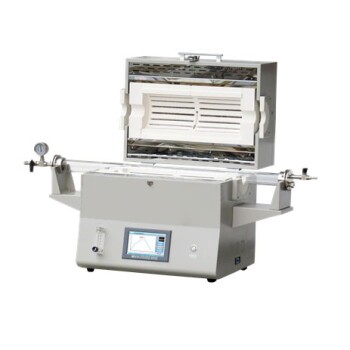
1400℃ Laboratory Quartz Tube Furnace with Alumina Tube Tubular Furnace

1400℃ Laboratory Quartz Tube Furnace with Alumina Tube Tubular Furnace

Looking for a tube furnace for high-temperature applications? Our 1400℃ Tube Furnace with Alumina Tube is perfect for research and industrial use.

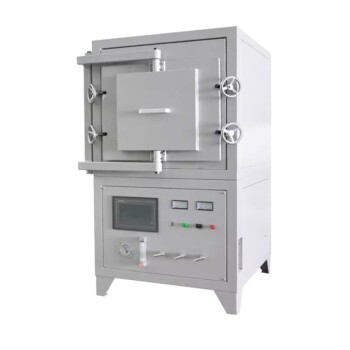
Vacuum Heat Treat Sintering Brazing Furnace

Vacuum Heat Treat Sintering Brazing Furnace

A vacuum brazing furnace is a type of industrial furnace used for brazing, a metalworking process that joins two pieces of metal using a filler metal that melts at a lower temperature than the base metals. Vacuum brazing furnaces are typically used for high-quality applications where a strong, clean joint is required.

Laboratory Muffle Oven Furnace Bottom Lifting Muffle Furnace

Laboratory Muffle Oven Furnace Bottom Lifting Muffle Furnace

Efficiently produce batches with excellent temperature uniformity using our Bottom Lifting Furnace. Features two electric lifting stages and advanced temperature control up to 1600℃.

2200 ℃ Tungsten Vacuum Heat Treat and Sintering Furnace

2200 ℃ Tungsten Vacuum Heat Treat and Sintering Furnace

Experience the ultimate refractory metal furnace with our Tungsten vacuum furnace. Capable of reaching 2200℃, perfect for sintering advanced ceramics and refractory metals. Order now for high-quality results.

High Pressure Laboratory Vacuum Tube Furnace Quartz Tubular Furnace

High Pressure Laboratory Vacuum Tube Furnace Quartz Tubular Furnace

KT-PTF High Pressure Tube Furnace: Compact split tube furnace with strong positive pressure resistance. Working temp up to 1100°C and pressure up to 15Mpa. Also works under controller atmosphere or high vacuum.

1700℃ Laboratory Quartz Tube Furnace with Alumina Tube Tubular Furnace

1700℃ Laboratory Quartz Tube Furnace with Alumina Tube Tubular Furnace

Looking for a high-temperature tube furnace? Check out our 1700℃ Tube Furnace with Alumina Tube. Perfect for research and industrial applications up to 1700C.

Vacuum Heat Treat and Molybdenum Wire Sintering Furnace for Vacuum Sintering

Vacuum Heat Treat and Molybdenum Wire Sintering Furnace for Vacuum Sintering

A vacuum molybdenum wire sintering furnace is a vertical or bedroom structure, which is suitable for withdrawal, brazing, sintering and degassing of metal materials under high vacuum and high temperature conditions. It is also suitable for dehydroxylation treatment of quartz materials.

Vacuum Heat Treat and Sintering Furnace with 9MPa Air Pressure

Vacuum Heat Treat and Sintering Furnace with 9MPa Air Pressure

The air pressure sintering furnace is a high-tech equipment commonly used for the sintering of advanced ceramic materials. It combines vacuum sintering and pressure sintering techniques to achieve high-density and high-strength ceramics.

High Temperature Muffle Oven Furnace for Laboratory Debinding and Pre Sintering

High Temperature Muffle Oven Furnace for Laboratory Debinding and Pre Sintering

KT-MD High temperature debinding and pre-sintering furnace for ceramic materials with various molding processes. Ideal for electronic components such as MLCC and NFC.

Vertical High Temperature Graphite Vacuum Graphitization Furnace

Vertical High Temperature Graphite Vacuum Graphitization Furnace

Vertical high temperature graphitization furnace for carbonization and graphitization of carbon materials up to 3100℃.Suitable for shaped graphitization of carbon fiber filaments and other materials sintered in a carbon environment.Applications in metallurgy, electronics, and aerospace for producing high-quality graphite products like electrodes and crucibles.

Vertical Laboratory Quartz Tube Furnace Tubular Furnace

Vertical Laboratory Quartz Tube Furnace Tubular Furnace

Elevate your experiments with our Vertical Tube Furnace. Versatile design allows for operation under various environments and heat treatment applications. Order now for precise results!

Vacuum Hot Press Furnace Heated Vacuum Press Machine Tube Furnace

Vacuum Hot Press Furnace Heated Vacuum Press Machine Tube Furnace

Reduce forming pressure & shorten sintering time with Vacuum Tube Hot Press Furnace for high-density, fine-grain materials. Ideal for refractory metals.

1200℃ Split Tube Furnace with Quartz Tube Laboratory Tubular Furnace

1200℃ Split Tube Furnace with Quartz Tube Laboratory Tubular Furnace

KT-TF12 split tube furnace: high-purity insulation, embedded heating wire coils, and max. 1200C. Widely used for new materials and chemical vapour deposition.

1700℃ Controlled Atmosphere Furnace Nitrogen Inert Atmosphere Furnace

1700℃ Controlled Atmosphere Furnace Nitrogen Inert Atmosphere Furnace

KT-17A Controlled atmosphere furnace: 1700℃ heating, vacuum sealing technology, PID temperature control, and versatile TFT smart touch screen controller for laboratory and industrial use.

600T Vacuum Induction Hot Press Furnace for Heat Treat and Sintering

600T Vacuum Induction Hot Press Furnace for Heat Treat and Sintering

Discover the 600T Vacuum Induction Hot Press Furnace, designed for high-temperature sintering experiments in vacuum or protected atmospheres. Its precise temperature and pressure control, adjustable working pressure, and advanced safety features make it ideal for nonmetal materials, carbon composites, ceramics, and metal powders.

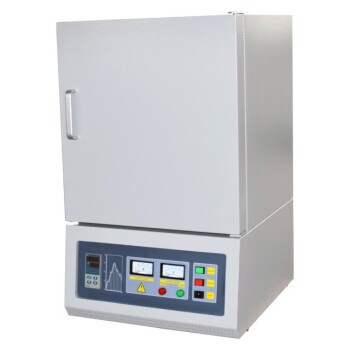
1800℃ Muffle Oven Furnace for Laboratory

1800℃ Muffle Oven Furnace for Laboratory

KT-18 muffle furnace with Japan Al2O3 polycrystalline fibe and Silicon Molybdenum heating element, up to 1900℃, PID temperature control and 7" smart touch screen. Compact design, low heat loss, and high energy efficiency. Safety interlock system and versatile functions.

1700℃ Muffle Oven Furnace for Laboratory

1700℃ Muffle Oven Furnace for Laboratory

Get superior heat control with our 1700℃ Muffle Furnace. Equipped with intelligent temperature microprocessor, TFT touch screen controller & advanced insulation materials for precise heating up to 1700C. Order now!

1200℃ Controlled Atmosphere Furnace Nitrogen Inert Atmosphere Furnace

1200℃ Controlled Atmosphere Furnace Nitrogen Inert Atmosphere Furnace

Discover our KT-12A Pro Controlled atmosphere furnace - high precision, heavy duty vacuum chamber, versatile smart touch screen controller, and excellent temperature uniformity up to 1200C. Ideal for both laboratory and industrial application.


Leave Your Message