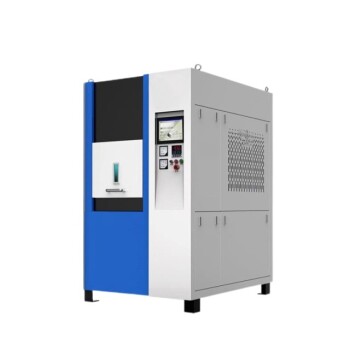
DC sputtering is primarily valued for its mechanical simplicity and efficiency in coating conductive materials. It stands out as a robust technique that excels when processing large quantities of large substrates, offering significantly high deposition rates for pure metal targets.
Core Takeaway While sophisticated variations of physical vapor deposition exist, DC sputtering remains the industry standard for conductive coatings. Its dominance stems from a unique ability to combine high-speed production with the scalability required for large industrial applications.
Operational Simplicity and Scale
Ideal for Large-Scale Processing
According to industry standards, DC sputtering is particularly advantageous for processing large quantities of large substrates.
Because the architecture is less complex than radio frequency (RF) alternatives, it is easier to scale the machinery up for industrial batches without sacrificing performance.
Streamlined System Design
The technique is fundamentally considered a simple process.
This mechanical simplicity translates to easier maintenance and operation, making it a reliable choice for manufacturing environments where uptime is critical.
Speed and Efficiency
High Deposition Rates
One of the distinct advantages of DC sputtering is its ability to achieve a high deposition rate, specifically when using pure metal sputtering targets.
This speed is crucial for cost-effective manufacturing, as it reduces the cycle time required to achieve the desired film thickness.
High Throughput Capability
Due to these fast deposition rates, the technology is highly suitable for high-throughput applications.
It allows manufacturers to maintain rapid production schedules while ensuring consistent coating coverage across extensive surface areas.
Film Integrity and Structure
Superior Uniformity
Beyond speed, the process creates neat, evenly deposited films.
This uniformity leads to improved yield rates, as fewer parts are rejected due to uneven coating or coverage defects.
High Purity and Density
The resulting films are characterized by high purity and high density.
The impact energy involved in the sputtering process ensures the films are compact, with excellent adhesion to the substrate, often resulting in moderate to high film stress which can be beneficial for durability.
Understanding the Trade-offs
The Conductivity Requirement
It is critical to note that standard DC sputtering generally requires the target material to be electrically conductive.
While the supplementary data mentions dielectrics, standard DC sputtering is optimized for metals; attempting to sputter insulators can lead to charge buildup and arcing (usually requiring RF sputtering instead).
Thermal Considerations
While the technique can be used on heat-sensitive substrates, the high kinetic energy involved can generate significant heat.
Operators must carefully manage deposition rates and cooling systems to prevent thermal damage to delicate substrate materials during high-rate processes.
Making the Right Choice for Your Goal
To determine if DC sputtering is the correct solution for your specific application, consider your primary objectives:
- If your primary focus is Industrial Scalability: Choose DC sputtering for its proven ability to handle large substrates and high-volume batches efficiently.
- If your primary focus is Cost and Speed: Leverage DC sputtering for its mechanical simplicity and high deposition rates, particularly for pure metal coatings.
- If your primary focus is Coating Insulators: Re-evaluate standard DC sputtering, as you may require RF sputtering or pulsed DC techniques to avoid charge accumulation.
DC sputtering offers the most direct path to high-quality metal film deposition when scalability and throughput are your defining metrics.
Summary Table:
| Feature | Advantage | Benefit |
|---|---|---|
| Deposition Rate | Extremely High | Faster cycle times and cost-effective manufacturing |
| Scalability | High-Volume Batches | Ideal for large substrates and industrial-scale production |
| System Design | Mechanical Simplicity | Easier maintenance, high uptime, and streamlined operation |
| Film Quality | High Density & Purity | Superior adhesion, uniformity, and enhanced coating durability |
| Target Material | Conductive Metals | Optimized for pure metals like gold, silver, and copper |
Maximize Your Thin-Film Production with KINTEK
Are you looking to scale your industrial coating processes with precision and speed? KINTEK specializes in advanced laboratory equipment and high-performance sputtering solutions. Whether you require high-throughput DC sputtering systems, vacuum furnaces, or precision crushing and milling equipment, we provide the tools necessary to ensure high-density, uniform results every time.
From high-temperature furnaces and vacuum systems to specialized PTFE and ceramic consumables, KINTEK is the trusted partner for researchers and manufacturers worldwide. Let our experts help you select the perfect configuration for your conductive or dielectric coating needs.
Ready to enhance your lab's efficiency? Contact KINTEK today to discuss your custom solution!
Related Products
- Spark Plasma Sintering Furnace SPS Furnace
- Vacuum Induction Melting Spinning System Arc Melting Furnace
- Circulating Water Vacuum Pump for Laboratory and Industrial Use
People Also Ask
- What is SPS sintering method? A Guide to High-Speed, High-Performance Material Fabrication
- Why are Spark Plasma Sintering (SPS) furnaces or hot presses utilized in the preparation of Li3PS4 solid electrolytes?
- What is the difference between spark plasma sintering and flash sintering? A Guide to Advanced Sintering Methods
- What technical advantages does a Spark Plasma Sintering (SPS) furnace offer for LZP ceramics? Enhance Ionic Conductivity
- What is the theory of spark plasma sintering? A Guide to Rapid, Low-Temperature Densification