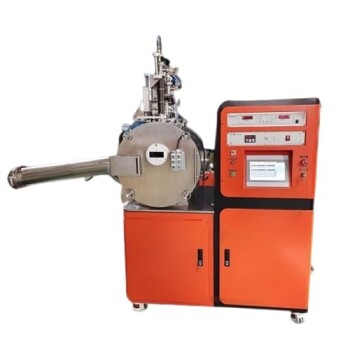
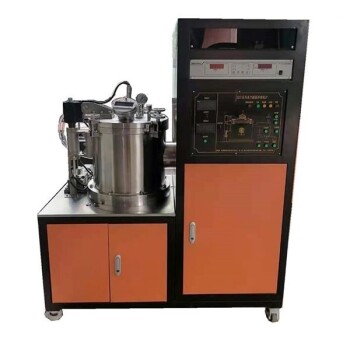
The primary advantage of a Vacuum Plasma Arc Melting Furnace is its ability to generate extreme localized heat while maintaining a pristine environment. This specific combination allows for the rapid, complete melting of refractory metals like Uranium, Zirconium, and Niobium (U-Zr-Nb) without compromising their chemical integrity. By operating in a vacuum or inert atmosphere, the system eliminates the risk of oxidation and impurity uptake that typically plagues the processing of these highly reactive nuclear metals.
The system’s core value lies in its integration of a non-consumable electrode and a water-cooled copper crucible within a vacuum chamber. This configuration ensures that the U-Zr-Nb alloy achieves high purity and precise compositional control, as it prevents the molten metal from reacting with oxygen or the containment vessel itself.
Overcoming the Challenges of Refractory Alloys
Achieving Extreme Localized Temperatures
Refractory metals such as zirconium and niobium possess exceptionally high melting points.
To process these materials, the furnace utilizes a plasma arc to generate extremely high localized temperatures. This intensity is required to rapidly transition the metals from solid to liquid, ensuring a complete and homogenous melt.
Preventing Oxidation and Impurities
Uranium, zirconium, and niobium are "active" nuclear metals, meaning they aggressively react with oxygen and other atmospheric gases at high temperatures.
The furnace mitigates this by operating under a controlled vacuum or inert atmosphere. This environmental isolation acts as a shield, preventing the formation of oxides and ensuring the material retains its intended chemical properties.
Ensuring Structural Integrity and Composition
The Role of the Water-Cooled Crucible
In many melting processes, the container (crucible) can degrade and contaminate the alloy, especially at the temperatures required for refractory metals.
This furnace employs a water-cooled copper crucible. The active cooling prevents the crucible from melting or reacting with the alloy, thereby eliminating a major source of potential impurities.
Precision Through Non-Consumable Electrodes
The system utilizes a non-consumable electrode system.
Unlike consumable electrodes that melt into the bath, this system provides the necessary energy arc without adding foreign material to the mix. This is critical for maintaining the precise compositional control required for nuclear-grade alloys.
Understanding the Trade-offs
Specificity vs. Versatility
This furnace is a highly specialized tool designed for high-value, reactive materials.
It is not intended for general-purpose melting of low-temperature metals. The complexity of the vacuum and cooling systems is justified only when material purity and high melting points are the absolute priorities.
Processing Complexity
The requirement for a vacuum or inert environment introduces operational complexity.
Strict control over the atmosphere must be maintained throughout the cycle. Any breach in the vacuum integrity or inert gas purity will immediately compromise the quality of the reactive U-Zr-Nb alloy.
Making the Right Choice for Your Goal
To determine if this furnace architecture aligns with your specific metallurgical requirements, consider the following:
- If your primary focus is Material Purity: The vacuum or inert atmosphere combined with the water-cooled crucible provides the highest level of protection against oxidation and crucible contamination.
- If your primary focus is Refractory Melting: The plasma arc's ability to generate extreme localized heat is essential for fully melting metals with high melting points like niobium and zirconium.
For the preparation of U-Zr-Nb, this technology offers the only reliable method to achieve a homogenous, contaminant-free alloy suitable for nuclear applications.
Summary Table:
| Feature | Benefit for U-Zr-Nb Alloys |
|---|---|
| Plasma Arc Heat | Generates extreme localized temperatures required to melt high-melting-point refractory metals like Niobium. |
| Vacuum/Inert Environment | Prevents oxidation and impurity uptake in highly reactive nuclear metals (Uranium, Zirconium). |
| Water-Cooled Copper Crucible | Eliminates crucible contamination by preventing reactions between the molten metal and the container. |
| Non-Consumable Electrode | Ensures precise compositional control by providing heat without adding foreign material to the melt. |
Elevate Your Nuclear & Refractory Material Research with KINTEK
Precision and purity are non-negotiable when dealing with high-value reactive metals. KINTEK specializes in advanced laboratory solutions designed to meet the most rigorous metallurgical standards. From our high-performance vacuum and induction melting furnaces to our specialized high-temperature high-pressure reactors, we provide the tools necessary for homogenous, contaminant-free results.
Whether you are refining U-Zr-Nb alloys or developing next-generation ceramics, our comprehensive portfolio—including crushing systems, hydraulic presses, and high-purity crucibles—is engineered for excellence.
Ready to optimize your lab’s thermal processing? Contact KINTEK today to discuss your specific requirements and discover how our expert solutions can accelerate your research.
References
- Aílton da Silva Ferreira, Andrea Paesano Júnior. Synthesis and Structural Characterization of U-Zr-Nb Alloys. DOI: 10.1590/1980-5373-mr-2017-0411
This article is also based on technical information from Kintek Solution Knowledge Base .
Related Products
- Vacuum Arc Induction Melting Furnace
- Vacuum Induction Melting Spinning System Arc Melting Furnace
- Non Consumable Vacuum Arc Induction Melting Furnace
- Vacuum Heat Treat Furnace and Levitation Induction Melting Furnace
- Lab-Scale Vacuum Induction Melting Furnace
People Also Ask
- How do vacuum induction or arc melting furnaces facilitate the synthesis of U-Al-C MAX phases? Precision Heat & Purity
- What core role does a Vacuum Induction Melting furnace play in nickel-free steel production? Achieve High-Purity Alloys
- What is the function of a vacuum arc melting furnace? Master Homogeneity for Amorphous Alloy Ribbons
- What is the primary function of a vacuum arc melting furnace in RHEA preparation? Achieving Extreme Thermal Fusion
- What is the function of vacuum arc melting equipment? Creating High-Purity Ferrochrome (CrFe) Alloys