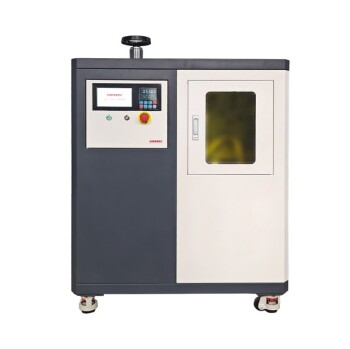
The primary function of a precision hot press in Thallium Bromide (TlBr) production is to transform purified raw material into dense, structurally uniform crystals through a process of thermal-mechanical coupling. By applying a constant pressure of approximately 30 kN at controlled temperatures between 455°C and 465°C, the equipment shapes the material while simultaneously determining its internal physical quality.
Core Takeaway The hot press does more than simply shape the crystal; it utilizes the synergy of high pressure and high temperature to eliminate residual internal stresses and control crystal orientation. This step is fundamental to converting raw TlBr into a semiconductor grade material capable of high-energy resolution and efficient photon counting.
The Mechanics of Crystal Formation
Thermal-Mechanical Coupling
The hot press operates on the principle of applying simultaneous thermal and mechanical energy. This dual action facilitates plastic flow and particle bonding, allowing the raw material to achieve full densification within a mold.
Precision Parameter Control
Success depends on maintaining a highly specific environment. The equipment maintains a constant pressure of 30 kN and a temperature range of 455°C to 465°C for a duration of several hours.
Geometric Accuracy
This process transforms loose or bulk purified material into specific, reproducible dimensions. For example, it is capable of producing precise 2 mm x 2 mm x 2.5 mm crystal specimens with high geometric accuracy.
Optimizing Internal Material Properties
Eliminating Internal Stress
One of the most critical functions of the hot press is the removal of residual internal stresses. By maintaining stable pressure and temperature over time, the equipment ensures the resulting crystal structure is relaxed and mechanically stable.
Controlling Crystal Orientation
The hot pressing process directly dictates the orientation of the crystals. Proper orientation is essential for ensuring uniform charge transport properties throughout the material.
Ensuring Structural Consistency
The process eliminates microscopic defects and ensures density is uniform throughout the depth of the crystal. This creates a high-density bulk crystal that is free from voids or structural inconsistencies.
Impact on Detector Performance
Enhancing Energy Resolution
The structural integrity gained from hot pressing leads directly to better spectral performance. The resulting crystals exhibit superior energy resolution, allowing for more precise identification of radiation sources.
Improving Detection Efficiency
By optimizing density and orientation, the process improves the material's gamma-ray attenuation coefficient. This results in higher detection efficiency, particularly for photon-counting applications.
Critical Process Trade-offs
The Necessity of Stability
The benefits of hot pressing are entirely dependent on the stability of the applied force and temperature. Fluctuations outside the 455-465°C window or variations in the 30 kN pressure can fail to relieve stress, potentially introducing new defects or inconsistent densities.
Balancing Time and compaction
The process requires a duration of "several hours" (typically around 2 hours) to be effective. Rushing this dwell time can result in incomplete densification, while excessive processing may yield diminishing returns on crystal quality.
Making the Right Choice for Your Goal
To maximize the utility of the hot pressing process in your TlBr fabrication line:
- If your primary focus is Physical Durability: Prioritize the stress elimination phase by ensuring the cooling cycle is as controlled as the heating cycle to prevent re-introducing thermal shock.
- If your primary focus is Electrical Performance: Focus on the crystal orientation controls, as this directly influences charge collection efficiency and the ability to resolve peak spectra (such as at 662 keV).
Precision hot pressing is the defining step that turns purified chemical compounds into functional, high-performance semiconductor devices.
Summary Table:
| Feature | Precision Requirement | Impact on TlBr Performance |
|---|---|---|
| Temperature Range | 455°C - 465°C | Ensures plastic flow and particle bonding |
| Applied Pressure | Constant 30 kN | Eliminates voids and achieves full densification |
| Processing Time | ~2 Hours | Relieves internal stress for mechanical stability |
| Crystal Quality | Uniform Orientation | Enhances charge transport and energy resolution |
| Geometric Precision | High (e.g., 2x2x2.5mm) | Ensures reproducible dimensions for detector arrays |
Elevate Your Semiconductor Research with KINTEK Precision Solutions
Achieving the perfect crystal structure for Thallium Bromide (TlBr) detectors requires more than just heat—it requires absolute precision. KINTEK specializes in advanced laboratory equipment designed for high-stakes material science. Our range of high-performance hydraulic presses (including pellet, hot, and isostatic models) and high-temperature furnaces provides the stability and control necessary to eliminate internal stress and optimize crystal orientation.
Whether you are developing next-generation radiation sensors or conducting advanced battery research, KINTEK offers the comprehensive tools you need—from high-pressure reactors and autoclaves to precision crushing, milling, and cooling solutions.
Ready to optimize your TlBr fabrication process? Contact our technical experts today to find the ideal precision hot press for your laboratory.
References
- Ivan Savić, Ivana Savić. Microwave-assisted extraction of antioxidants from black locust flowers (Robinia pseudoacacia flos). DOI: 10.21175/rad.abstr.book.2023.45.1
This article is also based on technical information from Kintek Solution Knowledge Base .
Related Products
- 24T 30T 60T Heated Hydraulic Press Machine with Heated Plates for Laboratory Hot Press
- Ball Press Mold for Lab
- 30T 40T Split Automatic Heated Hydraulic Press Machine with Heated Plates for Laboratory Hot Press
- Automatic High Temperature Heated Hydraulic Press Machine with Heated Plates for Lab
- Automatic Heated Hydraulic Press Machine with Heated Plates for Laboratory Hot Press 25T 30T 50T
People Also Ask
- What role does a heated hydraulic press play in Cold Sintering (CSP)? Enhancing LATP-Halide Densification
- Why is the heating function of a laboratory hydraulic press essential for MEA assembly in DEFC? Optimize Cell Bonding
- What technical conditions does a heated hydraulic press provide for PEO batteries? Optimize Solid-State Interfaces
- How is a heated hydraulic press used for Li-LLZO batteries? Optimize Interfacial Bonding with Thermal-Pressure
- What is the core function of a laboratory heated hydraulic press in CSP? Revolutionize Low-Temp Ceramic Sintering