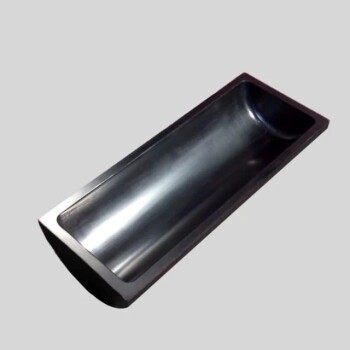
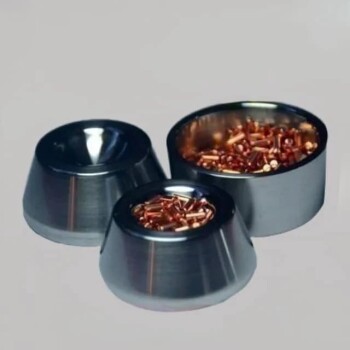
High-purity graphite crucibles act as the primary containment vessel for aggressive molten salts, specifically fluoride-based mixtures like FLiNaK, and the alloy specimens being tested. Their fundamental role is to provide a chemically inert environment that withstands high temperatures (up to 650°C) without degrading or introducing impurities into the experiment.
High-purity graphite is selected not just for its ability to hold molten salt, but for its capacity to maintain a stable, contaminant-free environment over long durations. It simultaneously ensures thermal uniformity and allows for the simulation of specific electrochemical interactions found in molten salt reactors.
Preserving Experimental Integrity
Preventing Impurity Leaching
The validity of a corrosion test depends on the purity of the molten salt. High-purity graphite offers superior resistance to erosion from aggressive fluoride salts.
By resisting erosion, the crucible prevents carbon or other impurity elements from leaching into the mixture. This ensures that the salt composition remains stable throughout long-duration experiments, such as those lasting 240 hours.
Ensuring Thermal Uniformity
Temperature gradients can skew corrosion rates, leading to inconsistent data across a single specimen. Graphite possesses excellent thermal conductivity properties.
This allows the crucible to distribute heat evenly throughout the molten salt. A uniform temperature distribution ensures that the corrosion observed on the alloy specimen is a result of chemical interaction, not localized overheating.
Simulating Reactor Dynamics
Modeling Galvanic Corrosion
In many molten salt reactor designs, metal components coexist with structural graphite. Graphite crucibles help replicate this specific environment.
Graphite generally possesses a more positive corrosion potential than many structural metals. When the metal specimen is submerged in the graphite crucible, they can form an electrochemical circuit.
This setup facilitates the study of galvanic corrosion effects. It allows researchers to observe how the coupling of graphite and metal influences the degradation of the alloy, mimicking real-world reactor conditions.
Critical Considerations and Trade-offs
The Risk of Carburization
While graphite is chemically stable, it is not strictly passive in all scenarios. In molten salt experiments, the crucible can act as a carbon source.
This can lead to the carburization of the metal samples. The introduction of carbon into the metal surface alters the material's diffusion kinetics and mechanical properties.
Interference with Pure Mechanism Studies
If the goal is to study oxidation or dissolution mechanisms in a purely radiation-corrosion context, graphite may interfere. The carburization effect described above can obscure the specific mechanisms you are trying to isolate.
In these specific cases, utilizing a metal-lined crucible (such as a nickel-based alloy lining) is necessary to isolate the carbon source from the salt and the specimen.
Making the Right Choice for Your Goal
To select the correct crucible configuration, you must define the specific interaction you intend to model.
- If your primary focus is simulating reactor realism: Use bare high-purity graphite to capture the galvanic corrosion effects between structural carbon and metal components.
- If your primary focus is pure oxidation mechanics: Use a metal liner within the crucible to prevent carburization from altering the specimen's diffusion properties.
- If your primary focus is thermal consistency: Rely on high-purity graphite for its superior thermal conductivity to eliminate temperature gradients in the salt.
By understanding the active role graphite plays in both thermal regulation and electrochemistry, you can ensure your experimental setup yields accurate, relevant data.
Summary Table:
| Feature | Role in Corrosion Testing | Primary Benefit |
|---|---|---|
| High Chemical Purity | Prevents impurity leaching into molten salts | Maintains salt chemistry integrity |
| Thermal Conductivity | Distributes heat evenly throughout the salt | Eliminates temperature gradients |
| Electrochemical Potential | Acts as a cathode relative to metal alloys | Enables study of galvanic corrosion |
| Thermal Stability | Withstands temperatures up to 650°C+ | Ensures durable containment |
| Carburization Risk | Acts as a potential carbon source | Facilitates study of carbon-metal interactions |
Optimize Your Molten Salt Research with KINTEK
Precise experimental results start with high-quality materials. KINTEK specializes in providing high-purity graphite crucibles and specialized laboratory equipment tailored for the most demanding research environments. Whether you are modeling galvanic corrosion in nuclear reactor simulations or studying pure oxidation mechanisms, our portfolio of high-temperature furnaces, crushing systems, and advanced consumables like PTFE and ceramics ensures your lab operates at peak performance.
From high-temperature high-pressure reactors to precision-engineered crucibles, we deliver the tools needed to maintain experimental integrity and thermal uniformity.
Ready to elevate your lab's capabilities? Contact our technical experts today to find the perfect solution for your high-temperature testing needs.
References
- Yufen Gu, Volodymyr Korzhyk. Stress-assisted corrosion behaviour of Hastelloy N in FLiNaK molten salt environment. DOI: 10.1038/s41529-022-00300-x
This article is also based on technical information from Kintek Solution Knowledge Base .
Related Products
- High Purity Pure Graphite Crucible for Evaporation
- High Purity Pure Graphite Crucible for Electron Beam Evaporation
- Carbon Graphite Boat -Laboratory Tube Furnace with Cover
- Custom Machined and Molded PTFE Teflon Parts Manufacturer with PTFE Crucible and Lid
- Arc-Shaped Alumina Ceramic Crucible High Temperature Resistant for Engineering Advanced Fine Ceramics
People Also Ask
- Why are high-purity graphite crucibles preferred for sulfide solid electrolytes? Achieve Superior Material Purity
- Why is a high-purity graphite crucible required for Chromel-TaC composites? Ensure Peak Purity at 1400°C
- What role do high-purity graphite crucibles play in molten salt corrosion research? Ensure Reactor-Grade Precision
- Why are high-purity graphite crucibles used for magnesium distillation? Ensure 3N8 Purity & Thermal Stability
- Why is a high-purity graphite crucible ideal for nitrogen-doped graphene at 1500 °C? Maximize Purity and Stability