Knowledge What are the problems with graphene technology? Scaling Up Quality and Cost-Effective Production
Author avatar

Tech Team · Kintek Solution

Updated 6 days ago

What are the problems with graphene technology? Scaling Up Quality and Cost-Effective Production


The primary challenge holding back graphene is the immense difficulty in producing large, perfect, and cost-effective sheets of it. While its properties are revolutionary in the laboratory, translating that potential to industrial-scale products is hindered by fundamental manufacturing problems. Current methods struggle to deliver the consistent quality and quantity needed for widespread, real-world applications.

Graphene's potential is undisputed. However, the core problem is not a failure of the material itself, but a profound manufacturing challenge. Producing the right type of high-quality graphene, consistently and at an industrial scale, remains the single greatest barrier to its adoption.
What are the problems with graphene technology? Scaling Up Quality and Cost-Effective Production

The Manufacturing Impasse: From Lab to Factory Floor

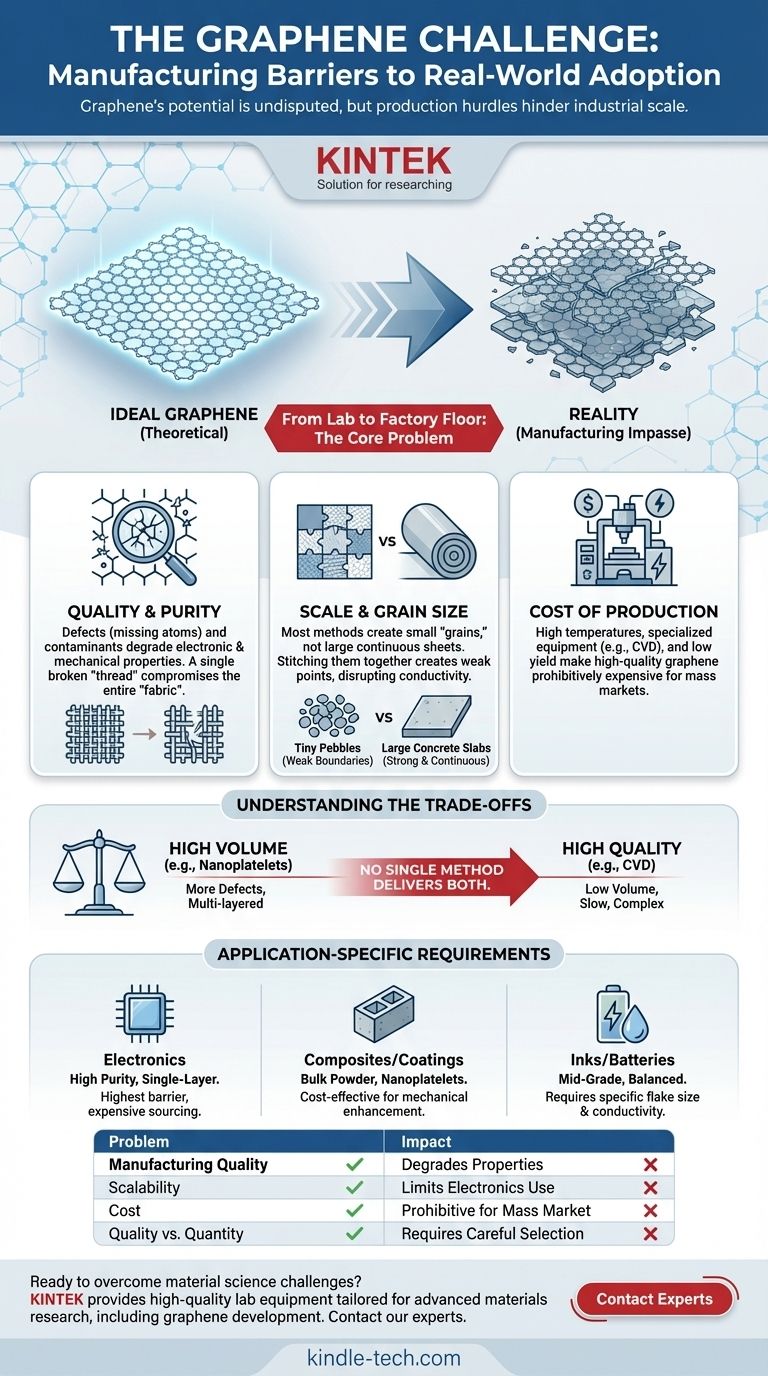
The excitement around graphene is based on its ideal, theoretical form: a perfect, single-atom-thick lattice of carbon. The reality of producing this material is far more complex and is the root cause of its slow commercialization.

The Challenge of Quality and Purity

The most common methods for making graphene often introduce defects and contaminants. A defect can be a vacancy (a missing atom) or a misplaced atom in the hexagonal lattice.

Think of it like a perfect, tightly woven piece of fabric. A single broken thread—a defect—compromises the strength and properties of the entire sheet. These imperfections drastically degrade the material's exceptional electronic and mechanical strength.

The Problem of Scale and Grain Size

For applications like electronics or transparent protective films, large, continuous sheets of graphene are required. Most production techniques create small, individual flakes, known as "grains."

Stitching these small grains together is like paving a road with tiny pebbles instead of large concrete slabs. The boundaries between the grains create weak points that disrupt electrical conductivity and reduce overall strength, negating many of the material's benefits.

The Prohibitive Cost of Production

Creating high-quality graphene is an expensive process. Techniques like Chemical Vapor Deposition (CVD), which can grow large, high-quality sheets, require specialized equipment, high temperatures, and costly precursor materials.

The low yield and high energy consumption of these methods make the resulting graphene too expensive for all but the most niche, high-value applications. Mass-market adoption requires a dramatic reduction in these production costs.

Understanding the Trade-offs: Not All Graphene is Created Equal

The term "graphene" is often used as a catch-all, but in reality, there are many different types. The method of production dictates its form and quality, leading to a critical trade-off that every potential user must understand.

Quality vs. Quantity

Methods that can produce graphene in large volumes, such as liquid-phase exfoliation of graphite, typically yield a powder of small, multi-layered flakes with a higher number of defects. This material is often called graphene nanoplatelets.

Conversely, methods that produce high-quality, single-layer graphene (like CVD) are slow, complex, and produce much smaller quantities. There is currently no single method that delivers both high quality and high quantity at a low cost.

Application-Specific Requirements

The "best" type of graphene is entirely dependent on the end-use. For an application like strengthening concrete or plastics, adding a bulk powder of graphene nanoplatelets may be perfectly sufficient and cost-effective.

However, for a high-frequency transistor or a transparent, conductive display, only a near-perfect, single-layer sheet of graphene will do. Using the wrong type of graphene for the job is a common source of failed projects and disillusionment.

Making the Right Choice for Your Goal

Navigating the graphene landscape requires matching the material's real-world form to your specific technical and commercial goals.

  • If your primary focus is high-performance electronics: You face the highest barrier and must source expensive, high-purity, single-layer graphene, likely produced via CVD.
  • If your primary focus is bulk composites or coatings: You can likely use lower-cost, mass-produced graphene nanoplatelets to enhance the mechanical or thermal properties of a host material.
  • If your primary focus is conductive inks or batteries: You will need a material that balances flake size, conductivity, and cost, often requiring a mid-grade graphene product.

Understanding these fundamental production hurdles is the key to realistically evaluating graphene's role in any future technology.

Summary Table:

Problem Key Challenge Impact on Adoption
Manufacturing Quality Defects and contaminants in the carbon lattice Degrades electronic and mechanical properties
Scalability Difficulty producing large, continuous sheets Limits use in electronics and films
Cost High energy use and expensive precursors Prohibitive for mass-market applications
Quality vs. Quantity Trade-off No single method delivers high quality and high volume Requires careful selection for specific applications

Ready to overcome material science challenges in your lab? KINTEK specializes in providing high-quality lab equipment and consumables tailored for advanced materials research, including graphene development. Our expertise can help you select the right tools for your specific production and analysis needs. Contact our experts today to discuss how we can support your innovative projects and help you navigate complex material landscapes efficiently.

Visual Guide
What are the problems with graphene technology? Scaling Up Quality and Cost-Effective Production Visual Guide

Related Products

People Also Ask

Related Products

Graphite Vacuum Continuous Graphitization Furnace

Graphite Vacuum Continuous Graphitization Furnace

High-temperature graphitization furnace is a professional equipment for graphitization treatment of carbon materials. It is a key equipment for the production of high-quality graphite products. It has high temperature, high efficiency and uniform heating. It is suitable for various high-temperature treatments and graphitization treatments. It is widely used in metallurgy, electronics, aerospace, etc. industry.

Large Vertical Graphite Vacuum Graphitization Furnace

Large Vertical Graphite Vacuum Graphitization Furnace

A large vertical high-temperature graphitization furnace is a type of industrial furnace used for the graphitization of carbon materials, such as carbon fiber and carbon black. It is a high-temperature furnace that can reach temperatures of up to 3100°C.

Graphite Vacuum Furnace Bottom Discharge Graphitization Furnace for Carbon Materials

Graphite Vacuum Furnace Bottom Discharge Graphitization Furnace for Carbon Materials

Bottom-out graphitization furnace for carbon materials, ultra-high temperature furnace up to 3100°C, suitable for graphitization and sintering of carbon rods and carbon blocks. Vertical design, bottom discharging, convenient feeding and discharging, high temperature uniformity, low energy consumption, good stability, hydraulic lifting system, convenient loading and unloading.

HFCVD Machine System Equipment for Drawing Die Nano-Diamond Coating

HFCVD Machine System Equipment for Drawing Die Nano-Diamond Coating

The nano-diamond composite coating drawing die uses cemented carbide (WC-Co) as the substrate, and uses the chemical vapor phase method ( CVD method for short ) to coat the conventional diamond and nano-diamond composite coating on the surface of the inner hole of the mold.

Customer Made Versatile CVD Tube Furnace Chemical Vapor Deposition Chamber System Equipment

Customer Made Versatile CVD Tube Furnace Chemical Vapor Deposition Chamber System Equipment

Get your exclusive CVD furnace with KT-CTF16 Customer Made Versatile Furnace. Customizable sliding, rotating, and tilting functions for precise reactions. Order now!

Multi Heating Zones CVD Tube Furnace Machine Chemical Vapor Deposition Chamber System Equipment

Multi Heating Zones CVD Tube Furnace Machine Chemical Vapor Deposition Chamber System Equipment

KT-CTF14 Multi Heating Zones CVD Furnace - Precise Temperature Control and Gas Flow for Advanced Applications. Max temp up to 1200℃, 4 channels MFC mass flow meter, and 7" TFT touch screen controller.

Chemical Vapor Deposition CVD Equipment System Chamber Slide PECVD Tube Furnace with Liquid Gasifier PECVD Machine

Chemical Vapor Deposition CVD Equipment System Chamber Slide PECVD Tube Furnace with Liquid Gasifier PECVD Machine

KT-PE12 Slide PECVD System: Wide power range, programmable temp control, fast heating/cooling with sliding system, MFC mass flow control & vacuum pump.

1700℃ Laboratory Quartz Tube Furnace with Alumina Tube Tubular Furnace

1700℃ Laboratory Quartz Tube Furnace with Alumina Tube Tubular Furnace

Looking for a high-temperature tube furnace? Check out our 1700℃ Tube Furnace with Alumina Tube. Perfect for research and industrial applications up to 1700C.

Vacuum Heat Treat and Pressure Sintering Furnace for High Temperature Applications

Vacuum Heat Treat and Pressure Sintering Furnace for High Temperature Applications

Vacuum pressure sintering furnaces are designed for high temperature hot pressing applications in metal and ceramic sintering. Its advanced features ensure precise temperature control, reliable pressure maintenance, and a robust design for seamless operation.

Small Vacuum Heat Treat and Tungsten Wire Sintering Furnace

Small Vacuum Heat Treat and Tungsten Wire Sintering Furnace

The small vacuum tungsten wire sintering furnace is a compact experimental vacuum furnace specially designed for universities and scientific research institutes. The furnace features a CNC welded shell and vacuum piping to ensure leak-free operation. Quick-connect electrical connections facilitate relocation and debugging, and the standard electrical control cabinet is safe and convenient to operate.

Laboratory Sterilizer Lab Autoclave Vertical Pressure Steam Sterilizer for Liquid Crystal Display Automatic Type

Laboratory Sterilizer Lab Autoclave Vertical Pressure Steam Sterilizer for Liquid Crystal Display Automatic Type

Liquid crystal display automatic vertical sterilizer is a safe, reliable and automatic control sterilization equipment, which is composed of heating system, microcomputer control system and overheating and overvoltage protection system.

Vacuum Sealed Continuous Working Rotary Tube Furnace Rotating Tube Furnace

Vacuum Sealed Continuous Working Rotary Tube Furnace Rotating Tube Furnace

Experience efficient material processing with our vacuum-sealed rotary tube furnace. Perfect for experiments or industrial production, equipped with optional features for controlled feeding and optimized results. Order now.

Vacuum Hot Press Furnace Machine for Lamination and Heating

Vacuum Hot Press Furnace Machine for Lamination and Heating

Experience clean and precise lamination with Vacuum Lamination Press. Perfect for wafer bonding, thin-film transformations, and LCP lamination. Order now!

915MHz MPCVD Diamond Machine Microwave Plasma Chemical Vapor Deposition System Reactor

915MHz MPCVD Diamond Machine Microwave Plasma Chemical Vapor Deposition System Reactor

915MHz MPCVD Diamond Machine and its multi-crystal effective growth, the maximum area can reach 8 inches, the maximum effective growth area of single crystal can reach 5 inches. This equipment is mainly used for the production of large-size polycrystalline diamond films, the growth of long single crystal diamonds, the low-temperature growth of high-quality graphene, and other materials that require energy provided by microwave plasma for growth.

Benchtop Laboratory Freeze Dryer for Lab Use

Benchtop Laboratory Freeze Dryer for Lab Use

Premium benchtop laboratory freeze dryer for lyophilization, preserving samples with ≤ -60°C cooling. Ideal for pharmaceuticals & research.

Three-dimensional electromagnetic sieving instrument

Three-dimensional electromagnetic sieving instrument

KT-VT150 is a desktop sample processing instrument for both sieving and grinding. Grinding and sieving can be used both dry and wet. The vibration amplitude is 5mm and the vibration frequency is 3000-3600 times/min.

Single Punch Electric Tablet Press Machine Laboratory Powder Tablet Punching TDP Tablet Press

Single Punch Electric Tablet Press Machine Laboratory Powder Tablet Punching TDP Tablet Press

The single-punch electric tablet press is a laboratory-scale tablet press suitable for corporate laboratories in pharmaceutical, chemical, food, metallurgical and other industries.

RF PECVD System Radio Frequency Plasma-Enhanced Chemical Vapor Deposition RF PECVD

RF PECVD System Radio Frequency Plasma-Enhanced Chemical Vapor Deposition RF PECVD

RF-PECVD is an acronym for "Radio Frequency Plasma-Enhanced Chemical Vapor Deposition." It deposits DLC (Diamond-like carbon film) on germanium and silicon substrates. It is utilized in the 3-12um infrared wavelength range.

Single Punch Tablet Press Machine and Mass Production Rotary Tablet Punching Machine for TDP

Single Punch Tablet Press Machine and Mass Production Rotary Tablet Punching Machine for TDP

Rotary tablet punching machine is an automatic rotating and continuous tableting machine. It is mainly used for tablet manufacturing in the pharmaceutical industry, and is also suitable for industrial sectors such as food, chemicals, batteries, electronics, ceramics, etc. to compress granular raw materials into tablets.

Anti-Cracking Press Mold for Lab Use

Anti-Cracking Press Mold for Lab Use

The anti-cracking press mold is a specialized equipment designed for molding various shapes and sizes of film using high pressure and electric heating.


Leave Your Message