Knowledge What are the products of calcination of limestone? Unlocking Quicklime and CO₂ for Industry
Author avatar

Tech Team · Kintek Solution

Updated 6 days ago

What are the products of calcination of limestone? Unlocking Quicklime and CO₂ for Industry


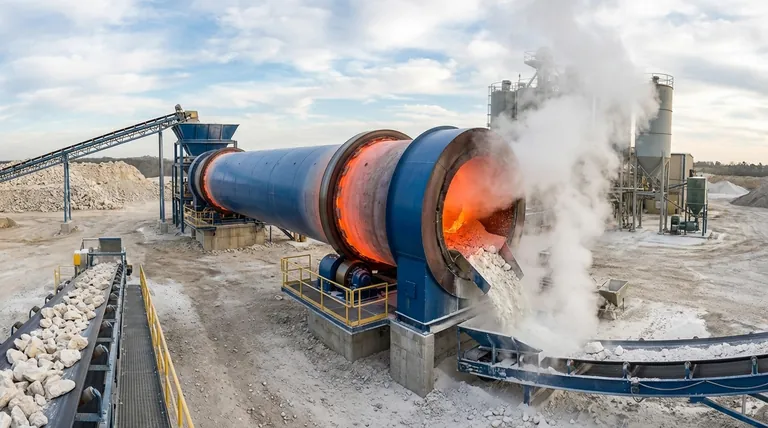
In short, the calcination of limestone produces two key products: calcium oxide (CaO) and carbon dioxide (CO₂). This process involves heating limestone, which is primarily calcium carbonate (CaCO₃), to a high temperature, causing it to chemically decompose rather than simply melt or burn.

The calcination of limestone is a foundational industrial process. It is a thermal decomposition reaction that transforms a stable, natural rock into a highly reactive chemical building block (calcium oxide) by driving off carbon dioxide gas.
What are the products of calcination of limestone? Unlocking Quicklime and CO₂ for Industry

The Chemistry of Calcination: A Closer Look

To fully grasp the process, it's essential to understand the underlying chemical transformation and the conditions required to make it happen.

The Core Chemical Equation

The reaction is elegantly simple and is a cornerstone of inorganic chemistry. It is an endothermic reaction, meaning it requires a continuous input of energy (heat) to proceed.

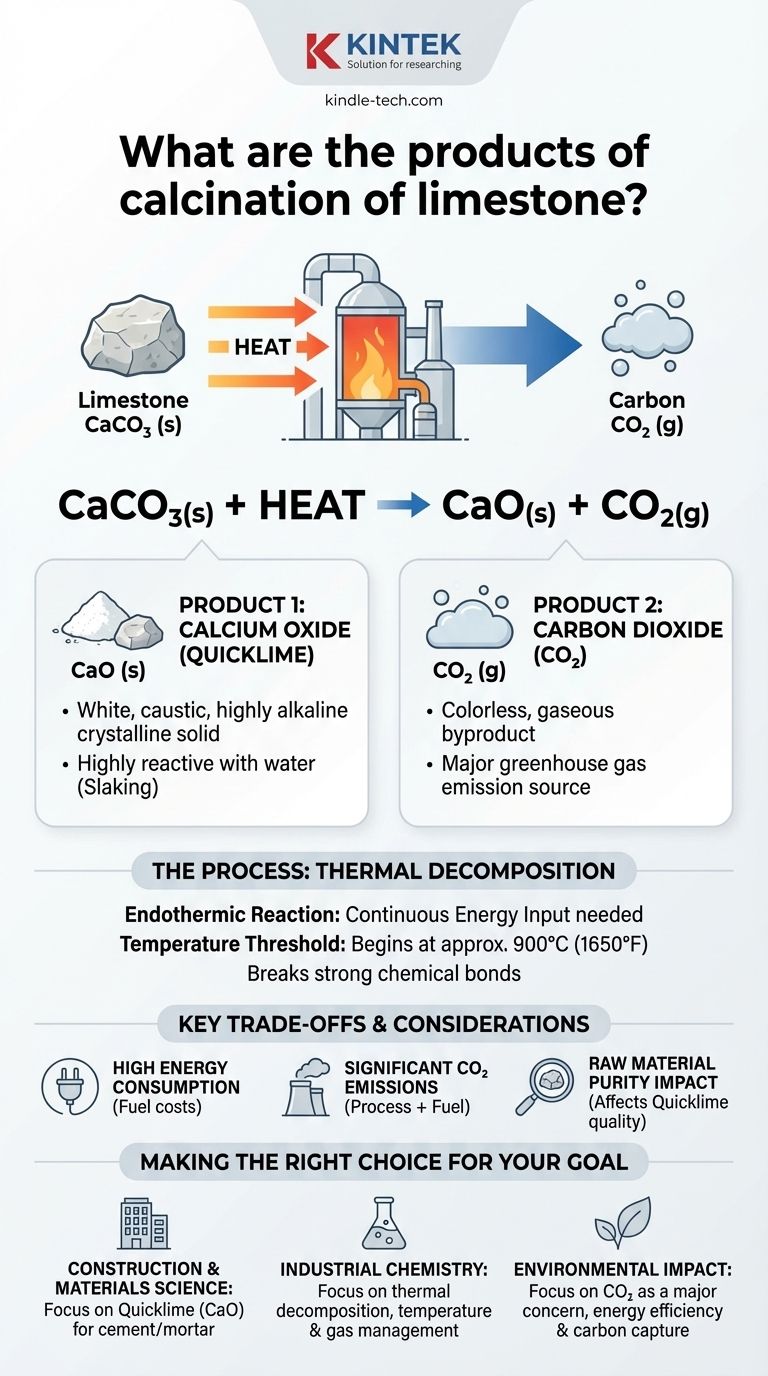
The balanced equation is: CaCO₃(s) + Heat → CaO(s) + CO₂(g)

This shows that one molecule of solid calcium carbonate breaks down into one molecule of solid calcium oxide and one molecule of gaseous carbon dioxide.

The Role of Thermal Decomposition

Calcination is not a reaction with heat; it's a decomposition caused by heat. The thermal energy is used to break the strong chemical bonds within the calcium carbonate structure.

Critical Temperature Threshold

The decomposition of calcium carbonate begins at approximately 900°C (1650°F) under normal atmospheric pressure. In industrial kilns, temperatures are often kept higher to ensure the reaction proceeds efficiently and completely.

Understanding the Products and Their Properties

The two products of this reaction have vastly different characteristics and uses, which is why the process is so fundamental to industry.

Product 1: Calcium Oxide (Quicklime)

Calcium oxide, commonly known as quicklime or burnt lime, is the primary desired product. It is a white, caustic, and highly alkaline crystalline solid.

Its most important property is its high reactivity, especially with water. This exothermic reaction, called slaking, produces calcium hydroxide, or hydrated lime.

Product 2: Carbon Dioxide (CO₂)

Carbon dioxide is the gaseous byproduct that is driven off and removed from the kiln during the process.

While sometimes captured for other industrial uses, it is more often considered a waste product and a significant source of greenhouse gas emissions.

Understanding the Trade-offs and Key Considerations

While the process is straightforward chemically, its industrial application involves significant challenges and impacts that must be managed.

High Energy Consumption

Achieving and maintaining temperatures above 900°C is an extremely energy-intensive process. Fuel costs represent a major portion of the operational expense of producing quicklime.

Significant CO₂ Emissions

The calcination of limestone is a major global source of carbon dioxide emissions. The CO₂ comes from two sources: the chemical decomposition of the limestone itself and the fossil fuels typically burned to heat the kilns.

Impact of Raw Material Purity

The quality of the final quicklime is directly dependent on the purity of the initial limestone. Impurities such as silica, clay, or magnesium carbonate can affect the reactivity and properties of the final product, which is critical for applications like steel and cement manufacturing.

Making the Right Choice for Your Goal

Understanding this process allows you to appreciate its role in different fields. The importance of the products depends entirely on your specific application.

  • If your primary focus is construction and materials science: The key product is calcium oxide (quicklime), as it is the essential precursor to cement and mortar.
  • If your primary focus is industrial chemistry: View this as a classic thermal decomposition reaction where managing temperature, energy inputs, and gas removal are the critical process variables.
  • If your primary focus is environmental impact: Recognize that the byproduct, carbon dioxide, is a major concern, making energy efficiency and carbon capture technologies vital for the industry's future.

Ultimately, understanding the products of limestone calcination is the first step toward mastering its application across countless essential industries.

Summary Table:

Product Chemical Formula Common Name Key Properties
Calcium Oxide CaO Quicklime White, caustic, highly alkaline, reactive with water
Carbon Dioxide CO₂ - Colorless gas, greenhouse gas, industrial byproduct

Optimize your calcination process with KINTEK's advanced laboratory equipment. Whether you're researching thermal decomposition reactions or scaling up industrial production, our high-temperature furnaces and kilns ensure precise temperature control and energy efficiency. We provide the reliable tools you need to produce high-purity quicklime while managing energy consumption and emissions. Contact us today (#ContactForm) to discuss how our solutions can enhance your materials science and industrial chemistry workflows.

Visual Guide
What are the products of calcination of limestone? Unlocking Quicklime and CO₂ for Industry Visual Guide

Related Products

People Also Ask

Related Products

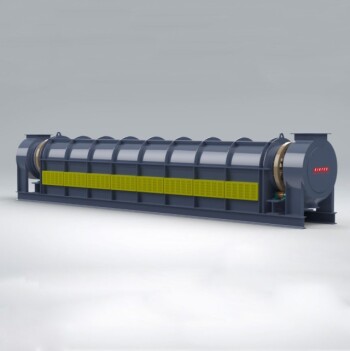
Electric Rotary Kiln Pyrolysis Furnace Plant Machine Calciner Small Rotary Kiln Rotating Furnace

Electric Rotary Kiln Pyrolysis Furnace Plant Machine Calciner Small Rotary Kiln Rotating Furnace

Electric rotary kiln - precisely controlled, it's ideal for calcination and drying of materials like lithium cobalate, rare earths, and non-ferrous metals.

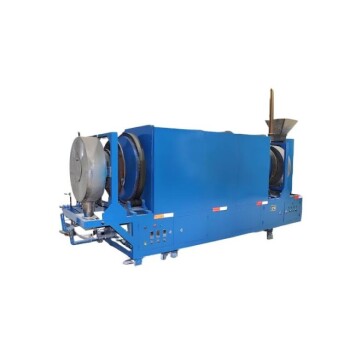
Electric Rotary Kiln Continuous Working Small Rotary Furnace Heating Pyrolysis Plant

Electric Rotary Kiln Continuous Working Small Rotary Furnace Heating Pyrolysis Plant

Efficiently calcine and dry bulk powder and lump fluid materials with an electric heating rotary furnace. Ideal for processing lithium ion battery materials and more.

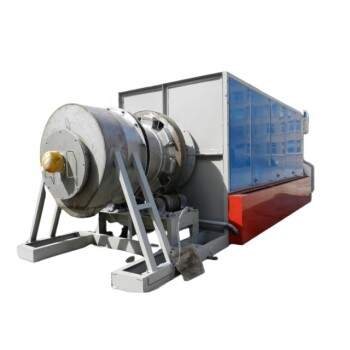
Electric Rotary Kiln Small Rotary Furnace for Activated Carbon Regeneration

Electric Rotary Kiln Small Rotary Furnace for Activated Carbon Regeneration

Revitalize your activated carbon with KinTek's Electric Regeneration Furnace. Achieve efficient and cost-effective regeneration with our highly automated rotary kiln and intelligent thermal controller.

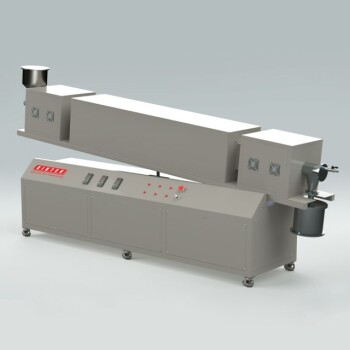
Vacuum Sealed Continuous Working Rotary Tube Furnace Rotating Tube Furnace

Vacuum Sealed Continuous Working Rotary Tube Furnace Rotating Tube Furnace

Experience efficient material processing with our vacuum-sealed rotary tube furnace. Perfect for experiments or industrial production, equipped with optional features for controlled feeding and optimized results. Order now.

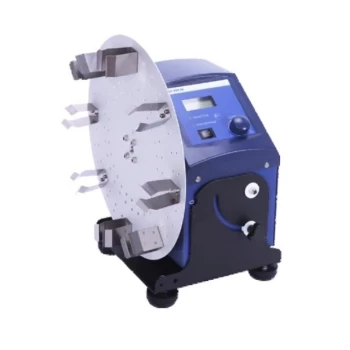
Laboratory Disc Rotary Mixer for Efficient Sample Mixing and Homogenization

Laboratory Disc Rotary Mixer for Efficient Sample Mixing and Homogenization

Efficient Laboratory Disc Rotary Mixer for Precise Sample Mixing, Versatile for Various Applications, DC Motor and Microcomputer Control, Adjustable Speed and Angle.

Mesh belt controlled atmosphere furnace

Mesh belt controlled atmosphere furnace

Discover our KT-MB mesh belt sintering furnace - perfect for high-temperature sintering of electronic components & glass insulators. Available for open air or controlled atmosphere environments.

High Temperature Constant Temperature Heating Circulator Water Bath Chiller Circulator for Reaction Bath

High Temperature Constant Temperature Heating Circulator Water Bath Chiller Circulator for Reaction Bath

Efficient and reliable, KinTek KHB Heating Circulator is perfect for your lab needs. With a max. heating temperature of up to 300℃, it features accurate temperature control and fast heating.

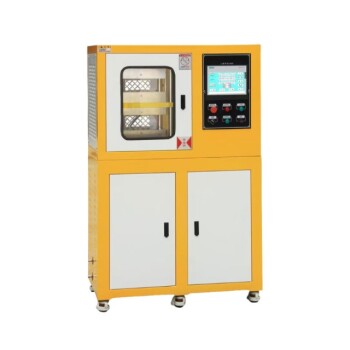
Rubber Vulcanizer Vulcanizing Machine Plate Vulcanizing Press for Lab

Rubber Vulcanizer Vulcanizing Machine Plate Vulcanizing Press for Lab

The Plate vulcanizing press is a kind of equipment used in the production of rubber products, mainly used for the vulcanization of rubber products. Vulcanization is a key step in rubber processing.

Laboratory Muffle Oven Furnace Bottom Lifting Muffle Furnace

Laboratory Muffle Oven Furnace Bottom Lifting Muffle Furnace

Efficiently produce batches with excellent temperature uniformity using our Bottom Lifting Furnace. Features two electric lifting stages and advanced temperature control up to 1600℃.

1700℃ Laboratory Quartz Tube Furnace with Alumina Tube Tubular Furnace

1700℃ Laboratory Quartz Tube Furnace with Alumina Tube Tubular Furnace

Looking for a high-temperature tube furnace? Check out our 1700℃ Tube Furnace with Alumina Tube. Perfect for research and industrial applications up to 1700C.

Small Jaw Crusher for Laboratory and Small Mines Efficient Flexible Affordable Laboratory Ore Crusher Coal Crusher

Small Jaw Crusher for Laboratory and Small Mines Efficient Flexible Affordable Laboratory Ore Crusher Coal Crusher

Discover the small jaw crusher for efficient, flexible, and affordable crushing in labs and small mines. Ideal for coal, ores, and rocks. Learn more now!

Vertical High Temperature Graphite Vacuum Graphitization Furnace

Vertical High Temperature Graphite Vacuum Graphitization Furnace

Vertical high temperature graphitization furnace for carbonization and graphitization of carbon materials up to 3100℃.Suitable for shaped graphitization of carbon fiber filaments and other materials sintered in a carbon environment.Applications in metallurgy, electronics, and aerospace for producing high-quality graphite products like electrodes and crucibles.

Graphite Vacuum Continuous Graphitization Furnace

Graphite Vacuum Continuous Graphitization Furnace

High-temperature graphitization furnace is a professional equipment for graphitization treatment of carbon materials. It is a key equipment for the production of high-quality graphite products. It has high temperature, high efficiency and uniform heating. It is suitable for various high-temperature treatments and graphitization treatments. It is widely used in metallurgy, electronics, aerospace, etc. industry.

Graphite Vacuum Furnace IGBT Experimental Graphitization Furnace

Graphite Vacuum Furnace IGBT Experimental Graphitization Furnace

IGBT experimental graphitization furnace, a tailored solution for universities and research institutions, with high heating efficiency, user-friendliness, and precise temperature control.

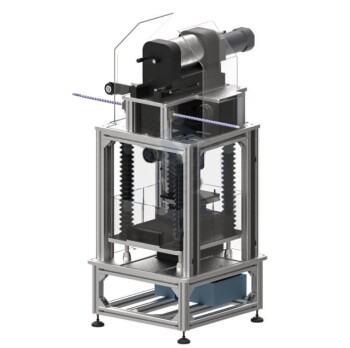
Precision Wire Saw Laboratory Cutting Machine with 800mm x 800mm Workbench for Diamond Single Wire Circular Small Cutting

Precision Wire Saw Laboratory Cutting Machine with 800mm x 800mm Workbench for Diamond Single Wire Circular Small Cutting

Diamond wire cutting machines are mainly used for precision cutting of ceramics, crystals, glass, metals, rocks, thermoelectric materials, infrared optical materials, composite materials, biomedical materials and other material analysis samples. Especially suitable for precision cutting of ultra-thin plates with thickness up to 0.2mm.

Small Vacuum Heat Treat and Tungsten Wire Sintering Furnace

Small Vacuum Heat Treat and Tungsten Wire Sintering Furnace

The small vacuum tungsten wire sintering furnace is a compact experimental vacuum furnace specially designed for universities and scientific research institutes. The furnace features a CNC welded shell and vacuum piping to ensure leak-free operation. Quick-connect electrical connections facilitate relocation and debugging, and the standard electrical control cabinet is safe and convenient to operate.

Infrared Heating Quantitative Flat Plate Press Mold

Infrared Heating Quantitative Flat Plate Press Mold

Discover advanced infrared heating solutions with high-density insulation and precise PID control for uniform thermal performance in various applications.

Heated Hydraulic Press Machine with Integrated Manual Heated Plates for Lab Use

Heated Hydraulic Press Machine with Integrated Manual Heated Plates for Lab Use

Efficiently process heat-pressing samples with our Integrated Manual Heated Lab Press. With a heating range up to 500°C, it's perfect for various industries.

Engineering Advanced Fine Ceramics Head Tweezers with Pointed Elbow Zirconia Ceramic Tip

Engineering Advanced Fine Ceramics Head Tweezers with Pointed Elbow Zirconia Ceramic Tip

Zirconia ceramic tweezers are a high-precision tool made of advanced ceramic materials, especially suitable for operating environments that require high precision and corrosion resistance. This type of tweezers not only has excellent physical properties, but is also popular in the medical and laboratory fields because of its biocompatibility.

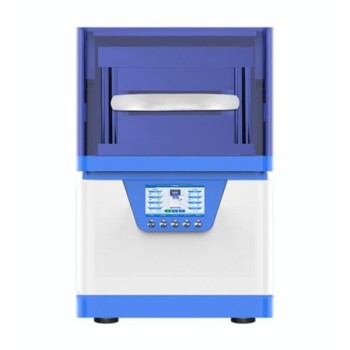
Automatic Laboratory Heat Press Machine

Automatic Laboratory Heat Press Machine

Precision automatic heat press machines for labs—ideal for material testing, composites, and R&D. Customizable, safe, and efficient. Contact KINTEK today!


Leave Your Message