Knowledge Vacuum Furnace What are the two types of furnace technologies used in heat treatment? Atmosphere vs. Vacuum Explained
Author avatar

Tech Team · Kintek Solution

Updated 2 months ago

What are the two types of furnace technologies used in heat treatment? Atmosphere vs. Vacuum Explained


At its core, the two primary furnace technologies used in heat treatment are distinguished by how they manage the environment surrounding the material. The fundamental choice is between using a controlled gas environment, known as an Atmosphere Furnace, or removing the environment entirely, which is done in a Vacuum Furnace. The selection between these two is determined by the specific surface chemistry and material properties required for the final product.

The critical distinction is not just how the furnace is heated, but what happens inside. Atmosphere furnaces actively use gases to protect or change a material's surface, while vacuum furnaces create a pure, non-reactive environment by removing those gases altogether.
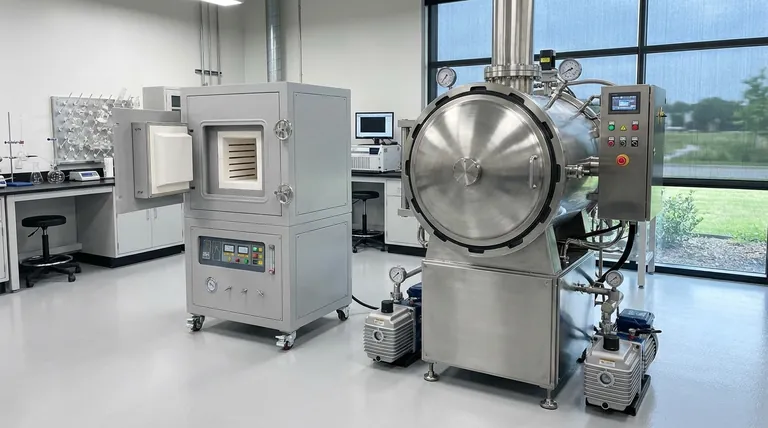
What are the two types of furnace technologies used in heat treatment? Atmosphere vs. Vacuum Explained

Understanding Atmosphere Furnaces

Atmosphere furnaces are sealed chambers where the air is replaced with a specific, carefully controlled mixture of gases. This "atmosphere" is a critical part of the heat treatment process itself.

The Purpose of a Controlled Atmosphere

The primary goal is to control the surface chemistry of the component being treated. Simply heating a metal in air would cause it to react with oxygen, leading to unwanted scaling and decarburization (the loss of carbon from the surface of steel).

Using Atmospheres for Protection

An inert atmosphere, using gases like argon or nitrogen, prevents these undesirable reactions. It acts as a protective blanket, shielding the material from oxygen and other reactive elements during the high-temperature cycle.

Using Atmospheres for Surface Modification

An active atmosphere is used to intentionally change the surface of the material. By introducing specific chemical species, you can achieve unique properties. This includes processes like carburizing (adding carbon) or nitriding (adding nitrogen) to harden the surface of a steel component.

The Alternative: Vacuum Furnaces

A vacuum furnace operates on the opposite principle. Instead of introducing a specific gas, it uses powerful pumps to remove nearly all of the air and gas from the sealed chamber, creating a near-vacuum.

The Core Advantage: Ultimate Purity

By removing the atmosphere, a vacuum furnace eliminates the risk of oxidation, decarburization, and contamination. This results in a clean, bright, and high-purity end product without the need for post-treatment cleaning.

Superior Process Control

The vacuum environment allows for extremely precise temperature management and highly uniform heating. With no atmosphere to interfere, heat is transferred efficiently and evenly, which is critical for complex parts and sensitive materials.

High Versatility of Processes

This controlled environment is ideal for a wide range of advanced processes. Vacuum furnaces are frequently used for high-demand applications like vacuum brazing, sintering, and quenching, where component integrity is paramount.

Understanding the Trade-offs

The choice between an atmosphere and vacuum furnace is driven by the desired outcome, cost, and the material being processed. Neither is universally superior; they are tools for different jobs.

When to Choose an Atmosphere Furnace

Atmosphere furnaces are the standard for processes that require adding elements to a material's surface. If your goal is carburizing or nitriding, an active atmosphere is not just an option—it's a fundamental requirement of the process.

When to Choose a Vacuum Furnace

Vacuum furnaces excel when the primary goal is to protect the material from any external influence. They produce components with superior mechanical properties and a clean finish, making them ideal for high-performance, critical applications where purity is non-negotiable.

The Heat Source: Gas vs. Electric

It is also important to note that both atmosphere and vacuum furnaces require a heat source. This is typically either gas-fuelled or electrically energized. The choice of heat source often depends on operational costs, required temperature precision, and the specific furnace design.

Making the Right Choice for Your Process

Your decision should be based entirely on the metallurgical outcome you need to achieve.

  • If your primary focus is surface modification (adding elements): An Atmosphere Furnace is the essential tool for processes like carburizing and nitriding.
  • If your primary focus is preventing any surface reaction or contamination: A Vacuum Furnace provides the purest, most controlled environment for achieving superior material properties.
  • If your primary focus is processing highly sensitive or complex parts: A Vacuum Furnace offers unmatched uniformity and precision in heating and cooling.

Ultimately, selecting the right furnace technology means choosing the ideal environment to produce the exact material characteristics your application demands.

Summary Table:

Feature Atmosphere Furnace Vacuum Furnace
Primary Function Surface modification (e.g., carburizing, nitriding) Material protection and purity
Environment Controlled gas mixture (inert or active) Near-total vacuum
Ideal For Adding elements to the surface Preventing oxidation and contamination
End Result Modified surface properties Clean, bright, high-purity finish

Struggling to choose the right furnace technology for your specific heat treatment needs? KINTEK specializes in lab equipment and consumables, offering expert guidance and high-performance furnaces tailored to your laboratory's requirements. Whether you need precise surface modification with an atmosphere furnace or ultimate material purity with a vacuum furnace, we have the solution. Contact us today to discuss your application and discover how KINTEK can enhance your heat treatment processes!

Visual Guide
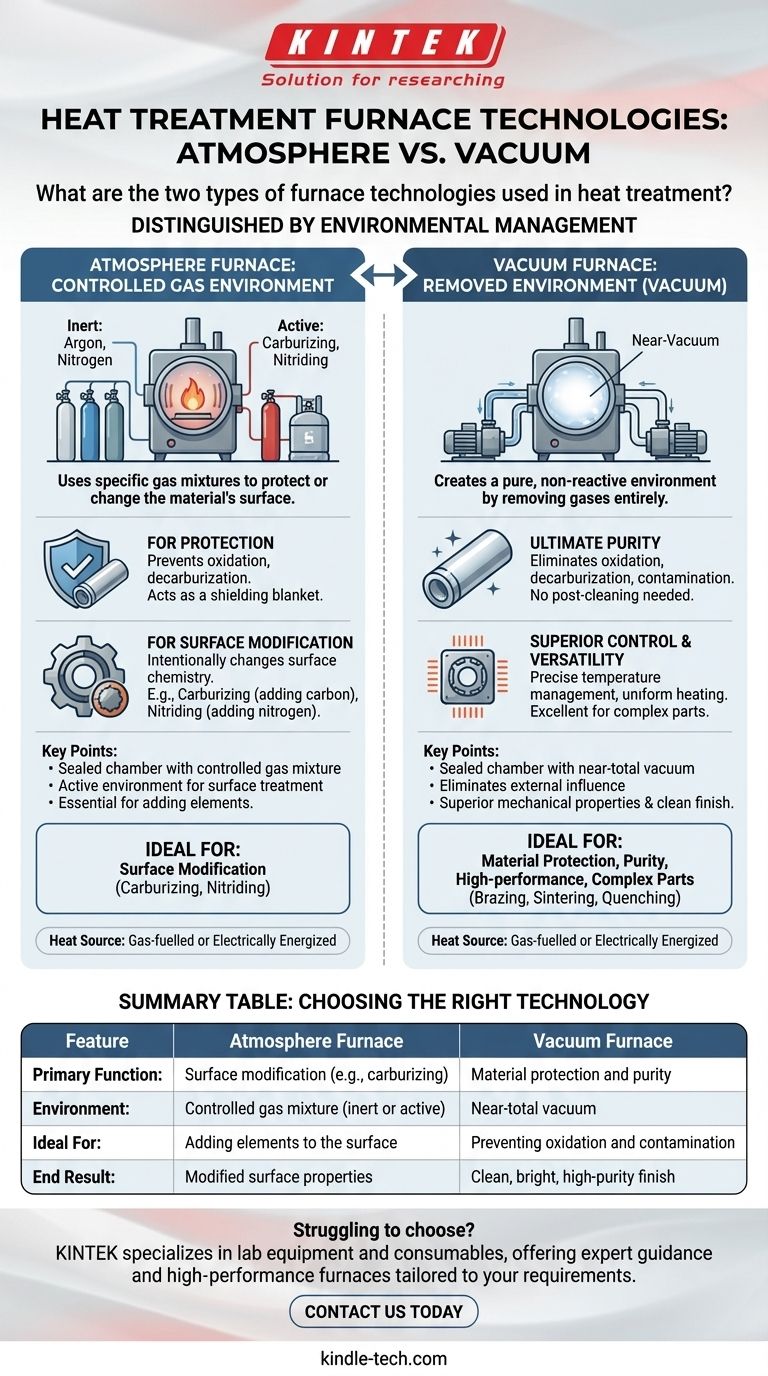
What are the two types of furnace technologies used in heat treatment? Atmosphere vs. Vacuum Explained Visual Guide

Related Products

People Also Ask

Related Products

Vacuum Heat Treat Furnace with Ceramic Fiber Liner

Vacuum Heat Treat Furnace with Ceramic Fiber Liner

Vacuum furnace with polycrystalline ceramic fiber insulation liner for excellent heat insulation and uniform temperature field. Choose from 1200℃ or 1700℃ max. working temperature with high vacuum performance and precise temperature control.

2200 ℃ Graphite Vacuum Heat Treat Furnace

2200 ℃ Graphite Vacuum Heat Treat Furnace

Discover the power of the KT-VG Graphite Vacuum Furnace - with a maximum working temperature of 2200℃, it's perfect for vacuum sintering of various materials. Learn more now.

Molybdenum Vacuum Heat Treat Furnace

Molybdenum Vacuum Heat Treat Furnace

Discover the benefits of a high-configuration molybdenum vacuum furnace with heat shield insulation. Ideal for high-purity, vacuum environments like sapphire crystal growth and heat treatment.

600T Vacuum Induction Hot Press Furnace for Heat Treat and Sintering

600T Vacuum Induction Hot Press Furnace for Heat Treat and Sintering

Discover the 600T Vacuum Induction Hot Press Furnace, designed for high-temperature sintering experiments in vacuum or protected atmospheres. Its precise temperature and pressure control, adjustable working pressure, and advanced safety features make it ideal for nonmetal materials, carbon composites, ceramics, and metal powders.

Vacuum Heat Treat and Pressure Sintering Furnace for High Temperature Applications

Vacuum Heat Treat and Pressure Sintering Furnace for High Temperature Applications

Vacuum pressure sintering furnaces are designed for high temperature hot pressing applications in metal and ceramic sintering. Its advanced features ensure precise temperature control, reliable pressure maintenance, and a robust design for seamless operation.

1400℃ Controlled Atmosphere Furnace with Nitrogen and Inert Atmosphere

1400℃ Controlled Atmosphere Furnace with Nitrogen and Inert Atmosphere

Achieve precise heat treatment with KT-14A controlled atmosphere furnace. Vacuum sealed with a smart controller, it's ideal for lab and industrial use up to 1400℃.

1200℃ Controlled Atmosphere Furnace Nitrogen Inert Atmosphere Furnace

1200℃ Controlled Atmosphere Furnace Nitrogen Inert Atmosphere Furnace

Discover our KT-12A Pro Controlled atmosphere furnace - high precision, heavy duty vacuum chamber, versatile smart touch screen controller, and excellent temperature uniformity up to 1200C. Ideal for both laboratory and industrial application.

1700℃ Controlled Atmosphere Furnace Nitrogen Inert Atmosphere Furnace

1700℃ Controlled Atmosphere Furnace Nitrogen Inert Atmosphere Furnace

KT-17A Controlled atmosphere furnace: 1700℃ heating, vacuum sealing technology, PID temperature control, and versatile TFT smart touch screen controller for laboratory and industrial use.

2200 ℃ Tungsten Vacuum Heat Treat and Sintering Furnace

2200 ℃ Tungsten Vacuum Heat Treat and Sintering Furnace

Experience the ultimate refractory metal furnace with our Tungsten vacuum furnace. Capable of reaching 2200℃, perfect for sintering advanced ceramics and refractory metals. Order now for high-quality results.

Laboratory Rapid Thermal Processing (RTP) Quartz Tube Furnace

Laboratory Rapid Thermal Processing (RTP) Quartz Tube Furnace

Get lightning-fast heating with our RTP Rapid Heating Tube Furnace. Designed for precise, high-speed heating and cooling with convenient sliding rail and TFT touch screen controller. Order now for ideal thermal processing!

Vacuum Hot Press Furnace Machine Heated Vacuum Press

Vacuum Hot Press Furnace Machine Heated Vacuum Press

Discover the advantages of Vacuum Hot Press Furnace! Manufacture dense refractory metals & compounds, ceramics, and composites under high temp and pressure.

Multi-zone Laboratory Tube Furnace

Multi-zone Laboratory Tube Furnace

Experience precise, efficient thermal testing with our Multi Zone Tube Furnace. Independent heating zones and temperature sensors allow for controlled high-temperature gradient heating fields. Order now for advanced thermal analysis!

Electric Rotary Kiln Continuous Working Small Rotary Furnace Heating Pyrolysis Plant

Electric Rotary Kiln Continuous Working Small Rotary Furnace Heating Pyrolysis Plant

Efficiently calcine and dry bulk powder and lump fluid materials with an electric heating rotary furnace. Ideal for processing lithium ion battery materials and more.

Laboratory Muffle Oven Furnace Bottom Lifting Muffle Furnace

Laboratory Muffle Oven Furnace Bottom Lifting Muffle Furnace

Efficiently produce batches with excellent temperature uniformity using our Bottom Lifting Furnace. Features two electric lifting stages and advanced temperature control up to 1600℃.

High Temperature Muffle Oven Furnace for Laboratory Debinding and Pre Sintering

High Temperature Muffle Oven Furnace for Laboratory Debinding and Pre Sintering

KT-MD High temperature debinding and pre-sintering furnace for ceramic materials with various molding processes. Ideal for electronic components such as MLCC and NFC.

Ultra-High Temperature Graphite Vacuum Graphitization Furnace

Ultra-High Temperature Graphite Vacuum Graphitization Furnace

The ultra-high temperature graphitization furnace utilizes medium frequency induction heating in a vacuum or inert gas environment. The induction coil generates an alternating magnetic field, inducing eddy currents in the graphite crucible, which heats up and radiates heat to the workpiece, bringing it to the desired temperature. This furnace is primarily used for graphitization and sintering of carbon materials, carbon fiber materials, and other composite materials.

1200℃ Split Tube Furnace with Quartz Tube Laboratory Tubular Furnace

1200℃ Split Tube Furnace with Quartz Tube Laboratory Tubular Furnace

KT-TF12 split tube furnace: high-purity insulation, embedded heating wire coils, and max. 1200C. Widely used for new materials and chemical vapour deposition.

Horizontal High Temperature Graphite Vacuum Graphitization Furnace

Horizontal High Temperature Graphite Vacuum Graphitization Furnace

Horizontal Graphitization Furnace: This type of furnace is designed with the heating elements placed horizontally, allowing for uniform heating of the sample. It's well-suited for graphitizing large or bulky samples that require precise temperature control and uniformity.

Vacuum Sealed Continuous Working Rotary Tube Furnace Rotating Tube Furnace

Vacuum Sealed Continuous Working Rotary Tube Furnace Rotating Tube Furnace

Experience efficient material processing with our vacuum-sealed rotary tube furnace. Perfect for experiments or industrial production, equipped with optional features for controlled feeding and optimized results. Order now.

1700℃ Muffle Oven Furnace for Laboratory

1700℃ Muffle Oven Furnace for Laboratory

Get superior heat control with our 1700℃ Muffle Furnace. Equipped with intelligent temperature microprocessor, TFT touch screen controller & advanced insulation materials for precise heating up to 1700C. Order now!


Leave Your Message



















