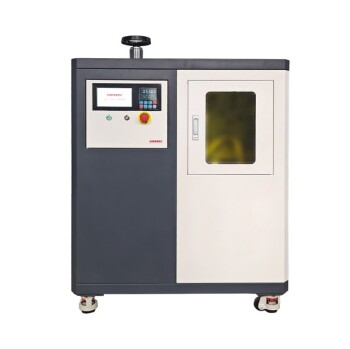
The Hot Press functions as the central mechanism for structural conditioning in the fabrication of Thallium Bromide (TlBr) semiconductor crystals. By applying a constant pressure of approximately 30 kN at precisely controlled temperatures between 455°C and 465°C, it transforms purified TlBr powder into a solid, high-density mass. This quasi-static pressurization is not merely for shaping; it is the critical step that defines the crystal's internal quality and suitability for radiation detection.
Core Insight: The Hot Press utilizes a specific synergy of heat and mechanical force to eliminate internal porosity and residual stresses. Without this precise densification, the material would lack the structural integrity and specific crystal orientation required to achieve high energy resolution and detection efficiency.
The Mechanics of Material Transformation
Precise Thermomechanical Coupling
The efficacy of the Hot Press relies on the simultaneous application of thermal and mechanical energy.
The system maintains a temperature range of 455-465°C, which is near the material's melting point, while exerting 30 kN of continuous axial pressure.
This coupled environment, typically sustained for a duration of two hours, allows for the sintering and rearrangement of the raw powder materials into a cohesive block.
Eliminating Structural Defects
A primary function of the Hot Press is the removal of internal imperfections that degrade detector performance.
The process eliminates internal micro-porosity and tightens inter-granular bonding through densification.
Furthermore, the quasi-static nature of the pressurization relieves internal residual stresses, preventing physical weaknesses in the final crystal block.
Achieving Detector-Grade Performance
Controlling Crystal Orientation
For a semiconductor to function correctly in photon counting, the arrangement of its lattice structure must be consistent.
The Hot Press regulates the growth orientation of the crystals during the consolidation phase.
By controlling the stress field within the material, the machine ensures the crystal orientation is uniform, which is vital for stable electrical properties.
Enhancing Detection Metrics
The physical improvements imparted by the Hot Press directly translate to the device's operational capabilities.
High-density consolidation results in a superior gamma-ray attenuation coefficient.
Consequently, crystals processed this way exhibit high photon counting efficiency and excellent energy resolution, making them "detector-grade."
Understanding the Operational Constraints
The Necessity of Precision
While the Hot Press is a powerful tool, it requires exacting control over its operating parameters.
The temperature window is narrow (455-465°C); deviating from this range can compromise the material's integrity or fail to achieve proper sintering.
Similarly, the pressure must remain constant to ensure uniform density; fluctuations could reintroduce stress or create inconsistent grain structures.
Making the Right Choice for Your Goal
To maximize the potential of Thallium Bromide detectors, you must correlate the manufacturing process with your specific end-use requirements.
- If your primary focus is high energy resolution: Ensure the hot pressing process prioritizes the complete elimination of internal residual stresses to prevent signal degradation.
- If your primary focus is maximum detection efficiency: Prioritize the densification parameters to achieve the highest possible gamma-ray attenuation coefficient and eliminate micro-porosity.
The Hot Press is the bridge between raw chemical purity and the physical reality required for high-performance radiation detection.
Summary Table:
| Parameter | Operating Specification | Impact on TlBr Quality |
|---|---|---|
| Temperature | 455°C - 465°C | Enables sintering near melting point while maintaining integrity |
| Applied Pressure | ~30 kN (Axial) | Eliminates micro-porosity and ensures high-density consolidation |
| Processing Time | ~2 Hours | Allows for stress relief and uniform grain rearrangement |
| Environment | Quasi-static Pressurization | Regulates crystal orientation and prevents internal defects |
Elevate Your Material Research with KINTEK Advanced Hot Pressing Systems
Precise control over thermomechanical parameters is the difference between raw material and a high-performance semiconductor. KINTEK specializes in precision laboratory equipment designed for the most demanding material transformations. Our industry-leading range of hydraulic presses (pellet, hot, and isostatic), high-temperature furnaces, and crushing systems provide the exact pressure and thermal stability required for TlBr crystal development.
Whether you are focusing on high energy resolution or maximum detection efficiency, our technical team is ready to help you optimize your laboratory workflow with our comprehensive portfolio of high-temperature reactors, autoclaves, and specialized consumables.
Unlock detector-grade performance today. Contact KINTEK for a custom solution!
References
- Marta Kuwik, Wojciech Pisarsk. Near-infrared luminescence properties of germanate based glasses as a function of glass modifier TiO2. DOI: 10.21175/rad.abstr.book.2023.19.2
This article is also based on technical information from Kintek Solution Knowledge Base .
Related Products
- 30T 40T Split Automatic Heated Hydraulic Press Machine with Heated Plates for Laboratory Hot Press
- Lab Infrared Press Mold
- Warm Isostatic Press for Solid State Battery Research
People Also Ask
- What are the advantages of using a laboratory hydraulic press for hot pressing? Achieve Peak Nano-Composite Density
- What are the core advantages of using a laboratory hot press to produce Bi2Se3? Achieve 93% Density & High Conductivity
- Why is a laboratory hydraulic hot press essential for high-density, additive-free Silicon Carbide? Unlock Pure SiC.
- How does a laboratory hydraulic hot press ensure the quality of PHBV/natural fiber composites? Expert Guide
- What is the function of a laboratory hydraulic hot press in the assembly of solid-state photoelectrochemical cells?