Knowledge What does it mean to sinter metals? A Guide to Solid-State Fusion for Strong, Complex Parts
Author avatar

Tech Team · Kintek Solution

Updated 6 days ago

What does it mean to sinter metals? A Guide to Solid-State Fusion for Strong, Complex Parts


In short, sintering metal is a manufacturing process that uses heat and pressure to fuse metal powders into a solid, functional part. Crucially, this is accomplished at temperatures below the metal's melting point, causing the particles to bond at an atomic level without ever turning into a liquid.

The central concept to grasp is that sintering is a form of solid-state fusion. It allows for the creation of strong, often complex, metal components directly from a powder, bypassing the need for traditional melting and casting.
What does it mean to sinter metals? A Guide to Solid-State Fusion for Strong, Complex Parts

How Sintering Transforms Powder into a Solid Part

The process isn't just about applying heat; it's a precise, multi-step method designed to create parts with specific properties. It fundamentally relies on the principle of atomic diffusion—where atoms from individual powder granules migrate across boundaries to form strong metallic bonds with their neighbors.

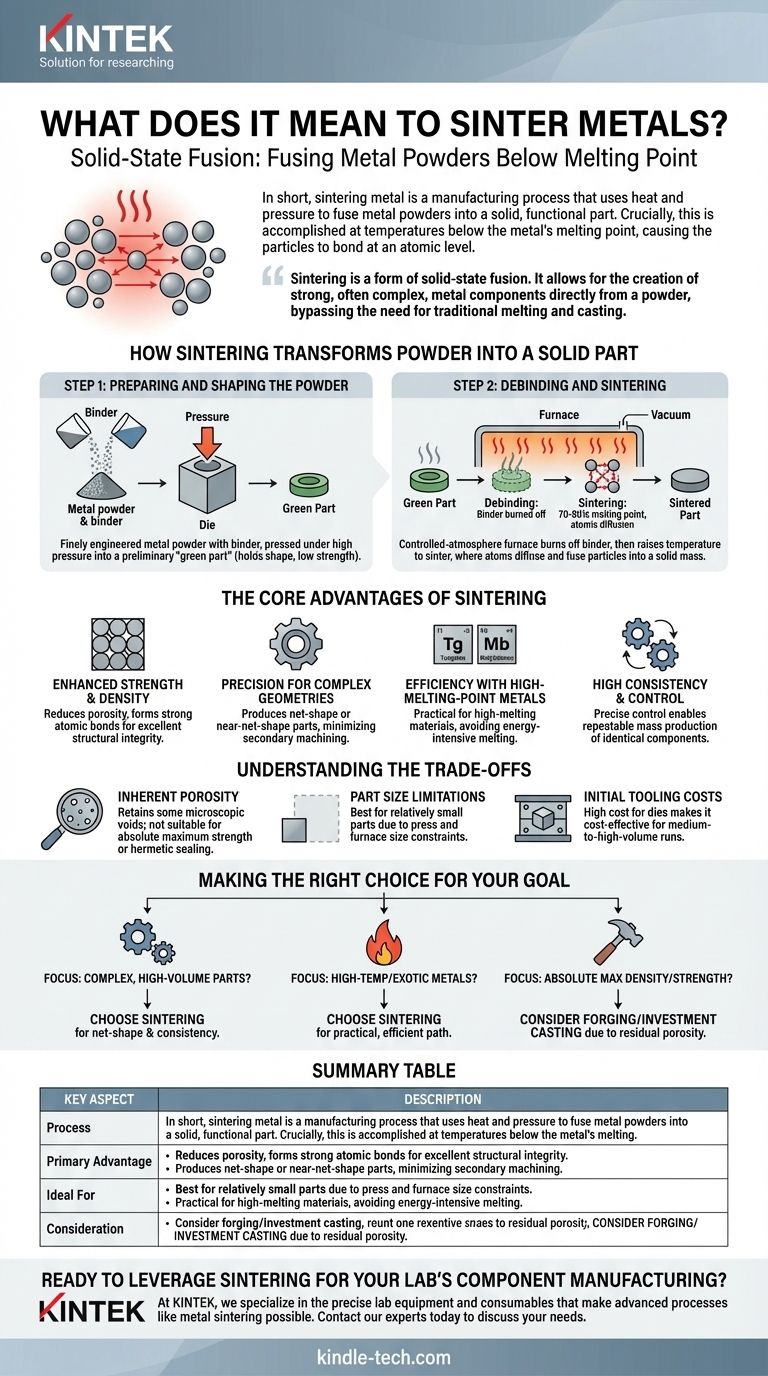
Step 1: Preparing and Shaping the Powder

The journey begins with finely engineered metal powder. This powder is often mixed with a temporary polymeric binder to improve its molding characteristics.

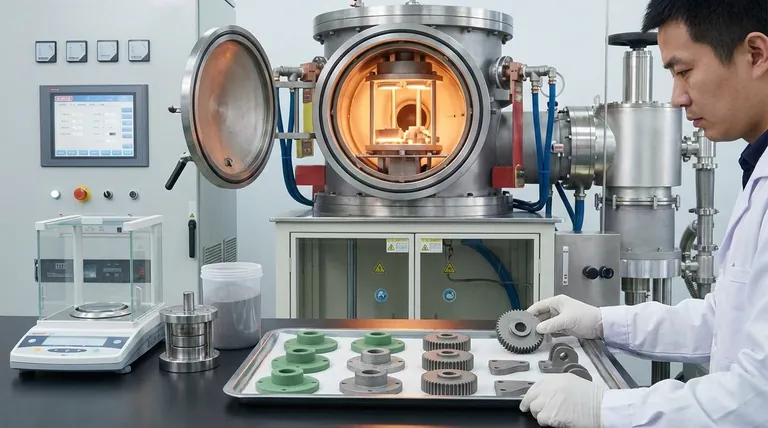
This mixture is then poured into a die and compacted under high pressure to form a fragile, preliminary shape known as a "green part." This part holds its shape but has not yet developed its final strength.

Step 2: Debinding and Sintering

The green part is placed into a controlled-atmosphere furnace, often a vacuum furnace. The initial heating phase is called debinding, where the binder material is carefully burned off.

Next, the temperature is raised to the sintering point. At this high temperature—typically 70-90% of the metal's melting point—the atoms in the metal particles become highly agitated and begin to diffuse across the particle boundaries, fusing them together into a solid, coherent mass.

The Core Advantages of Sintering

Manufacturers choose sintering not just because it's interesting, but because it offers distinct advantages for creating certain types of components, from automotive gears to electrical contacts.

Enhanced Strength and Density

The process significantly reduces the empty space, or porosity, that existed between the loose powder granules. This densification, combined with the formation of strong atomic bonds, results in a part with excellent structural integrity and durability.

Precision for Complex Geometries

Sintering is exceptionally good at producing net-shape or near-net-shape parts. This means the component comes out of the furnace very close to its final dimensions, drastically reducing or even eliminating the need for expensive and time-consuming secondary machining.

Efficiency with High-Melting-Point Metals

For metals like tungsten or molybdenum, which have extremely high melting points, melting and casting is an energy-intensive and difficult process. Sintering provides a more practical and cost-effective method to form these materials into usable parts.

High Consistency and Control

Because the process is based on precise control over powder composition, pressure, temperature, and time, it is highly repeatable. This makes sintering an ideal choice for the mass production of consistent, identical components.

Understanding the Trade-offs

No manufacturing process is perfect for every application. To use sintering effectively, it's critical to understand its limitations.

Inherent Porosity

While sintering dramatically increases density, it rarely eliminates all porosity. Most sintered parts retain a small percentage of microscopic voids. For applications requiring absolute maximum strength or hermetic sealing, this residual porosity can be a disqualifying factor.

Part Size Limitations

The need for high-pressure compaction and large, specialized furnaces means that sintering is typically best suited for producing relatively small parts. Creating very large components via sintering is often impractical or economically unfeasible.

Initial Tooling Costs

The dies required to press the metal powders into their green shapes are made from hardened tool steel and can be expensive to produce. This initial investment means sintering is most cost-effective for medium-to-high-volume production runs that can amortize the cost of the tooling.

Making the Right Choice for Your Goal

Selecting sintering depends entirely on the specific requirements of your component and production scale.

  • If your primary focus is producing complex, high-volume parts: Sintering is an excellent choice for its ability to create near-net-shape components with high consistency, minimizing machining costs.
  • If your primary focus is working with high-temperature or exotic metals: Sintering offers a more practical and energy-efficient manufacturing path than attempting to melt and cast these materials.
  • If your primary focus is achieving the absolute maximum density and fatigue strength: You may need to consider a process like forging or investment casting, as the residual porosity in sintered parts can be a limiting factor for extreme-performance applications.

By understanding its principles, you can leverage sintering as a powerful tool for efficient and precise metal component manufacturing.

Summary Table:

Key Aspect Description
Process Fusing metal powders using heat and pressure below the melting point (solid-state diffusion).
Primary Advantage Creates complex, net-shape parts with high consistency and minimal machining.
Ideal For High-volume production and working with high-melting-point metals like tungsten.
Consideration Parts have slight inherent porosity; initial tooling costs are high.

Ready to leverage sintering for your lab's component manufacturing?

At KINTEK, we specialize in the precise lab equipment and consumables that make advanced processes like metal sintering possible. Whether you're developing new materials or scaling up production, our expertise and high-quality solutions can help you achieve superior results.

Contact our experts today to discuss how we can support your laboratory's specific needs and drive your projects forward.

Visual Guide
What does it mean to sinter metals? A Guide to Solid-State Fusion for Strong, Complex Parts Visual Guide

Related Products

People Also Ask

Related Products

2200 ℃ Tungsten Vacuum Heat Treat and Sintering Furnace

2200 ℃ Tungsten Vacuum Heat Treat and Sintering Furnace

Experience the ultimate refractory metal furnace with our Tungsten vacuum furnace. Capable of reaching 2200℃, perfect for sintering advanced ceramics and refractory metals. Order now for high-quality results.

Molybdenum Vacuum Heat Treat Furnace

Molybdenum Vacuum Heat Treat Furnace

Discover the benefits of a high-configuration molybdenum vacuum furnace with heat shield insulation. Ideal for high-purity, vacuum environments like sapphire crystal growth and heat treatment.

Vacuum Heat Treat Sintering Brazing Furnace

Vacuum Heat Treat Sintering Brazing Furnace

A vacuum brazing furnace is a type of industrial furnace used for brazing, a metalworking process that joins two pieces of metal using a filler metal that melts at a lower temperature than the base metals. Vacuum brazing furnaces are typically used for high-quality applications where a strong, clean joint is required.

Vacuum Heat Treat and Sintering Furnace with 9MPa Air Pressure

Vacuum Heat Treat and Sintering Furnace with 9MPa Air Pressure

The air pressure sintering furnace is a high-tech equipment commonly used for the sintering of advanced ceramic materials. It combines vacuum sintering and pressure sintering techniques to achieve high-density and high-strength ceramics.

Vacuum Heat Treat and Molybdenum Wire Sintering Furnace for Vacuum Sintering

Vacuum Heat Treat and Molybdenum Wire Sintering Furnace for Vacuum Sintering

A vacuum molybdenum wire sintering furnace is a vertical or bedroom structure, which is suitable for withdrawal, brazing, sintering and degassing of metal materials under high vacuum and high temperature conditions. It is also suitable for dehydroxylation treatment of quartz materials.

Small Vacuum Heat Treat and Tungsten Wire Sintering Furnace

Small Vacuum Heat Treat and Tungsten Wire Sintering Furnace

The small vacuum tungsten wire sintering furnace is a compact experimental vacuum furnace specially designed for universities and scientific research institutes. The furnace features a CNC welded shell and vacuum piping to ensure leak-free operation. Quick-connect electrical connections facilitate relocation and debugging, and the standard electrical control cabinet is safe and convenient to operate.

600T Vacuum Induction Hot Press Furnace for Heat Treat and Sintering

600T Vacuum Induction Hot Press Furnace for Heat Treat and Sintering

Discover the 600T Vacuum Induction Hot Press Furnace, designed for high-temperature sintering experiments in vacuum or protected atmospheres. Its precise temperature and pressure control, adjustable working pressure, and advanced safety features make it ideal for nonmetal materials, carbon composites, ceramics, and metal powders.

Dental Porcelain Zirconia Sintering Ceramic Vacuum Press Furnace

Dental Porcelain Zirconia Sintering Ceramic Vacuum Press Furnace

Get precise dental results with Dental Vacuum Press Furnace. Automatic temperature calibration, low noise tray, and touch screen operation. Order now!

Vacuum Hot Press Furnace Heated Vacuum Press Machine Tube Furnace

Vacuum Hot Press Furnace Heated Vacuum Press Machine Tube Furnace

Reduce forming pressure & shorten sintering time with Vacuum Tube Hot Press Furnace for high-density, fine-grain materials. Ideal for refractory metals.

2200 ℃ Graphite Vacuum Heat Treat Furnace

2200 ℃ Graphite Vacuum Heat Treat Furnace

Discover the power of the KT-VG Graphite Vacuum Furnace - with a maximum working temperature of 2200℃, it's perfect for vacuum sintering of various materials. Learn more now.

Vacuum Heat Treat Furnace with Ceramic Fiber Liner

Vacuum Heat Treat Furnace with Ceramic Fiber Liner

Vacuum furnace with polycrystalline ceramic fiber insulation liner for excellent heat insulation and uniform temperature field. Choose from 1200℃ or 1700℃ max. working temperature with high vacuum performance and precise temperature control.

Non Consumable Vacuum Arc Induction Melting Furnace

Non Consumable Vacuum Arc Induction Melting Furnace

Explore the benefits of Non-Consumable Vacuum Arc Furnace with high melting point electrodes. Small, easy to operate & eco-friendly. Ideal for laboratory research on refractory metals & carbides.

Ultra-High Temperature Graphite Vacuum Graphitization Furnace

Ultra-High Temperature Graphite Vacuum Graphitization Furnace

The ultra-high temperature graphitization furnace utilizes medium frequency induction heating in a vacuum or inert gas environment. The induction coil generates an alternating magnetic field, inducing eddy currents in the graphite crucible, which heats up and radiates heat to the workpiece, bringing it to the desired temperature. This furnace is primarily used for graphitization and sintering of carbon materials, carbon fiber materials, and other composite materials.

Vacuum Dental Porcelain Sintering Furnace

Vacuum Dental Porcelain Sintering Furnace

Get precise and reliable results with KinTek's Vacuum Porcelain Furnace. Suitable for all porcelain powders, it features hyperbolic ceramic furnace function, voice prompt, and automatic temperature calibration.

Graphite Vacuum Furnace High Thermal Conductivity Film Graphitization Furnace

Graphite Vacuum Furnace High Thermal Conductivity Film Graphitization Furnace

The high thermal conductivity film graphitization furnace has uniform temperature, low energy consumption and can operate continuously.

Graphite Vacuum Furnace IGBT Experimental Graphitization Furnace

Graphite Vacuum Furnace IGBT Experimental Graphitization Furnace

IGBT experimental graphitization furnace, a tailored solution for universities and research institutions, with high heating efficiency, user-friendliness, and precise temperature control.

Vertical High Temperature Graphite Vacuum Graphitization Furnace

Vertical High Temperature Graphite Vacuum Graphitization Furnace

Vertical high temperature graphitization furnace for carbonization and graphitization of carbon materials up to 3100℃.Suitable for shaped graphitization of carbon fiber filaments and other materials sintered in a carbon environment.Applications in metallurgy, electronics, and aerospace for producing high-quality graphite products like electrodes and crucibles.

1400℃ Controlled Atmosphere Furnace with Nitrogen and Inert Atmosphere

1400℃ Controlled Atmosphere Furnace with Nitrogen and Inert Atmosphere

Achieve precise heat treatment with KT-14A controlled atmosphere furnace. Vacuum sealed with a smart controller, it's ideal for lab and industrial use up to 1400℃.

1200℃ Controlled Atmosphere Furnace Nitrogen Inert Atmosphere Furnace

1200℃ Controlled Atmosphere Furnace Nitrogen Inert Atmosphere Furnace

Discover our KT-12A Pro Controlled atmosphere furnace - high precision, heavy duty vacuum chamber, versatile smart touch screen controller, and excellent temperature uniformity up to 1200C. Ideal for both laboratory and industrial application.

Split Chamber CVD Tube Furnace with Vacuum Station Chemical Vapor Deposition System Equipment Machine

Split Chamber CVD Tube Furnace with Vacuum Station Chemical Vapor Deposition System Equipment Machine

Efficient split chamber CVD furnace with vacuum station for intuitive sample checking and quick cooling. Up to 1200℃ max temperature with accurate MFC mass flowmeter control.


Leave Your Message