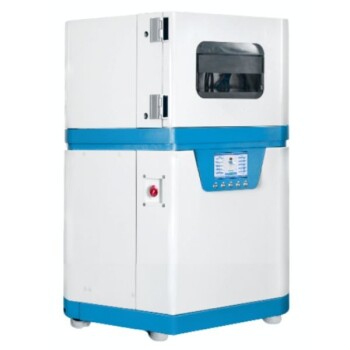
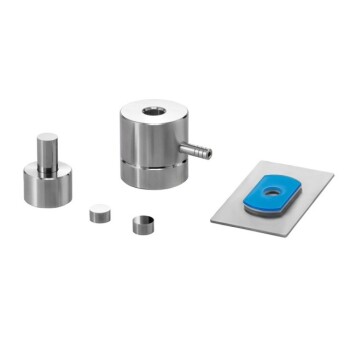
In the fabrication of Li@LCP-Cu composite materials, a hot press functions as a precision integration tool that forces ultra-thin lithium foil into a three-dimensional lithiophilic carbon paper (LCP) framework. By applying controlled temperature and pressure, the device physically merges the malleable lithium source with the porous current collector to create a unified, void-free composite.
Core Takeaway The hot press is essential for eliminating microscopic gaps between the lithium metal and the current collector. This process transforms a loose assembly into a cohesive unit with low contact resistance, enabling the effective pre-storage of lithium and ensuring uniform electrochemical deposition.
The Mechanics of Structural Integration
Physical Infusion of Lithium
The primary function of the hot press is to overcome the physical separation between distinct materials. In this specific application, it acts upon ultra-thin lithium foil or similar lithium sources.
Under the influence of heat, the lithium becomes more malleable. The applied pressure then forces this softened metal into the intricate structure of the 3D carbon paper.
Elimination of Interfacial Voids
Simply layering materials often leaves microscopic air gaps or "dead zones" at the interface. These gaps prevent direct interaction between the active material and the current collector.
The hot press compresses the assembly to physically eliminate these gaps. This ensures that the lithium is not just sitting on top of the carbon paper, but is tightly interlocked with it.
Electrochemical Implications
Minimizing Contact Resistance
The mechanical tightness achieved by the hot press directly translates to electrical performance. By maximizing the surface area of contact, the process significantly lowers electrical resistance.
A low-resistance connection is critical for battery efficiency. It ensures that electrons can flow freely between the lithium source and the copper current collector without energy loss.
Inducing Uniform Deposition
The hot press prepares the material for its operational life. By embedding the lithium uniformly into the lithiophilic framework, the device effectively "pre-stores" the lithium source.
This uniform distribution is vital for subsequent cycles. It encourages the lithium to deposit and strip evenly across the surface, rather than forming dangerous dendrites or hotspots.
Understanding the Critical Variables
While the primary goal is integration, the "controlled" aspect of the temperature and pressure mentioned in the primary reference is paramount.
The Risk of Under-Processing
If the pressure or temperature is insufficient, the lithium will not fully penetrate the carbon framework. This results in residual voids, which lead to high internal resistance and uneven current distribution.
The Risk of Over-Processing
Conversely, excessive force or heat can be detrimental. While the goal is a dense composite, one must preserve the structural integrity of the 3D carbon framework to maintain its benefits as a scaffold.
Making the Right Choice for Your Fabrication
When utilizing a hot press for Li@LCP-Cu composites, your specific objectives will dictate your parameter settings.
- If your primary focus is minimizing internal resistance: Prioritize pressure settings that maximize the density of the composite to ensure complete elimination of interfacial gaps.
- If your primary focus is cycle stability: Focus on temperature control to ensure the lithium softens enough to flow uniformly into the 3D structure without damaging the carbon paper architecture.
Ultimately, the hot press bridges the gap between raw materials and a functional electrode by ensuring the physical intimacy required for high-performance electrochemical reactions.
Summary Table:
| Function | Description | Impact on Performance |
|---|---|---|
| Physical Infusion | Forces softened lithium into the 3D carbon framework | Creates a unified, void-free composite structure |
| Interfacial Elimination | Removes microscopic air gaps between layers | Maximizes surface contact for better electron flow |
| Resistance Reduction | Tightens the bond between Li and Cu collector | Minimizes energy loss and internal resistance |
| Deposition Control | Pre-stores lithium uniformly in the scaffold | Encourages even stripping and inhibits dendrite growth |
Elevate Your Battery Research with KINTEK Precision Hot Presses
High-performance Li@LCP-Cu composites require more than just heat—they demand precision. KINTEK specializes in advanced laboratory equipment, providing researchers with the high-accuracy hydraulic presses (pellet, hot, isostatic) needed to achieve perfect interfacial contact and structural integrity.
Our extensive portfolio also includes high-temperature furnaces, high-pressure reactors, and specialized battery research tools designed to streamline your material fabrication. Don't let interfacial voids compromise your electrochemical results.
Contact us today to find the perfect hot press solution for your laboratory!
Related Products
- Automatic Heated Hydraulic Press Machine with Heated Plates for Laboratory Hot Press 25T 30T 50T
- Manual High Temperature Heated Hydraulic Press Machine with Heated Plates for Lab
- Touchscreen Automatic Vacuum Heat Press
- 30T 40T Split Automatic Heated Hydraulic Press Machine with Heated Plates for Laboratory Hot Press
- Vacuum Hot Press Furnace Machine Heated Vacuum Press
People Also Ask
- Why is the heating function of a laboratory hydraulic press essential for MEA assembly in DEFC? Optimize Cell Bonding
- What technical conditions does a heated hydraulic press provide for PEO batteries? Optimize Solid-State Interfaces
- How is a heated hydraulic press used for Li-LLZO batteries? Optimize Interfacial Bonding with Thermal-Pressure
- What role does a heated hydraulic press play in Cold Sintering (CSP)? Enhancing LATP-Halide Densification
- What are heated hydraulic presses used for? Molding Composites, Vulcanizing Rubber, and More