Knowledge What function does a vacuum annealing furnace perform for tungsten-diamond coatings? Achieve Strong Metallurgical Bonds
Author avatar

Tech Team · Kintek Solution

Updated 6 days ago

What function does a vacuum annealing furnace perform for tungsten-diamond coatings? Achieve Strong Metallurgical Bonds


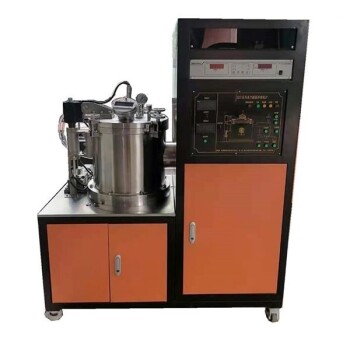
The primary function of a vacuum annealing furnace in this context is to create a controlled environment where heat drives the diffusion process without chemical contamination. By maintaining a high vacuum (typically around $1.0 \times 10^{-3}$ Pa), the furnace allows carbon atoms from the diamond to migrate and react with the tungsten powder. This specific condition is the only way to form a durable tungsten carbide interface layer while strictly preventing the oxidation of both materials.

Solid-state diffusion relies on the vacuum annealing furnace to eliminate oxygen and provide precise thermal energy. This environment enables a chemical reaction between diamond carbon and tungsten, creating a metallurgical bond via a tungsten carbide interface rather than a simple mechanical adhesion.

The Role of Environmental Control

To understand the furnace's function, you must look at the specific vulnerabilities of the materials involved. The furnace solves two critical problems that occur when heating diamond and tungsten.

Preventing Oxidation

Both tungsten and diamond are highly reactive to oxygen at the elevated temperatures required for diffusion.

If heated in a standard atmosphere, tungsten powder would rapidly oxidize, rendering it useless for coating.

The vacuum environment removes atmospheric oxygen, protecting the materials from degradation.

Precision Pressure Management

The furnace maintains a specific high-vacuum level, cited as $1.0 \times 10^{-3}$ Pa.

This deep vacuum is essential for removing volatile impurities that could otherwise interfere with the coating process.

It ensures that the environment surrounding the diamond is chemically inert, allowing only the intended diffusion reactions to occur.

Facilitating the Chemical Bond

Beyond protection, the furnace acts as the active driver of the metallurgical process. It provides the energy required to change the atomic structure at the material interface.

Driving Carbon Diffusion

The furnace supplies precise high-temperature control to the system.

This thermal energy causes carbon atoms on the surface of the diamond to become mobile.

These atoms diffuse outward from the diamond lattice into the surrounding tungsten powder.

Creating the Interface Layer

As the carbon atoms meet the tungsten, a chemical reaction is triggered.

This reaction forms tungsten carbide (specifically WC or W2C).

This carbide layer acts as a chemical bridge, bonding the tungsten coating firmly to the diamond substrate.

Understanding the Trade-offs

While vacuum annealing is the definitive method for achieving this chemical bond, it introduces specific operational constraints.

Process Complexity and Time

Achieving and maintaining a high vacuum of $1.0 \times 10^{-3}$ Pa requires sophisticated pumping systems and rigorous seal integrity.

The process is generally slower than atmospheric heating methods due to the time required to pump down the chamber and cool it safely.

Sensitivity to Contamination

The system is unforgiving of leaks or maintenance lapses.

Even a minor breach in vacuum integrity during the heating phase can lead to immediate oxidation of the tungsten, resulting in a failed batch.

Optimizing the Diffusion Process

The vacuum annealing furnace is not just a heater; it is a reactor that synthesizes a new composite interface. Your success depends on how you manage the variables of heat and pressure.

  • If your primary focus is bond strength: Ensure the temperature profile allows sufficient time for the carbon diffusion to react with the tungsten, fully forming the WC/W2C interface layer.
  • If your primary focus is material purity: Rigorously monitor vacuum levels to stay at or below $1.0 \times 10^{-3}$ Pa to eliminate any risk of oxide formation on the tungsten powder.

Ultimately, the vacuum annealing furnace acts as the catalyst that transforms loose tungsten powder and diamond grit into a chemically unified, high-performance composite.

Summary Table:

Feature Function in Diffusion Process Benefit to Coating Quality
High Vacuum ($1.0 \times 10^{-3}$ Pa) Eliminates atmospheric oxygen and volatile impurities Prevents tungsten oxidation and ensures material purity
Thermal Energy Control Mobilizes carbon atoms within the diamond lattice Drives the outward diffusion necessary for chemical reaction
Controlled Environment Facilitates chemical reaction between C and W Creates a WC/W2C carbide interface for superior adhesion
Interface Synthesis Transforms mechanical contact into metallurgical bonding Enhances bond strength and thermal stability of the composite

Elevate Your Material Science with KINTEK Precision

Unlock the full potential of your diamond coating and solid-state diffusion processes with KINTEK’s advanced thermal solutions. Whether you are developing high-performance composites or conducting cutting-edge battery research, our comprehensive range of high-temperature vacuum and atmosphere furnaces provides the precise environment needed to prevent oxidation and ensure metallurgical excellence.

From crushing and milling systems for powder preparation to high-pressure reactors, autoclaves, and hydraulic presses for material synthesis, KINTEK specializes in delivering the laboratory equipment and consumables essential for high-tech manufacturing.

Ready to optimize your lab’s efficiency and coating durability?

Contact KINTEK today for a customized consultation!

Related Products

People Also Ask

Related Products

Vacuum Heat Treat Furnace with Ceramic Fiber Liner

Vacuum Heat Treat Furnace with Ceramic Fiber Liner

Vacuum furnace with polycrystalline ceramic fiber insulation liner for excellent heat insulation and uniform temperature field. Choose from 1200℃ or 1700℃ max. working temperature with high vacuum performance and precise temperature control.

Molybdenum Vacuum Heat Treat Furnace

Molybdenum Vacuum Heat Treat Furnace

Discover the benefits of a high-configuration molybdenum vacuum furnace with heat shield insulation. Ideal for high-purity, vacuum environments like sapphire crystal growth and heat treatment.

Vacuum Heat Treat Sintering Brazing Furnace

Vacuum Heat Treat Sintering Brazing Furnace

A vacuum brazing furnace is a type of industrial furnace used for brazing, a metalworking process that joins two pieces of metal using a filler metal that melts at a lower temperature than the base metals. Vacuum brazing furnaces are typically used for high-quality applications where a strong, clean joint is required.

2200 ℃ Graphite Vacuum Heat Treat Furnace

2200 ℃ Graphite Vacuum Heat Treat Furnace

Discover the power of the KT-VG Graphite Vacuum Furnace - with a maximum working temperature of 2200℃, it's perfect for vacuum sintering of various materials. Learn more now.

2200 ℃ Tungsten Vacuum Heat Treat and Sintering Furnace

2200 ℃ Tungsten Vacuum Heat Treat and Sintering Furnace

Experience the ultimate refractory metal furnace with our Tungsten vacuum furnace. Capable of reaching 2200℃, perfect for sintering advanced ceramics and refractory metals. Order now for high-quality results.

1200℃ Controlled Atmosphere Furnace Nitrogen Inert Atmosphere Furnace

1200℃ Controlled Atmosphere Furnace Nitrogen Inert Atmosphere Furnace

Discover our KT-12A Pro Controlled atmosphere furnace - high precision, heavy duty vacuum chamber, versatile smart touch screen controller, and excellent temperature uniformity up to 1200C. Ideal for both laboratory and industrial application.

Vacuum Heat Treat and Molybdenum Wire Sintering Furnace for Vacuum Sintering

Vacuum Heat Treat and Molybdenum Wire Sintering Furnace for Vacuum Sintering

A vacuum molybdenum wire sintering furnace is a vertical or bedroom structure, which is suitable for withdrawal, brazing, sintering and degassing of metal materials under high vacuum and high temperature conditions. It is also suitable for dehydroxylation treatment of quartz materials.

1400℃ Controlled Atmosphere Furnace with Nitrogen and Inert Atmosphere

1400℃ Controlled Atmosphere Furnace with Nitrogen and Inert Atmosphere

Achieve precise heat treatment with KT-14A controlled atmosphere furnace. Vacuum sealed with a smart controller, it's ideal for lab and industrial use up to 1400℃.

Vacuum Heat Treat and Sintering Furnace with 9MPa Air Pressure

Vacuum Heat Treat and Sintering Furnace with 9MPa Air Pressure

The air pressure sintering furnace is a high-tech equipment commonly used for the sintering of advanced ceramic materials. It combines vacuum sintering and pressure sintering techniques to achieve high-density and high-strength ceramics.

Small Vacuum Heat Treat and Tungsten Wire Sintering Furnace

Small Vacuum Heat Treat and Tungsten Wire Sintering Furnace

The small vacuum tungsten wire sintering furnace is a compact experimental vacuum furnace specially designed for universities and scientific research institutes. The furnace features a CNC welded shell and vacuum piping to ensure leak-free operation. Quick-connect electrical connections facilitate relocation and debugging, and the standard electrical control cabinet is safe and convenient to operate.

Horizontal High Temperature Graphite Vacuum Graphitization Furnace

Horizontal High Temperature Graphite Vacuum Graphitization Furnace

Horizontal Graphitization Furnace: This type of furnace is designed with the heating elements placed horizontally, allowing for uniform heating of the sample. It's well-suited for graphitizing large or bulky samples that require precise temperature control and uniformity.

Graphite Vacuum Furnace Bottom Discharge Graphitization Furnace for Carbon Materials

Graphite Vacuum Furnace Bottom Discharge Graphitization Furnace for Carbon Materials

Bottom-out graphitization furnace for carbon materials, ultra-high temperature furnace up to 3100°C, suitable for graphitization and sintering of carbon rods and carbon blocks. Vertical design, bottom discharging, convenient feeding and discharging, high temperature uniformity, low energy consumption, good stability, hydraulic lifting system, convenient loading and unloading.

Laboratory Vacuum Tilt Rotary Tube Furnace Rotating Tube Furnace

Laboratory Vacuum Tilt Rotary Tube Furnace Rotating Tube Furnace

Discover the versatility of Laboratory Rotary Furnace: Ideal for calcination, drying, sintering, and high-temperature reactions. Adjustable rotating and tilting functions for optimal heating. Suitable for vacuum and controlled atmosphere environments. Learn more now!

Graphite Vacuum Furnace High Thermal Conductivity Film Graphitization Furnace

Graphite Vacuum Furnace High Thermal Conductivity Film Graphitization Furnace

The high thermal conductivity film graphitization furnace has uniform temperature, low energy consumption and can operate continuously.

Vacuum Hot Press Furnace Heated Vacuum Press Machine Tube Furnace

Vacuum Hot Press Furnace Heated Vacuum Press Machine Tube Furnace

Reduce forming pressure & shorten sintering time with Vacuum Tube Hot Press Furnace for high-density, fine-grain materials. Ideal for refractory metals.

Vacuum Dental Porcelain Sintering Furnace

Vacuum Dental Porcelain Sintering Furnace

Get precise and reliable results with KinTek's Vacuum Porcelain Furnace. Suitable for all porcelain powders, it features hyperbolic ceramic furnace function, voice prompt, and automatic temperature calibration.

Ultra-High Temperature Graphite Vacuum Graphitization Furnace

Ultra-High Temperature Graphite Vacuum Graphitization Furnace

The ultra-high temperature graphitization furnace utilizes medium frequency induction heating in a vacuum or inert gas environment. The induction coil generates an alternating magnetic field, inducing eddy currents in the graphite crucible, which heats up and radiates heat to the workpiece, bringing it to the desired temperature. This furnace is primarily used for graphitization and sintering of carbon materials, carbon fiber materials, and other composite materials.

Graphite Vacuum Furnace IGBT Experimental Graphitization Furnace

Graphite Vacuum Furnace IGBT Experimental Graphitization Furnace

IGBT experimental graphitization furnace, a tailored solution for universities and research institutions, with high heating efficiency, user-friendliness, and precise temperature control.

Vacuum Hot Press Furnace Machine Heated Vacuum Press

Vacuum Hot Press Furnace Machine Heated Vacuum Press

Discover the advantages of Vacuum Hot Press Furnace! Manufacture dense refractory metals & compounds, ceramics, and composites under high temp and pressure.

600T Vacuum Induction Hot Press Furnace for Heat Treat and Sintering

600T Vacuum Induction Hot Press Furnace for Heat Treat and Sintering

Discover the 600T Vacuum Induction Hot Press Furnace, designed for high-temperature sintering experiments in vacuum or protected atmospheres. Its precise temperature and pressure control, adjustable working pressure, and advanced safety features make it ideal for nonmetal materials, carbon composites, ceramics, and metal powders.


Leave Your Message