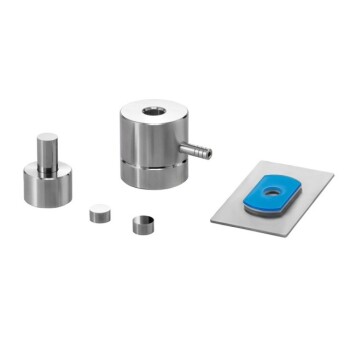
Graphite molds serve as the critical structural interface between the raw alloy powder and the sintering equipment. In the vacuum hot press sintering of Cu-18Ni-2W alloys, their primary function is to act as a rigid container that defines the specimen's shape (such as a 50 mm diameter) while simultaneously transmitting the hydraulic pressure necessary to densify the powder at high temperatures.
During the sintering process, the mold transforms from a passive vessel into an active mechanical component. It must withstand extreme heat without deforming to ensure that pressure is applied uniformly, a requirement essential for achieving high density and structural integrity in the final alloy.
Mechanical Containment and Shaping
Defining Specimen Geometry
The most immediate function of the graphite mold is to act as a precision vessel for the mixed Cu-18Ni-2W alloy powder.
It constrains the loose powder within a specific geometric volume. This ensures that as the material consolidates, it takes on the exact dimensions required for the final specimen, such as a specific cylinder diameter.
Structural Integrity at High Heat
To maintain this shape, the mold must possess exceptional high-temperature resistance.
Standard metal molds might soften or warp under sintering conditions. Graphite retains its rigidity, ensuring dimensional accuracy even when subjected to the thermal stresses of the process.
Pressure Transmission and Densification
Acting as a Hydraulic Interface
Beyond containment, the mold is the vehicle for force transmission. It connects the external hydraulic system to the internal powder compact.
The mold components (specifically the punches) transfer the hydraulic force—often uniaxial pressures around 30 MPa—directly to the alloy powder.
Facilitating Uniform Compaction
The ability of graphite to maintain high mechanical strength at elevated temperatures is vital here.
Because the mold does not yield under the applied load, it ensures that the pressure forces particles into intimate contact. This action expels trapped gases and promotes the closure of pores, leading to a high-density sintered product.
Thermal and Chemical Functions
Thermal Conductivity and Heating
Graphite is not just a container; it is an active participant in the thermal cycle. In induction-heated systems, the mold often acts as a susceptor, converting electromagnetic energy into heat.
Its high thermal conductivity ensures this heat is distributed uniformly to the Cu-18Ni-2W powder inside. This prevents thermal gradients that could lead to uneven sintering or internal stresses in the alloy.
Creating a Protective Atmosphere
In a vacuum environment, graphite creates a beneficial local chemical environment.
At high temperatures, the graphite can react with residual oxygen to form trace amounts of carbon monoxide (CO). This localized reducing atmosphere helps decompose oxide layers on the metal powder surfaces, facilitating cleaner metallurgical bonding between the Copper, Nickel, and Tungsten particles.
Understanding the Trade-offs
Mechanical Brittleness
While graphite has excellent compressive strength at high temperatures, it is inherently brittle.
Unlike metal molds which might deform plastically if overstressed, graphite molds can fracture or crack if subjected to sudden shock loading or shear forces. Careful alignment of the hydraulic rams is critical to prevent mold failure.
Oxidation Sensitivity
Graphite performs exceptionally well in a vacuum, but it degrades rapidly in air at high temperatures.
The "protective" oxidation described above is a sacrificial process. If the vacuum integrity is compromised or oxygen levels are too high, the mold will erode, leading to dimensional loss and potential contamination of the alloy.
Ensuring Process Success
To maximize the effectiveness of graphite molds in your specific sintering context, consider the following:
- If your primary focus is Dimensional Accuracy: Ensure the graphite grade selected has high density and low porosity to resist slight deformation under maximum load.
- If your primary focus is Material Purity: Monitor the vacuum level strictly to utilize the graphite's reducing potential without causing excessive mold erosion or carbon contamination.
- If your primary focus is Cycle Time: Utilize the high thermal conductivity of the mold to ramp temperatures quickly, but ensure pressure is applied only after the material softens to protect the mold.
Graphite molds are not merely holders for powder; they are high-performance tools that simultaneously manage geometry, pressure, and thermal energy to drive the sintering reaction.
Summary Table:
| Function Category | Key Role of Graphite Mold | Specific Benefit for Cu-18Ni-2W Alloys |
|---|---|---|
| Mechanical | Geometry & Containment | Defines precise specimen dimensions and ensures structural integrity at high heat. |
| Pressure | Hydraulic Transmission | Transfers uniaxial pressure (30 MPa) directly to powder for high-density compaction. |
| Thermal | Uniform Heating | Acts as a susceptor with high conductivity to eliminate thermal gradients. |
| Chemical | Local Reducing Atmosphere | Reacts with residual oxygen to remove surface oxides for cleaner metallurgical bonding. |
| Structural | Compressive Strength | Maintains rigidity under load to expel trapped gases and promote pore closure. |
Elevate Your Material Research with KINTEK Precision Solutions
Unlock superior densification and dimensional accuracy for your advanced alloy sintering projects. At KINTEK, we specialize in high-performance laboratory equipment and consumables designed for demanding thermal processes.
Whether you are working with Cu-18Ni-2W alloys or advanced ceramics, our expert solutions include:
- Advanced High-Temperature Furnaces: Muffle, tube, vacuum, and atmosphere-controlled systems.
- Precision Sintering Tools: High-density graphite molds, ceramics, and durable crucibles.
- Hydraulic Presses: Pellet, hot, and isostatic presses for optimal powder compaction.
- Specialized Lab Gear: High-pressure reactors, battery research tools, and crushing systems.
Ready to optimize your sintering results? Our team is dedicated to providing the technical expertise and high-quality equipment you need to achieve breakthrough results. Contact us today to discuss your project requirements!
Related Products
- 2200 ℃ Graphite Vacuum Heat Treat Furnace
- Ultra-High Temperature Graphite Vacuum Graphitization Furnace
- 600T Vacuum Induction Hot Press Furnace for Heat Treat and Sintering
- Vacuum Heat Treat and Pressure Sintering Furnace for High Temperature Applications
- Vacuum Heat Treat and Sintering Furnace with 9MPa Air Pressure
People Also Ask
- How does heat transmit in a vacuum? Mastering Thermal Radiation for Purity & Precision
- What is the process of vacuum heat treating? Achieve Superior Hardening with a Clean, Bright Finish
- Why do you heat treat in a vacuum? Achieve Perfect Surface Finish and Material Integrity
- How does a vacuum heat treat furnace work? Achieve Pristine, Oxide-Free Metal Parts
- What is graphite heating? A Guide to Durable, High-Temp Industrial Furnace Solutions