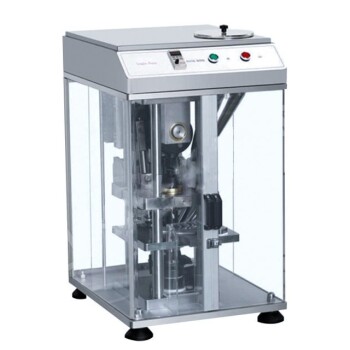
A cubic press is a specialized high-pressure device that utilizes six synchronized anvils to apply compressive force simultaneously to all faces of a cube-shaped sample. Developed as an evolution of the tetrahedral press, its primary design advantage is the ability to accommodate and process a larger volume of material while maintaining uniform pressure.
Core Takeaway While standard presses apply force from a single axis (up and down), the cubic press generates a three-dimensional pressure field by converging six independent anvils. This geometry allows for the creation of stable, high-pressure environments necessary for synthesizing materials that require uniform density across a larger volume.
The Geometry of Pressure
The Six-Anvil Configuration
The defining feature of a cubic press is its geometry. It surrounds the target material with six anvils.
These anvils are arranged to correspond to the six faces of a cube. When activated, they move inward toward a central point, compressing the sample volume from the top, bottom, front, back, left, and right simultaneously.
Evolution from Tetrahedral Designs
The cubic press was engineered to solve a specific limitation of earlier high-pressure devices, specifically the tetrahedral press.
While tetrahedral designs were effective, the cubic configuration allows for a significantly larger sample volume. This increase in usable space makes the cubic press more viable for industrial applications where maximizing yield is critical.
The Mechanism of Force
Hydraulic Power Generation
The immense force required to drive the anvils is generated through hydraulic systems.
As described by Pascal’s law, pressure exerted on a fluid within a closed system is transmitted evenly throughout that fluid. The press utilizes an oil-filled cylinder and a pump to create this internal pressure.
Force Multiplication
The cubic press leverages the principles of the standard hydraulic press to multiply force. The force generated is proportional to the area of the piston multiplied by the applied pressure.
By using a small amount of fluid pressure to move large pistons, the system creates a compressive force many orders of magnitude greater than what could be achieved by mechanical means alone. In a cubic press, this hydraulic force is distributed to drive all six anvils in unison.
Understanding the Trade-offs
Complexity of Synchronization
The primary challenge of a cubic press compared to a standard 2-piston hydraulic press is mechanical complexity.
In a standard press, you only need to manage a pressure differential between two vertical points. In a cubic press, all six anvils must advance at perfectly synchronized rates. If one anvil moves faster than the others, the pressure becomes uneven, potentially shearing or destroying the sample rather than compressing it uniformly.
Equipment Footprint
Due to the need for six distinct force-generating components and their supporting hydraulic infrastructure, cubic presses are generally massive and complex installations. They require significant maintenance to ensure the alignment and seal of the six-anvil assembly remains precise.
Making the Right Choice for Your Goal
When evaluating high-pressure equipment, the choice depends on the directionality of the force required and the volume of the material.
- If your primary focus is simple compression or flattening: A standard hydraulic press is sufficient, as it applies uniaxial force to crush or bond materials between two plates.
- If your primary focus is volumetric synthesis (e.g., creating diamonds): The cubic press is required to simulate hydrostatic pressure (pressure from all sides) on a larger volume of solid material.
Success in high-pressure processing relies on matching the geometry of the press to the physical requirements of the material transformation.
Summary Table:
| Feature | Cubic Press | Standard Hydraulic Press |
|---|---|---|
| Force Direction | 3D (Simultaneous 6-axis) | Uniaxial (Vertical) |
| Anvil Count | 6 synchronized anvils | 2 plates/pistons |
| Primary Use | Volumetric synthesis (e.g., diamonds) | Crushing, bonding, flattening |
| Sample Volume | Large, uniform processing | Limited to plate area |
| Complexity | High (Requires precise synchronization) | Low (Simple two-point pressure) |
Elevate Your Material Research with KINTEK Precision
At KINTEK, we understand that achieving uniform density and stable high-pressure environments is critical for advanced material synthesis. Whether you are performing industrial-scale volumetric processing or laboratory-scale testing, our comprehensive range of high-pressure solutions—including isostatic hydraulic presses, high-temperature furnaces, and specialized crushing systems—is designed to deliver unmatched precision and reliability.
Our value to you:
- Comprehensive Portfolio: From high-temperature high-pressure reactors to specialized battery research tools.
- Expert Engineering: Equipment designed to handle the mechanical complexity of synchronized compression.
- Tailored Solutions: Consumables like ceramics, crucibles, and PTFE products to support every stage of your workflow.
Ready to optimize your high-pressure processing? Contact KINTEK today to discuss your project requirements!
Related Products
- Assemble Square Lab Press Mold for Laboratory Applications
- Cylindrical Press Mold with Scale for Lab
- Cylindrical Press Mold for Lab Applications
- Square Lab Press Mold for Laboratory Applications
- Round Bidirectional Press Mold for Lab
People Also Ask
- How to use a press mold? Master the Art of Creating Consistent Ceramic Forms
- What is a laboratory press? Achieve Precise Sample Preparation for Reliable Analysis
- How does a laboratory press contribute to the initial forming of a porous copper wick? Optimize Wick Pore Architecture
- What is the press mould method? A Guide to Consistent, Detailed Ceramic Forms
- What is the process of mold press? A Step-by-Step Guide to Compression Molding