A primary hurdle in gas-to-particle conversion is the unintended formation of hard aggregates. This phenomenon occurs because particles synthesized in the process tend to agglomerate (clump together) while they are still in the gas phase, rather than remaining distinct.
The central challenge in this Chemical Vapor Deposition (CVD) method is preventing particles from colliding and fusing in the gas phase, which leads to hard aggregates that degrade the quality of the final bulk material.
The Mechanics of the Problem
Understanding Gas Phase Agglomeration
In the gas-to-particle conversion process, the objective is often to generate specific, high-quality particles. However, the gas phase environment is dynamic.
Particles moving within this stream do not always remain isolated. They frequently collide with one another due to thermal motion or flow turbulence.
The Formation of Hard Aggregates
When these collisions occur, the particles adhere to one another. Over time, or under specific thermal conditions, these loose clusters can fuse.
This results in hard aggregates—clusters of particles that are chemically or physically bonded. Unlike soft agglomerates, these cannot easily be separated back into individual primary particles.
Impact on Material Quality
Compromising Bulk Properties
The primary goal of this CVD method is usually to synthesize high-quality bulk materials. Uniformity is key to high quality.
The presence of hard aggregates disrupts this uniformity. Instead of a consistent material structure, the final product contains irregular lumps and fused masses.
Introduction of Defects
Hard aggregates act as contaminants within the bulk material structure. They create inconsistencies that can weaken the mechanical or electrical properties of the material.
Consequently, the inability to control this agglomeration directly limits the purity and performance of the synthesized material.
The Trade-offs in Synthesis Control
Throughput vs. Dispersion
To increase production rates (throughput), one might increase the concentration of precursors in the gas phase.
However, a higher concentration of particles increases the probability of collisions. This leads to a higher rate of agglomeration, forcing a trade-off between production speed and particle singularity.
Quality vs. Process Complexity
Mitigating agglomeration requires precise control over the gas flow and temperature profile to keep particles separated.
Achieving this level of control often adds significant complexity and cost to the CVD system design. Ignoring it simplifies the process but inevitably results in lower-quality material filled with aggregates.
Making the Right Choice for Your Goal
To navigate this challenge effectively, consider your specific requirements for the final material:
- If your primary focus is high material uniformity: You must prioritize process parameters that minimize particle concentration in the gas phase to reduce collision probability.
- If your primary focus is bulk production speed: Be prepared to implement post-processing steps to break down or filter out the resulting hard aggregates.
Control the gas phase environment rigorously to ensure your particles remain distinct rather than fusing into unusable aggregates.
Summary Table:
| Challenge Factor | Impact on Synthesis | Consequences for Bulk Material |
|---|---|---|
| Particle Collision | High collision probability in gas phase | Formation of loose clusters |
| Fusion/Sintering | Physical/chemical bonding of clusters | Development of irreversible hard aggregates |
| High Throughput | Increased precursor concentration | Accelerated agglomeration and defect rate |
| Process Complexity | Need for precise flow & thermal control | Increased production cost and system design requirements |
Elevate Your Material Purity with KINTEK Precision
Don't let hard aggregates compromise the integrity of your research or production. KINTEK specializes in advanced laboratory solutions designed to overcome the most complex synthesis challenges.
Whether you are performing CVD, PECVD, or MPCVD, our comprehensive range of high-performance equipment—from high-temperature tube furnaces and vacuum systems to precision crushing and milling tools—ensures you maintain absolute control over your material properties.
Ready to optimize your synthesis workflow? Contact us today to discover how our specialized equipment and expertise in high-temperature processing can help you achieve superior material uniformity and performance.
Related Products
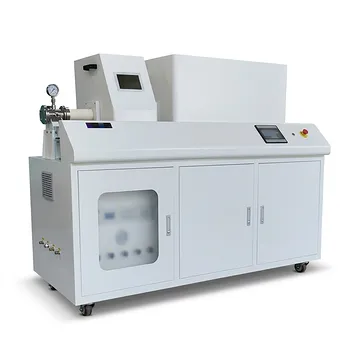
- Chemical Vapor Deposition CVD Equipment System Chamber Slide PECVD Tube Furnace with Liquid Gasifier PECVD Machine
- Customer Made Versatile CVD Tube Furnace Chemical Vapor Deposition Chamber System Equipment
- HFCVD Machine System Equipment for Drawing Die Nano-Diamond Coating
- Split Chamber CVD Tube Furnace with Vacuum Station Chemical Vapor Deposition System Equipment Machine
- Multi Heating Zones CVD Tube Furnace Machine Chemical Vapor Deposition Chamber System Equipment
People Also Ask
- What are the advantages of chemical vapor deposition? Achieve Superior Thin Films for Your Lab
- What types of substrates are used in CVD to facilitate graphene films? Optimize Graphene Growth with the Right Catalyst
- What is the chemical vapor deposition growth process? Build Superior Thin Films from the Atom Up
- How expensive is chemical vapor deposition? Understanding the True Cost of High-Performance Coating
- Why is Chemical Vapor Deposition (CVD) equipment uniquely suited for constructing hierarchical superhydrophobic structures?