Knowledge What is chemical Vapour deposition in simple words? A Simple Guide to 'Painting' with Gas
Author avatar

Tech Team · Kintek Solution

Updated 6 days ago

What is chemical Vapour deposition in simple words? A Simple Guide to 'Painting' with Gas


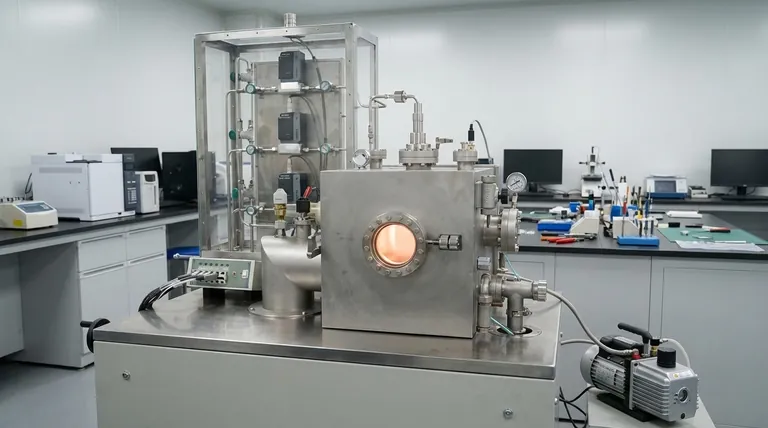
In simple terms, Chemical Vapor Deposition (CVD) is a method for "painting" with gas. Instead of using liquid paint, this process uses reactive gases in a high-temperature chamber to deposit an exceptionally thin and high-quality solid film onto a surface, atom by atom.

Chemical Vapor Deposition is fundamentally a manufacturing technique for building high-performance, ultra-thin solid layers on a surface (the substrate). It achieves this by introducing precursor gases into a chamber, which then react or decompose on the hot substrate to form the desired solid material.
What is chemical Vapour deposition in simple words? A Simple Guide to 'Painting' with Gas

How Does CVD Actually Work?

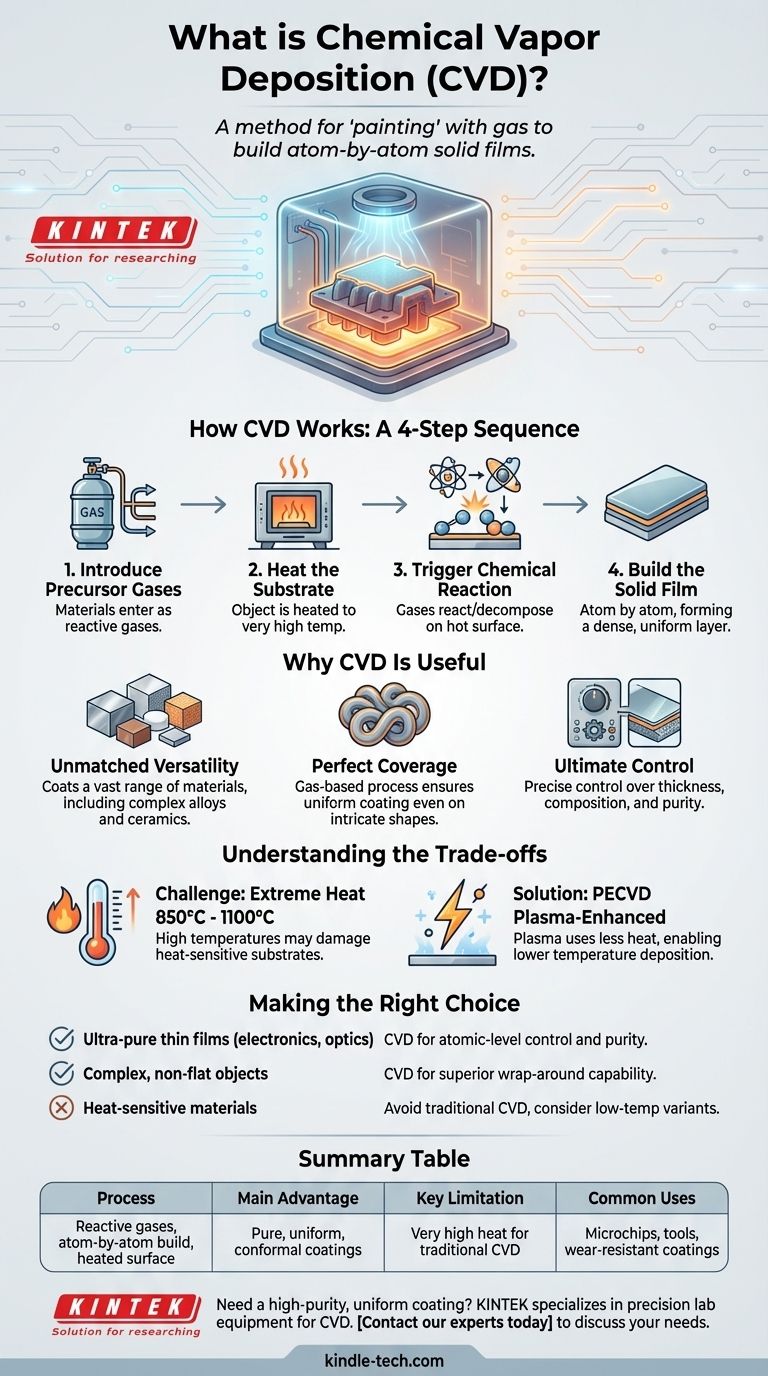
At its core, the CVD process can be understood as a three-step sequence involving gas, heat, and a chemical reaction. It is a precise and highly controlled method for building materials from the ground up.

Step 1: Introduce Gaseous Ingredients

The materials that will form the final solid film are first introduced into a reaction chamber as gases. These are often called precursor gases.

Step 2: Heat the Surface

The object to be coated, known as the substrate, is placed inside the chamber and heated to a very high temperature. This heat provides the energy needed for the next step to occur.

Step 3: Trigger a Chemical Reaction

When the precursor gases come into contact with the hot substrate, they undergo a chemical reaction or decomposition. This reaction causes the atoms to settle out of the gas and bond to the surface, forming a solid layer.

Step 4: Build the Solid Film

This process continues, building up the solid film one atomic layer at a time. The result is an exceptionally pure, dense, and uniform coating that perfectly conforms to the shape of the substrate.

Why Is CVD So Useful?

CVD is not just one technique but a versatile platform used to create critical components in industries from microelectronics to aerospace. Its advantages stem from the high degree of control it offers.

Unmatched Versatility

CVD can be used to deposit a vast range of materials. This includes metals, non-metals, complex alloys, and advanced ceramic compounds that are prized for their hardness and heat resistance.

Perfect Coverage on Complex Shapes

Because the coating is built from a gas, it can reach and uniformly cover every nook and cranny of a complex, three-dimensional object. This is known as a good wrap-around property, which is very difficult to achieve with liquid-based coating methods.

Ultimate Control and Purity

Technicians can precisely control the final film’s properties—such as its thickness, chemical composition, and crystal structure—by adjusting parameters like temperature, pressure, and gas mixture. This results in films of extremely high purity and density.

Understanding the Trade-offs

While powerful, the traditional CVD process has one significant limitation that determines where and how it can be used.

The Primary Challenge: Extreme Heat

Classic CVD processes require very high temperatures, often between 850°C and 1100°C. This intense heat means that the substrate material itself must be able to withstand it without melting, warping, or degrading.

Modern Solutions

To overcome this heat limitation, specialized versions of the process have been developed. Techniques like Plasma-Enhanced CVD (PECVD) use plasma instead of just heat to energize the gases, allowing deposition to occur at much lower temperatures.

Making the Right Choice for Your Goal

Understanding the core strengths of CVD helps clarify its ideal applications.

  • If your primary focus is creating an ultra-pure, flawless thin film for electronics or optics: CVD is the gold standard due to its atomic-level control and high purity.
  • If your primary focus is coating a complex, non-flat object with a uniform protective layer: CVD's "wrap-around" capability makes it a superior choice over line-of-sight methods.
  • If your primary focus is working with heat-sensitive materials like plastics or certain alloys: You should avoid traditional CVD and instead investigate lower-temperature variants.

Ultimately, Chemical Vapor Deposition empowers engineers to construct materials with a precision that is simply not possible with other methods.

Summary Table:

Key Aspect Simple Explanation
Process Using reactive gases to build a solid film atom by atom on a heated surface.
Main Advantage Creates exceptionally pure, uniform, and conformal coatings on complex shapes.
Key Limitation Traditional CVD requires very high temperatures, unsuitable for heat-sensitive materials.
Common Uses Manufacturing microchips, cutting tools, and wear-resistant coatings.

Need a high-purity, uniform coating for your components?

KINTEK specializes in precision lab equipment and consumables for advanced material deposition processes like CVD. Whether you are developing next-generation electronics, durable tool coatings, or specialized optics, our solutions help you achieve the ultimate control and purity your research demands.

Contact our experts today to discuss how we can support your laboratory's specific coating and thin-film needs.

Visual Guide
What is chemical Vapour deposition in simple words? A Simple Guide to 'Painting' with Gas Visual Guide

Related Products

People Also Ask

Related Products

Inclined Rotary Plasma Enhanced Chemical Vapor Deposition PECVD Equipment Tube Furnace Machine

Inclined Rotary Plasma Enhanced Chemical Vapor Deposition PECVD Equipment Tube Furnace Machine

Upgrade your coating process with PECVD coating equipment. Ideal for LED, power semiconductors, MEMS and more. Deposits high-quality solid films at low temps.

HFCVD Machine System Equipment for Drawing Die Nano-Diamond Coating

HFCVD Machine System Equipment for Drawing Die Nano-Diamond Coating

The nano-diamond composite coating drawing die uses cemented carbide (WC-Co) as the substrate, and uses the chemical vapor phase method ( CVD method for short ) to coat the conventional diamond and nano-diamond composite coating on the surface of the inner hole of the mold.

915MHz MPCVD Diamond Machine Microwave Plasma Chemical Vapor Deposition System Reactor

915MHz MPCVD Diamond Machine Microwave Plasma Chemical Vapor Deposition System Reactor

915MHz MPCVD Diamond Machine and its multi-crystal effective growth, the maximum area can reach 8 inches, the maximum effective growth area of single crystal can reach 5 inches. This equipment is mainly used for the production of large-size polycrystalline diamond films, the growth of long single crystal diamonds, the low-temperature growth of high-quality graphene, and other materials that require energy provided by microwave plasma for growth.

Vacuum Hot Press Furnace Machine for Lamination and Heating

Vacuum Hot Press Furnace Machine for Lamination and Heating

Experience clean and precise lamination with Vacuum Lamination Press. Perfect for wafer bonding, thin-film transformations, and LCP lamination. Order now!

1200℃ Split Tube Furnace with Quartz Tube Laboratory Tubular Furnace

1200℃ Split Tube Furnace with Quartz Tube Laboratory Tubular Furnace

KT-TF12 split tube furnace: high-purity insulation, embedded heating wire coils, and max. 1200C. Widely used for new materials and chemical vapour deposition.

CVD Diamond Cutting Tool Blanks for Precision Machining

CVD Diamond Cutting Tool Blanks for Precision Machining

CVD Diamond Cutting Tools: Superior Wear Resistance, Low Friction, High Thermal Conductivity for Non-Ferrous Materials, Ceramics, Composites Machining

Small Vacuum Heat Treat and Tungsten Wire Sintering Furnace

Small Vacuum Heat Treat and Tungsten Wire Sintering Furnace

The small vacuum tungsten wire sintering furnace is a compact experimental vacuum furnace specially designed for universities and scientific research institutes. The furnace features a CNC welded shell and vacuum piping to ensure leak-free operation. Quick-connect electrical connections facilitate relocation and debugging, and the standard electrical control cabinet is safe and convenient to operate.

1400℃ Laboratory Quartz Tube Furnace with Alumina Tube Tubular Furnace

1400℃ Laboratory Quartz Tube Furnace with Alumina Tube Tubular Furnace

Looking for a tube furnace for high-temperature applications? Our 1400℃ Tube Furnace with Alumina Tube is perfect for research and industrial use.

Laboratory Quartz Tube Furnace Tubular RTP Heating Furnace

Laboratory Quartz Tube Furnace Tubular RTP Heating Furnace

Get lightning-fast heating with our RTP Rapid Heating Tube Furnace. Designed for precise, high-speed heating and cooling with convenient sliding rail and TFT touch screen controller. Order now for ideal thermal processing!

1700℃ Laboratory Quartz Tube Furnace with Alumina Tube Tubular Furnace

1700℃ Laboratory Quartz Tube Furnace with Alumina Tube Tubular Furnace

Looking for a high-temperature tube furnace? Check out our 1700℃ Tube Furnace with Alumina Tube. Perfect for research and industrial applications up to 1700C.

Graphite Vacuum Furnace IGBT Experimental Graphitization Furnace

Graphite Vacuum Furnace IGBT Experimental Graphitization Furnace

IGBT experimental graphitization furnace, a tailored solution for universities and research institutions, with high heating efficiency, user-friendliness, and precise temperature control.

High Temperature Muffle Oven Furnace for Laboratory Debinding and Pre Sintering

High Temperature Muffle Oven Furnace for Laboratory Debinding and Pre Sintering

KT-MD High temperature debinding and pre-sintering furnace for ceramic materials with various molding processes. Ideal for electronic components such as MLCC and NFC.

Vacuum Heat Treat and Molybdenum Wire Sintering Furnace for Vacuum Sintering

Vacuum Heat Treat and Molybdenum Wire Sintering Furnace for Vacuum Sintering

A vacuum molybdenum wire sintering furnace is a vertical or bedroom structure, which is suitable for withdrawal, brazing, sintering and degassing of metal materials under high vacuum and high temperature conditions. It is also suitable for dehydroxylation treatment of quartz materials.

Laboratory Muffle Oven Furnace Bottom Lifting Muffle Furnace

Laboratory Muffle Oven Furnace Bottom Lifting Muffle Furnace

Efficiently produce batches with excellent temperature uniformity using our Bottom Lifting Furnace. Features two electric lifting stages and advanced temperature control up to 1600℃.

Vacuum Dental Porcelain Sintering Furnace

Vacuum Dental Porcelain Sintering Furnace

Get precise and reliable results with KinTek's Vacuum Porcelain Furnace. Suitable for all porcelain powders, it features hyperbolic ceramic furnace function, voice prompt, and automatic temperature calibration.

1700℃ Muffle Oven Furnace for Laboratory

1700℃ Muffle Oven Furnace for Laboratory

Get superior heat control with our 1700℃ Muffle Furnace. Equipped with intelligent temperature microprocessor, TFT touch screen controller & advanced insulation materials for precise heating up to 1700C. Order now!

Laboratory Sterilizer Lab Autoclave Pulse Vacuum Lifting Sterilizer

Laboratory Sterilizer Lab Autoclave Pulse Vacuum Lifting Sterilizer

The pulse vacuum lifting sterilizer is a state-of-the-art equipment for efficient and precise sterilization. It uses pulsating vacuum technology, customizable cycles, and a user-friendly design for easy operation and safety.

Laboratory Sterilizer Lab Autoclave Vertical Pressure Steam Sterilizer for Liquid Crystal Display Automatic Type

Laboratory Sterilizer Lab Autoclave Vertical Pressure Steam Sterilizer for Liquid Crystal Display Automatic Type

Liquid crystal display automatic vertical sterilizer is a safe, reliable and automatic control sterilization equipment, which is composed of heating system, microcomputer control system and overheating and overvoltage protection system.

Benchtop Laboratory Vacuum Freeze Dryer

Benchtop Laboratory Vacuum Freeze Dryer

Benchtop laboratory freeze dryer for efficient lyophilization of biological, pharmaceutical, and food samples. Features intuitive touchscreen, high-performance refrigeration, and durable design. Preserve sample integrity—consult now!

Anti-Cracking Press Mold for Lab Use

Anti-Cracking Press Mold for Lab Use

The anti-cracking press mold is a specialized equipment designed for molding various shapes and sizes of film using high pressure and electric heating.


Leave Your Message