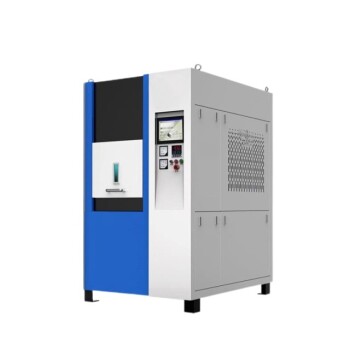
Low Pressure Chemical Vapor Deposition (LPCVD) is a specialized deposition process conducted at sub-atmospheric pressures to create high-quality thin films. By utilizing a vacuum pump to lower the pressure within the furnace tube, the process minimizes unwanted reactions in the gas phase and ensures a significantly more uniform coating thickness on the substrate compared to atmospheric methods.
The Core Insight LPCVD bridges the gap between coating quality and substrate protection. By operating in a vacuum, it allows for high-precision, uniform films at temperatures that are safe for sensitive materials, avoiding the structural damage often caused by high-energy plasma alternatives.
The Mechanics of Low Pressure
Creating the Vacuum Environment
In standard Atmospheric Pressure CVD (APCVD), gases react at normal pressure. In LPCVD, a vacuum pump actively draws gas out of the deposition chamber.
This drastically reduces the pressure of the process gases inside the furnace tube.
Improving Diffusion and Uniformity
The primary benefit of this low-pressure environment is the control of gas dynamics.
At atmospheric pressure, reactant gases often react with each other before reaching the wafer, creating dust or uneven films.
In LPCVD, the mean free path of gas molecules increases. This allows the gas to diffuse evenly across the substrate surface before reacting, resulting in exceptional uniformity of thickness.
The Thermal Advantages
Operating at Reduced Temperatures
A critical limitation of traditional CVD is the high heat required to drive chemical reactions.
LPCVD facilitates these reactions at lower temperatures compared to APCVD.
Protecting Existing Layers
Because the process runs cooler, it is safe for substrates that cannot withstand extreme heat.
For example, LPCVD allows for the deposition of new layers on top of materials with lower melting points, such as previously deposited aluminum.
Preserving Impurity Distributions
High heat causes atoms to migrate, which can ruin the precise "doping" (impurity distribution) of a semiconductor.
By reducing the thermal load, LPCVD prevents this migration. It ensures the impurity distribution cross-section remains intact, preserving the electrical properties of the device.
Understanding the Trade-offs: LPCVD vs. Alternatives
LPCVD vs. Plasma CVD (PECVD)
To lower temperatures even further, engineers often use plasma (PECVD) to drive reactions. However, plasma involves high-energy particles bombarding the surface.
LPCVD avoids this damage. Unlike plasma methods, standard LPCVD does not subject the film to high-energy particle irradiation, making it superior for maintaining the structural integrity of delicate films.
Plasma-Enhanced LPCVD
It is worth noting that energy can be added to an LPCVD system via plasma to lower the temperature requirements even further.
However, this introduces the trade-off of potential surface damage mentioned above. Pure thermal LPCVD remains the choice for low-defect requirements.
Making the Right Choice for Your Goal
When selecting a deposition method, align the process with your limiting constraints:
- If your primary focus is Film Uniformity: Choose LPCVD for its superior step coverage and ability to prevent gas-phase dust formation.
- If your primary focus is Substrate Integrity: Choose LPCVD to avoid the lattice damage caused by high-energy particle bombardment in Plasma CVD.
- If your primary focus is Thermal Budget: Choose LPCVD (or Plasma-Enhanced LPCVD) to deposit onto temperature-sensitive metals like aluminum without melting them.
LPCVD is the definitive solution when you require a high-purity, uniform coating without risking thermal degradation or plasma-induced damage to your device.
Summary Table:
| Feature | LPCVD Advantage | Benefit to User |
|---|---|---|
| Pressure Level | Sub-atmospheric (Vacuum) | Reduces gas-phase reactions and dust formation |
| Uniformity | High Mean Free Path | Exceptional thickness control and step coverage |
| Thermal Impact | Reduced Operating Temps | Protects low-melting point layers like aluminum |
| Film Integrity | No Plasma Bombardment | Prevents structural lattice damage and defects |
| Doping Control | Minimal Atom Migration | Preserves precise impurity distributions in semiconductors |
Elevate Your Thin Film Deposition with KINTEK
Precision and material integrity are non-negotiable in advanced research and semiconductor manufacturing. KINTEK specializes in high-performance laboratory equipment, offering a comprehensive range of CVD systems (including LPCVD, PECVD, and MPCVD), high-temperature furnaces, and vacuum solutions designed to meet the most rigorous scientific standards.
Whether you are developing next-generation battery technology, processing dental ceramics, or engineering delicate semiconductor devices, our portfolio—from crushing systems and hydraulic presses to PTFE consumables and cooling solutions—ensures your lab operates at peak efficiency.
Ready to optimize your deposition process and protect your thermal budget? Contact KINTEK today to consult with our experts on the perfect high-temperature and vacuum solutions for your specific application.
Related Products
- Chemical Vapor Deposition CVD Equipment System Chamber Slide PECVD Tube Furnace with Liquid Gasifier PECVD Machine
- Customer Made Versatile CVD Tube Furnace Chemical Vapor Deposition Chamber System Equipment
- Split Chamber CVD Tube Furnace with Vacuum Station Chemical Vapor Deposition System Equipment Machine
- RF PECVD System Radio Frequency Plasma-Enhanced Chemical Vapor Deposition RF PECVD
- Multi Heating Zones CVD Tube Furnace Machine Chemical Vapor Deposition Chamber System Equipment
People Also Ask
- What are the advantages of chemical vapor deposition? Achieve Superior Thin Films for Your Lab
- What types of substrates are used in CVD to facilitate graphene films? Optimize Graphene Growth with the Right Catalyst
- What is the chemical vapor deposition growth process? Build Superior Thin Films from the Atom Up
- How expensive is chemical vapor deposition? Understanding the True Cost of High-Performance Coating
- Why is Chemical Vapor Deposition (CVD) equipment uniquely suited for constructing hierarchical superhydrophobic structures?