Knowledge What is PVD diamond? The Truth About This Durable, High-Tech Coating
Author avatar

Tech Team · Kintek Solution

Updated 1 week ago

What is PVD diamond? The Truth About This Durable, High-Tech Coating


In short, "PVD diamond" is most often a marketing term, not a technical one. It describes a product coated using Physical Vapor Deposition (PVD) to achieve a highly durable finish that may have a specific aesthetic, but it is not a layer of actual diamond. The PVD process bonds a microscopic-thin film of a hard, resilient material onto a base metal in a vacuum, creating a surface far superior to traditional plating.

The term "PVD diamond" is used to convey the toughness and premium quality of a coating, not its composition. The underlying technology, Physical Vapor Deposition, is a sophisticated vacuum coating process that creates exceptionally hard, pure, and durable thin-film surfaces on a wide range of products.

How Does the PVD Process Actually Work?

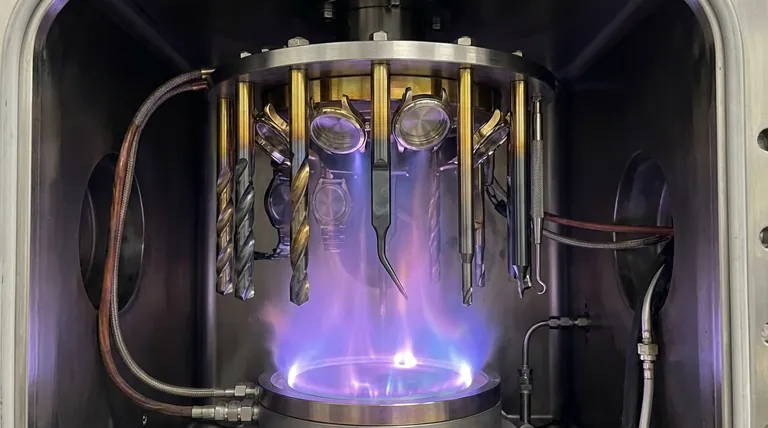
Physical Vapor Deposition is a high-tech process that fundamentally changes a material's surface properties. It's best understood as a three-stage sequence performed inside a high-vacuum chamber.

Stage 1: Vaporization

First, a solid source material, often a high-purity metal or ceramic like titanium or zirconium, is vaporized. This is done using intense heat or plasma, turning the solid material directly into a gas of individual atoms or molecules.

Stage 2: Migration

These vaporized particles then travel across the vacuum chamber. The vacuum is critical because it ensures there are no other atoms (like oxygen or nitrogen from the air) for the coating material to collide with, guaranteeing an extremely pure film.

Stage 3: Deposition

Finally, the vaporized material deposits onto the target object (the substrate). It builds up layer by layer, atom by atom, forming a thin, dense, and highly uniform coating that is molecularly bonded to the surface beneath it.

What PVD Coatings Actually Provide

The result of the PVD process is a finish that is far more than just a layer of paint. Its unique characteristics are why it's used in demanding fields from medical devices to aerospace.

Exceptional Hardness and Durability

PVD coatings are significantly harder and more resistant to corrosion and wear than coatings applied by traditional methods like electroplating. This bond at the atomic level makes the coating extremely difficult to chip or fade.

Superior Purity and Adhesion

Because it's applied in a vacuum, the coating is exceptionally pure and free of contaminants. The strong bond to the substrate means it won't flake or peel, providing long-lasting protection and color.

Environmentally Responsible

Compared to processes like electroplating, which involve harsh chemicals and produce hazardous waste, PVD is a clean, dry, and environmentally friendly process.

Understanding the Trade-offs

While PVD offers remarkable performance, it's crucial to understand its limitations. A clear understanding prevents misconceptions about what the coating can and cannot do.

It Is a Thin Film

The PVD coating is incredibly thin, often just a few microns thick. While extremely hard, it does not change the fundamental properties of the base material. The overall strength and dent resistance of an object depend on the substrate, not the coating.

Susceptible to Deep Gouges

The coating's hardness protects exceptionally well against light scratches and daily wear. However, a deep gouge or impact that deforms the base metal underneath can still damage or break through the PVD layer.

Quality Is Not Universal

The final quality, durability, and color of a PVD coating depend heavily on the specific materials used and the precision of the application process. A "PVD" label on its own is not a guarantee of the highest quality; the reputation of the manufacturer is also a key factor.

Making the Right Choice for Your Product

When evaluating a product marketed with a "PVD diamond" or similar finish, your decision should be guided by your primary goal for that item.

  • If your primary focus is aesthetics and daily wear resistance: A PVD coating on jewelry or a watch is an excellent choice for maintaining color and preventing minor scratches.
  • If your primary focus is extreme performance: For tools or industrial components, look for specific PVD coating types like TiN (Titanium Nitride) or DLC (Diamond-Like Carbon), as these offer documented hardness and lubricity properties.
  • If your primary focus is value: Recognize that you are paying for a superior surface finish that drastically outperforms traditional plating, not for a product made of a new, indestructible material.

Ultimately, PVD is a proven technology that produces one of the most durable and high-quality surface finishes available today.
What is PVD diamond? The Truth About This Durable, High-Tech Coating

Summary Table:

Feature What PVD Coating Is What PVD Coating Is Not
Composition A thin film of metal or ceramic (e.g., Titanium Nitride) A layer of actual diamond
Durability Extremely hard, scratch-resistant, and corrosion-resistant Indestructible or immune to deep gouges
Bonding Molecular bond for superior adhesion, won't flake or peel A superficial layer like paint or traditional plating
Process A clean, dry, vacuum-based (Physical Vapor Deposition) process A wet, chemical-heavy process like electroplating

Need a durable, high-performance coating for your lab equipment or components?

At KINTEK, we specialize in advanced PVD coating solutions for laboratory needs. Our coatings provide exceptional hardness, purity, and longevity, protecting your valuable equipment from wear and corrosion. Whether you require specific coatings like TiN for tools or a durable finish for precision components, our expertise ensures a superior result.

Contact our coating experts today to discuss how KINTEK's PVD technology can enhance your products' performance and lifespan.

Visual Guide

What is PVD diamond? The Truth About This Durable, High-Tech Coating Visual Guide

Related Products

People Also Ask

Related Products

HFCVD Machine System Equipment for Drawing Die Nano-Diamond Coating

HFCVD Machine System Equipment for Drawing Die Nano-Diamond Coating

The nano-diamond composite coating drawing die uses cemented carbide (WC-Co) as the substrate, and uses the chemical vapor phase method ( CVD method for short ) to coat the conventional diamond and nano-diamond composite coating on the surface of the inner hole of the mold.

RF PECVD System Radio Frequency Plasma-Enhanced Chemical Vapor Deposition RF PECVD

RF PECVD System Radio Frequency Plasma-Enhanced Chemical Vapor Deposition RF PECVD

RF-PECVD is an acronym for "Radio Frequency Plasma-Enhanced Chemical Vapor Deposition." It deposits DLC (Diamond-like carbon film) on germanium and silicon substrates. It is utilized in the 3-12um infrared wavelength range.

915MHz MPCVD Diamond Machine Microwave Plasma Chemical Vapor Deposition System Reactor

915MHz MPCVD Diamond Machine Microwave Plasma Chemical Vapor Deposition System Reactor

915MHz MPCVD Diamond Machine and its multi-crystal effective growth, the maximum area can reach 8 inches, the maximum effective growth area of single crystal can reach 5 inches. This equipment is mainly used for the production of large-size polycrystalline diamond films, the growth of long single crystal diamonds, the low-temperature growth of high-quality graphene, and other materials that require energy provided by microwave plasma for growth.

CVD Diamond Domes for Industrial and Scientific Applications

CVD Diamond Domes for Industrial and Scientific Applications

Discover CVD diamond domes, the ultimate solution for high-performance loudspeakers. Made with DC Arc Plasma Jet technology, these domes deliver exceptional sound quality, durability, and power handling.

CVD Diamond Cutting Tool Blanks for Precision Machining

CVD Diamond Cutting Tool Blanks for Precision Machining

CVD Diamond Cutting Tools: Superior Wear Resistance, Low Friction, High Thermal Conductivity for Non-Ferrous Materials, Ceramics, Composites Machining

Split Chamber CVD Tube Furnace with Vacuum Station Chemical Vapor Deposition System Equipment Machine

Split Chamber CVD Tube Furnace with Vacuum Station Chemical Vapor Deposition System Equipment Machine

Efficient split chamber CVD furnace with vacuum station for intuitive sample checking and quick cooling. Up to 1200℃ max temperature with accurate MFC mass flowmeter control.

Vacuum Hot Press Furnace Machine for Lamination and Heating

Vacuum Hot Press Furnace Machine for Lamination and Heating

Experience clean and precise lamination with Vacuum Lamination Press. Perfect for wafer bonding, thin-film transformations, and LCP lamination. Order now!

Laboratory Sterilizer Lab Autoclave Pulse Vacuum Lifting Sterilizer

Laboratory Sterilizer Lab Autoclave Pulse Vacuum Lifting Sterilizer

The pulse vacuum lifting sterilizer is a state-of-the-art equipment for efficient and precise sterilization. It uses pulsating vacuum technology, customizable cycles, and a user-friendly design for easy operation and safety.

Laboratory Sterilizer Lab Autoclave Vertical Pressure Steam Sterilizer for Liquid Crystal Display Automatic Type

Laboratory Sterilizer Lab Autoclave Vertical Pressure Steam Sterilizer for Liquid Crystal Display Automatic Type

Liquid crystal display automatic vertical sterilizer is a safe, reliable and automatic control sterilization equipment, which is composed of heating system, microcomputer control system and overheating and overvoltage protection system.

Anti-Cracking Press Mold for Lab Use

Anti-Cracking Press Mold for Lab Use

The anti-cracking press mold is a specialized equipment designed for molding various shapes and sizes of film using high pressure and electric heating.

Benchtop Laboratory Vacuum Freeze Dryer

Benchtop Laboratory Vacuum Freeze Dryer

Benchtop laboratory freeze dryer for efficient lyophilization of biological, pharmaceutical, and food samples. Features intuitive touchscreen, high-performance refrigeration, and durable design. Preserve sample integrity—consult now!

Vertical High Temperature Graphite Vacuum Graphitization Furnace

Vertical High Temperature Graphite Vacuum Graphitization Furnace

Vertical high temperature graphitization furnace for carbonization and graphitization of carbon materials up to 3100℃.Suitable for shaped graphitization of carbon fiber filaments and other materials sintered in a carbon environment.Applications in metallurgy, electronics, and aerospace for producing high-quality graphite products like electrodes and crucibles.

Graphite Vacuum Furnace High Thermal Conductivity Film Graphitization Furnace

Graphite Vacuum Furnace High Thermal Conductivity Film Graphitization Furnace

The high thermal conductivity film graphitization furnace has uniform temperature, low energy consumption and can operate continuously.

Oil Free Diaphragm Vacuum Pump for Laboratory and Industrial Use

Oil Free Diaphragm Vacuum Pump for Laboratory and Industrial Use

Oil-free diaphragm vacuum pump for labs: clean, reliable, chemical-resistant. Ideal for filtration, SPE, and rotary evaporation. Maintenance-free operation.

Ultra-High Temperature Graphite Vacuum Graphitization Furnace

Ultra-High Temperature Graphite Vacuum Graphitization Furnace

The ultra-high temperature graphitization furnace utilizes medium frequency induction heating in a vacuum or inert gas environment. The induction coil generates an alternating magnetic field, inducing eddy currents in the graphite crucible, which heats up and radiates heat to the workpiece, bringing it to the desired temperature. This furnace is primarily used for graphitization and sintering of carbon materials, carbon fiber materials, and other composite materials.

Vacuum Heat Treat and Molybdenum Wire Sintering Furnace for Vacuum Sintering

Vacuum Heat Treat and Molybdenum Wire Sintering Furnace for Vacuum Sintering

A vacuum molybdenum wire sintering furnace is a vertical or bedroom structure, which is suitable for withdrawal, brazing, sintering and degassing of metal materials under high vacuum and high temperature conditions. It is also suitable for dehydroxylation treatment of quartz materials.

Small Vacuum Heat Treat and Tungsten Wire Sintering Furnace

Small Vacuum Heat Treat and Tungsten Wire Sintering Furnace

The small vacuum tungsten wire sintering furnace is a compact experimental vacuum furnace specially designed for universities and scientific research institutes. The furnace features a CNC welded shell and vacuum piping to ensure leak-free operation. Quick-connect electrical connections facilitate relocation and debugging, and the standard electrical control cabinet is safe and convenient to operate.

Vacuum Heat Treat Furnace with Ceramic Fiber Liner

Vacuum Heat Treat Furnace with Ceramic Fiber Liner

Vacuum furnace with polycrystalline ceramic fiber insulation liner for excellent heat insulation and uniform temperature field. Choose from 1200℃ or 1700℃ max. working temperature with high vacuum performance and precise temperature control.

Vacuum Dental Porcelain Sintering Furnace

Vacuum Dental Porcelain Sintering Furnace

Get precise and reliable results with KinTek's Vacuum Porcelain Furnace. Suitable for all porcelain powders, it features hyperbolic ceramic furnace function, voice prompt, and automatic temperature calibration.

Benchtop Laboratory Freeze Dryer for Lab Use

Benchtop Laboratory Freeze Dryer for Lab Use

Premium benchtop laboratory freeze dryer for lyophilization, preserving samples with ≤ -60°C cooling. Ideal for pharmaceuticals & research.


Leave Your Message