Knowledge What is the difference between chemical vapor transport and chemical vapor deposition? Master Vapor-Phase Material Processing
Author avatar

Tech Team · Kintek Solution

Updated 2 weeks ago

What is the difference between chemical vapor transport and chemical vapor deposition? Master Vapor-Phase Material Processing


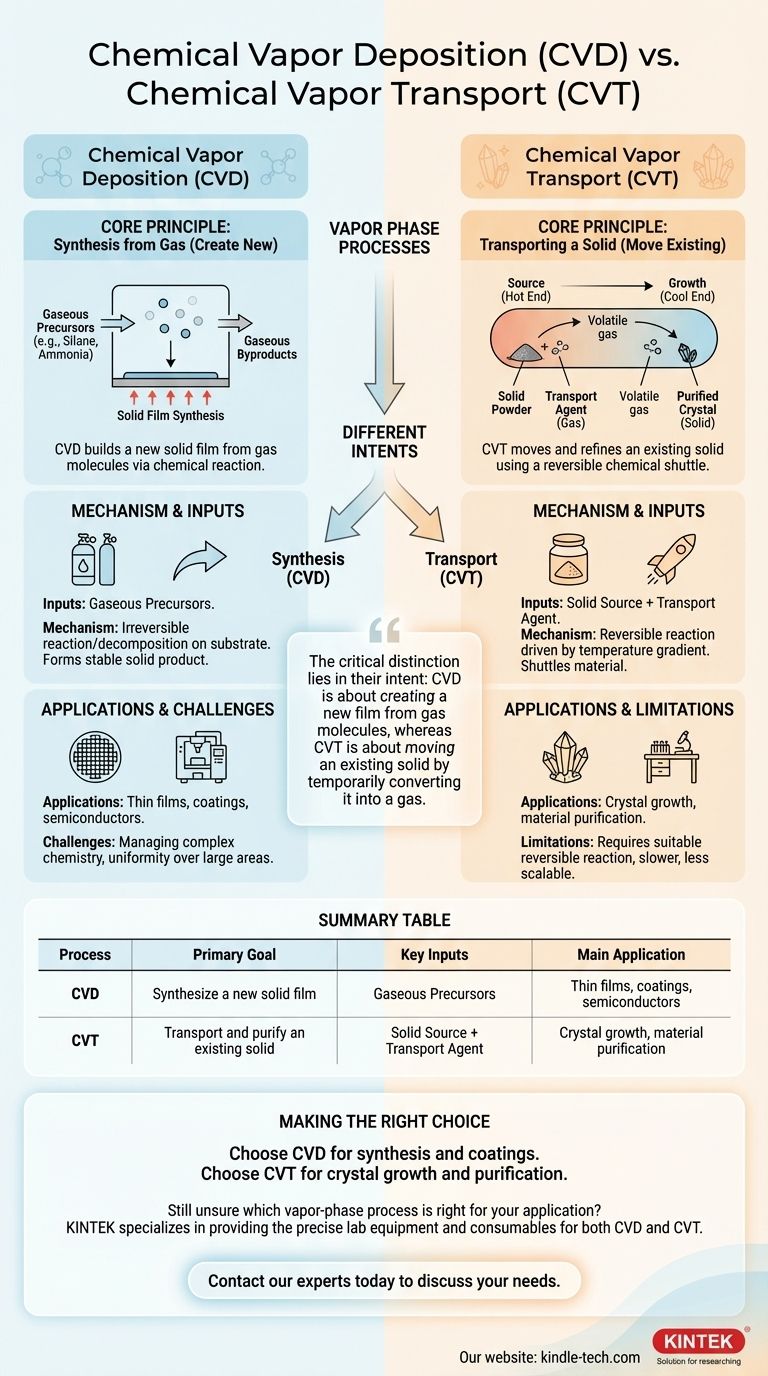
The fundamental difference is their primary purpose. Chemical Vapor Deposition (CVD) is a process that synthesizes a new, solid material directly from gaseous precursors onto a substrate. In contrast, Chemical Vapor Transport (CVT) is a process used to transport and purify an existing solid material from one location to another using a reversible chemical reaction.

While both processes operate in the vapor phase, the critical distinction lies in their intent: CVD is about creating a new film from gas molecules, whereas CVT is about moving an existing solid by temporarily converting it into a gas.
What is the difference between chemical vapor transport and chemical vapor deposition? Master Vapor-Phase Material Processing

Deconstructing Chemical Vapor Deposition (CVD)

CVD is a versatile and widely used technique for producing high-quality thin films and coatings. Its foundation is the synthesis of a new material directly on a surface.

The Core Principle: Synthesis from Gas

The goal of CVD is to build a solid film from the ground up. This is achieved by introducing one or more reactive gases, known as precursors, into a reaction chamber containing the object to be coated (the substrate).

The Mechanism of Deposition

The process involves a series of carefully controlled steps. Gaseous precursors are transported to the substrate's surface, where the heat (or plasma) provides the energy for a chemical reaction or decomposition to occur.

This reaction forms a stable solid product that deposits and grows on the surface, creating the desired film. Gaseous byproducts from the reaction are then transported away and exhausted from the chamber.

Key Inputs: Gaseous Precursors

In CVD, the starting materials are the gases themselves. For example, to deposit a silicon nitride film, gaseous precursors like silane (SiH₄) and ammonia (NH₃) might be used. These gases react to form solid Si₃N₄ on the substrate.

Deconstructing Chemical Vapor Transport (CVT)

CVT is a more specialized technique, often used in research and for producing high-purity single crystals. Its purpose is not to create a new material but to move and refine an existing one.

The Core Principle: Transporting a Solid

Imagine you have a solid powder of a material and you want to grow a perfect, large crystal of that same material. CVT is the process to achieve this. It uses a chemical "shuttle" to pick up the material at one end and drop it off at the other.

The Reversible Reaction Mechanism

CVT relies entirely on a reversible chemical reaction. The process occurs in a sealed tube with a temperature gradient (one end is hotter than the other).

  1. Forward Reaction (Source): At the "source" end, the solid material you want to transport reacts with a gaseous transport agent. This reaction converts the solid into a new, volatile gas molecule.
  2. Reverse Reaction (Growth): This new gas molecule diffuses to the other end of the tube (the "growth" end), which is at a different temperature. The temperature change causes the reaction to reverse, re-depositing the original solid material—often in a much purer, crystalline form. The transport agent gas is released and is free to shuttle more material.

Key Inputs: Solid Source + Transport Agent

The starting materials for CVT are the solid powder of the substance you wish to transport and a separate transport agent gas. The transport agent's only job is to act as a temporary chemical taxi for the solid material.

Understanding the Trade-offs and Applications

The fundamental difference in mechanism dictates where these processes are used and what challenges they present.

CVD Applications and Challenges

CVD is an industrial workhorse for creating protective coatings, semiconductor layers, and optical films. Its main challenge lies in managing the complex chemistry of precursors and ensuring uniform temperature and gas flow to achieve a consistent film over a large area.

CVT Applications and Limitations

CVT is primarily a laboratory technique for crystal growth and material purification. Its major limitation is the need for a suitable, reversible chemical reaction and a compatible transport agent for the specific material, which is not always available. The process is generally slower and less scalable than CVD.

Making the Right Choice for Your Goal

Your objective determines which process is appropriate.

  • If your primary focus is applying a new coating or thin film onto a substrate (e.g., depositing titanium nitride on a tool bit): CVD is the correct choice because its purpose is to synthesize a new material layer from gaseous precursors.
  • If your primary focus is purifying an existing solid or growing a large, high-quality single crystal of a specific compound (e.g., growing a MoS₂ crystal from powder): CVT is the appropriate method because it is designed to transport and recrystallize an existing material.

Ultimately, understanding this core difference between synthesis and transport is the key to mastering vapor-phase material processing.

Summary Table:

Process Primary Goal Key Inputs Main Application
Chemical Vapor Deposition (CVD) Synthesize a new solid film Gaseous Precursors Thin films, coatings, semiconductors
Chemical Vapor Transport (CVT) Transport and purify an existing solid Solid Source + Transport Agent Crystal growth, material purification

Still unsure which vapor-phase process is right for your application?

KINTEK specializes in providing the precise lab equipment and consumables needed for both CVD and CVT processes. Whether you are developing new thin films or growing high-purity crystals, our expertise can help you achieve superior results.

Contact our experts today to discuss your specific material processing needs and find the perfect solution for your laboratory.

Visual Guide
What is the difference between chemical vapor transport and chemical vapor deposition? Master Vapor-Phase Material Processing Visual Guide

Related Products

People Also Ask

Related Products

Inclined Rotary Plasma Enhanced Chemical Vapor Deposition PECVD Equipment Tube Furnace Machine

Inclined Rotary Plasma Enhanced Chemical Vapor Deposition PECVD Equipment Tube Furnace Machine

Upgrade your coating process with PECVD coating equipment. Ideal for LED, power semiconductors, MEMS and more. Deposits high-quality solid films at low temps.

HFCVD Machine System Equipment for Drawing Die Nano-Diamond Coating

HFCVD Machine System Equipment for Drawing Die Nano-Diamond Coating

The nano-diamond composite coating drawing die uses cemented carbide (WC-Co) as the substrate, and uses the chemical vapor phase method ( CVD method for short ) to coat the conventional diamond and nano-diamond composite coating on the surface of the inner hole of the mold.

915MHz MPCVD Diamond Machine Microwave Plasma Chemical Vapor Deposition System Reactor

915MHz MPCVD Diamond Machine Microwave Plasma Chemical Vapor Deposition System Reactor

915MHz MPCVD Diamond Machine and its multi-crystal effective growth, the maximum area can reach 8 inches, the maximum effective growth area of single crystal can reach 5 inches. This equipment is mainly used for the production of large-size polycrystalline diamond films, the growth of long single crystal diamonds, the low-temperature growth of high-quality graphene, and other materials that require energy provided by microwave plasma for growth.

Vacuum Hot Press Furnace Machine for Lamination and Heating

Vacuum Hot Press Furnace Machine for Lamination and Heating

Experience clean and precise lamination with Vacuum Lamination Press. Perfect for wafer bonding, thin-film transformations, and LCP lamination. Order now!

Laboratory CVD Boron Doped Diamond Materials

Laboratory CVD Boron Doped Diamond Materials

CVD boron-doped diamond: A versatile material enabling tailored electrical conductivity, optical transparency, and exceptional thermal properties for applications in electronics, optics, sensing, and quantum technologies.

Small Vacuum Heat Treat and Tungsten Wire Sintering Furnace

Small Vacuum Heat Treat and Tungsten Wire Sintering Furnace

The small vacuum tungsten wire sintering furnace is a compact experimental vacuum furnace specially designed for universities and scientific research institutes. The furnace features a CNC welded shell and vacuum piping to ensure leak-free operation. Quick-connect electrical connections facilitate relocation and debugging, and the standard electrical control cabinet is safe and convenient to operate.

Laboratory Quartz Tube Furnace Tubular RTP Heating Furnace

Laboratory Quartz Tube Furnace Tubular RTP Heating Furnace

Get lightning-fast heating with our RTP Rapid Heating Tube Furnace. Designed for precise, high-speed heating and cooling with convenient sliding rail and TFT touch screen controller. Order now for ideal thermal processing!

Vacuum Heat Treat and Molybdenum Wire Sintering Furnace for Vacuum Sintering

Vacuum Heat Treat and Molybdenum Wire Sintering Furnace for Vacuum Sintering

A vacuum molybdenum wire sintering furnace is a vertical or bedroom structure, which is suitable for withdrawal, brazing, sintering and degassing of metal materials under high vacuum and high temperature conditions. It is also suitable for dehydroxylation treatment of quartz materials.

Graphite Vacuum Furnace High Thermal Conductivity Film Graphitization Furnace

Graphite Vacuum Furnace High Thermal Conductivity Film Graphitization Furnace

The high thermal conductivity film graphitization furnace has uniform temperature, low energy consumption and can operate continuously.

Vacuum Heat Treat Furnace with Ceramic Fiber Liner

Vacuum Heat Treat Furnace with Ceramic Fiber Liner

Vacuum furnace with polycrystalline ceramic fiber insulation liner for excellent heat insulation and uniform temperature field. Choose from 1200℃ or 1700℃ max. working temperature with high vacuum performance and precise temperature control.

High Temperature Muffle Oven Furnace for Laboratory Debinding and Pre Sintering

High Temperature Muffle Oven Furnace for Laboratory Debinding and Pre Sintering

KT-MD High temperature debinding and pre-sintering furnace for ceramic materials with various molding processes. Ideal for electronic components such as MLCC and NFC.

Graphite Vacuum Furnace IGBT Experimental Graphitization Furnace

Graphite Vacuum Furnace IGBT Experimental Graphitization Furnace

IGBT experimental graphitization furnace, a tailored solution for universities and research institutions, with high heating efficiency, user-friendliness, and precise temperature control.

Vacuum Dental Porcelain Sintering Furnace

Vacuum Dental Porcelain Sintering Furnace

Get precise and reliable results with KinTek's Vacuum Porcelain Furnace. Suitable for all porcelain powders, it features hyperbolic ceramic furnace function, voice prompt, and automatic temperature calibration.

Laboratory Vacuum Tilt Rotary Tube Furnace Rotating Tube Furnace

Laboratory Vacuum Tilt Rotary Tube Furnace Rotating Tube Furnace

Discover the versatility of Laboratory Rotary Furnace: Ideal for calcination, drying, sintering, and high-temperature reactions. Adjustable rotating and tilting functions for optimal heating. Suitable for vacuum and controlled atmosphere environments. Learn more now!

Molybdenum Vacuum Heat Treat Furnace

Molybdenum Vacuum Heat Treat Furnace

Discover the benefits of a high-configuration molybdenum vacuum furnace with heat shield insulation. Ideal for high-purity, vacuum environments like sapphire crystal growth and heat treatment.

1700℃ Muffle Oven Furnace for Laboratory

1700℃ Muffle Oven Furnace for Laboratory

Get superior heat control with our 1700℃ Muffle Furnace. Equipped with intelligent temperature microprocessor, TFT touch screen controller & advanced insulation materials for precise heating up to 1700C. Order now!

Vacuum Sealed Continuous Working Rotary Tube Furnace Rotating Tube Furnace

Vacuum Sealed Continuous Working Rotary Tube Furnace Rotating Tube Furnace

Experience efficient material processing with our vacuum-sealed rotary tube furnace. Perfect for experiments or industrial production, equipped with optional features for controlled feeding and optimized results. Order now.

Laboratory Sterilizer Lab Autoclave Pulse Vacuum Lifting Sterilizer

Laboratory Sterilizer Lab Autoclave Pulse Vacuum Lifting Sterilizer

The pulse vacuum lifting sterilizer is a state-of-the-art equipment for efficient and precise sterilization. It uses pulsating vacuum technology, customizable cycles, and a user-friendly design for easy operation and safety.

Anti-Cracking Press Mold for Lab Use

Anti-Cracking Press Mold for Lab Use

The anti-cracking press mold is a specialized equipment designed for molding various shapes and sizes of film using high pressure and electric heating.

Laboratory Sterilizer Lab Autoclave Vertical Pressure Steam Sterilizer for Liquid Crystal Display Automatic Type

Laboratory Sterilizer Lab Autoclave Vertical Pressure Steam Sterilizer for Liquid Crystal Display Automatic Type

Liquid crystal display automatic vertical sterilizer is a safe, reliable and automatic control sterilization equipment, which is composed of heating system, microcomputer control system and overheating and overvoltage protection system.


Leave Your Message