Knowledge What is the difference between forging hammer and forging press? Impact vs. Pressure for Superior Metal Parts
Author avatar

Tech Team · Kintek Solution

Updated 5 days ago

What is the difference between forging hammer and forging press? Impact vs. Pressure for Superior Metal Parts


At their core, the difference between a forging hammer and a forging press comes down to how they apply force. A forging hammer delivers a rapid, high-velocity impact with limited contact time, deforming the metal through kinetic energy. In contrast, a forging press applies a slow, controlled, and continuous pressure that "squeezes" the metal into shape.

The fundamental choice is not about which machine is "better," but which method of force application—sudden impact versus sustained pressure—is required to achieve the desired material properties and final geometry for a specific component.
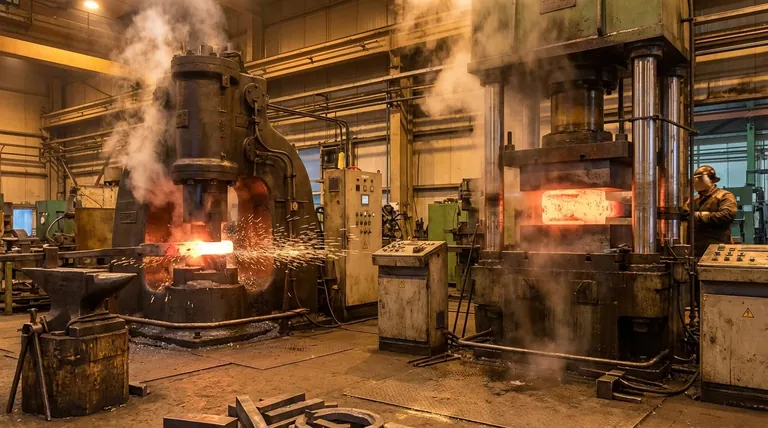
What is the difference between forging hammer and forging press? Impact vs. Pressure for Superior Metal Parts

How Each Machine Applies Force

Understanding the mechanics of each machine is the first step in appreciating their distinct effects on the metal workpiece.

The Forging Hammer: High-Velocity Impact

A forging hammer uses a falling ram to strike the workpiece. The force comes from the kinetic energy of the ram, which is released in a very short, high-energy blow.

This process is characterized by extremely high strain rates. Because the contact time is minimal (measured in milliseconds), the cooling effect from the dies is limited.

The Forging Press: Controlled Squeezing

A forging press uses either mechanical or hydraulic power to apply a continuous, controlled force. Instead of a "hit," the press performs a "squeeze."

This slow application of force allows the pressure to penetrate deep into the material. The contact time between the die and the workpiece is significantly longer, which can lead to more heat transfer and cooling of the part's surface.

Critical Differences in Process and Outcome

The distinction between impact and pressure creates significant differences in the final product's grain structure, precision, and complexity.

Force Penetration and Grain Structure

This is arguably the most critical difference. A hammer's impact primarily deforms the surface layers of the metal. While it refines the surface grain, its effect may not penetrate to the core, especially in large parts.

A press, however, applies force slowly, allowing it to fully penetrate the workpiece. This results in a more uniform grain structure and density throughout the entire cross-section of the component, which is critical for high-performance applications.

Precision and Part Complexity

Press forging offers superior control. The slow, guided stroke allows for the creation of intricate, complex shapes with tight tolerances, often referred to as near-net shapes.

Hammer forging is better suited for simpler shapes. The inherent nature of impact makes it less precise and generally requires more secondary machining to achieve final dimensions.

Speed of Deformation

Hammers work at a very high velocity, deforming the metal almost instantly upon impact. This is a high strain rate process.

Presses work at a much lower velocity, deforming the material progressively throughout the stroke. This is a low strain rate process.

Contact Time with the Workpiece

A hammer blow has a very short contact time. This minimizes heat loss from the workpiece to the dies, keeping the metal hotter and more malleable for subsequent blows.

A press has a long contact time, which can significantly cool the workpiece surface. This can be a disadvantage, sometimes requiring reheating or affecting the material's final properties.

Understanding the Trade-offs

Choosing between a hammer and a press involves balancing cost, production needs, and final part requirements.

Cost and Initial Investment

Forging hammers are generally less expensive to purchase, install, and maintain. Their mechanical simplicity makes them a more accessible technology.

Forging presses, especially large hydraulic ones, represent a significant capital investment. Their complexity and the massive foundations they require contribute to their high cost.

Production Rate vs. Control

For simple parts, a hammer can often achieve a higher production rate due to its rapid blows. An operator can make many strikes in a short period.

A press operates more slowly per cycle, but its precision can reduce or eliminate the need for later machining steps. It offers repeatability and process control that is difficult to achieve with a hammer.

Operator Skill and Automation

Traditional hammer forging is often considered an art, relying heavily on the skill and experience of the operator to control the material flow.

Press forging is much more conducive to automation and computer control. This leads to highly consistent and repeatable results, reducing the dependency on specialized operator skill.

Making the Right Choice for Your Application

Your final decision depends entirely on the requirements of the component you are producing.

  • If your primary focus is high-volume production of simple shapes at a lower capital cost: A forging hammer is likely the more economical and efficient choice.
  • If your primary focus is creating complex, high-precision parts with a uniform internal grain structure: A forging press is the necessary tool for the job.
  • If you are working with very large components or specific alloys sensitive to strain rate: The deep penetration and control of a forging press are almost always required.
  • If your operation values flexibility and the ability to work a wide range of part sizes without massive investment: A forging hammer provides a versatile solution.

Ultimately, both hammers and presses are essential tools, each engineered to manipulate metal in a fundamentally different yet equally powerful way.

Summary Table:

Feature Forging Hammer Forging Press
Force Application High-velocity impact Slow, continuous pressure
Grain Structure Surface refinement, less core penetration Uniform, full-depth grain refinement
Part Complexity Simpler shapes Complex, near-net shapes
Process Control High operator skill, less automation High repeatability, easily automated
Initial Cost Lower Higher

Still unsure which forging method is right for your application?

Choosing between a hammer and a press is critical for achieving the desired material properties, precision, and cost-efficiency in your metal components. The experts at KINTEK can help you analyze your specific needs—whether you're producing high-volume simple parts or complex, high-performance components.

Contact our forging specialists today to discuss your project and get a personalized recommendation. Let KINTEK's expertise guide you to the optimal solution for superior results.

Get Your Free Consultation Now

Visual Guide

What is the difference between forging hammer and forging press? Impact vs. Pressure for Superior Metal Parts Visual Guide

Related Products

People Also Ask

Related Products

Metallographic Specimen Mounting Machine for Laboratory Materials and Analysis

Metallographic Specimen Mounting Machine for Laboratory Materials and Analysis

Precision metallographic mounting machines for labs—automated, versatile, and efficient. Ideal for sample prep in research and quality control. Contact KINTEK today!

Automatic Heated Hydraulic Press Machine with Heated Plates for Laboratory Hot Press 25T 30T 50T

Automatic Heated Hydraulic Press Machine with Heated Plates for Laboratory Hot Press 25T 30T 50T

Efficiently prepare your samples with our Automatic Heated Lab Press. With a pressure range up to 50T and precise control, it's perfect for various industries.

Manual Heated Hydraulic Press Machine with Heated Plates for Laboratory Hot Press

Manual Heated Hydraulic Press Machine with Heated Plates for Laboratory Hot Press

The Manual Heat Press is a versatile piece of equipment suitable for a variety of applications, operated by a manual hydraulic system that applies controlled pressure and heat to the material placed on the piston.

Warm Isostatic Press WIP Workstation 300Mpa for High Pressure Applications

Warm Isostatic Press WIP Workstation 300Mpa for High Pressure Applications

Discover Warm Isostatic Pressing (WIP) - A cutting-edge technology that enables uniform pressure to shape and press powdered products at a precise temperature. Ideal for complex parts and components in manufacturing.

Heated Hydraulic Press Machine with Integrated Manual Heated Plates for Lab Use

Heated Hydraulic Press Machine with Integrated Manual Heated Plates for Lab Use

Efficiently process heat-pressing samples with our Integrated Manual Heated Lab Press. With a heating range up to 500°C, it's perfect for various industries.

Double Plate Heating Press Mold for Lab

Double Plate Heating Press Mold for Lab

Discover precision in heating with our Double Plate Heating Mold, featuring high-quality steel and uniform temperature control for efficient lab processes. Ideal for various thermal applications.

Manual High Temperature Heated Hydraulic Press Machine with Heated Plates for Lab

Manual High Temperature Heated Hydraulic Press Machine with Heated Plates for Lab

The High Temperature Hot Press is a machine specifically designed for pressing, sintering and processing materials in a high temperature environment. It is capable of operating in the range of hundreds of degrees Celsius to thousands of degrees Celsius for a variety of high temperature process requirements.

Precision Wire Saw Laboratory Cutting Machine with 800mm x 800mm Workbench for Diamond Single Wire Circular Small Cutting

Precision Wire Saw Laboratory Cutting Machine with 800mm x 800mm Workbench for Diamond Single Wire Circular Small Cutting

Diamond wire cutting machines are mainly used for precision cutting of ceramics, crystals, glass, metals, rocks, thermoelectric materials, infrared optical materials, composite materials, biomedical materials and other material analysis samples. Especially suitable for precision cutting of ultra-thin plates with thickness up to 0.2mm.

High Precision Diamond Wire Cutting Machine Laboratory Saw Precision Wire EDM Cutting Machine

High Precision Diamond Wire Cutting Machine Laboratory Saw Precision Wire EDM Cutting Machine

The high precision diamond wire cutting machine is a versatile and precise cutting tool designed specifically for material researchers. It utilizes a continuous diamond wire cutting mechanism, enabling precise cutting of brittle materials such as ceramics, crystals, glass, metals, rocks, and various other materials.

12 Inch 24 Inch High Precision Automatic Diamond Wire Cutting Machine Laboratory Saw Precision Wire EDM Cutting Machine

12 Inch 24 Inch High Precision Automatic Diamond Wire Cutting Machine Laboratory Saw Precision Wire EDM Cutting Machine

The high precision automatic diamond wire cutting machine is a versatile cutting tool that uses a diamond wire to cut through a wide range of materials, including conductive and non-conductive materials, ceramics, glass, rocks, gems, jade, meteorites, monocrystalline silicon, silicon carbide, polycrystalline silicon, refractory bricks, epoxy boards, and ferrite bodies. It is especially suitable for cutting various brittle crystals with high hardness, high value, and easy to break.

Inclined Rotary Plasma Enhanced Chemical Vapor Deposition PECVD Equipment Tube Furnace Machine

Inclined Rotary Plasma Enhanced Chemical Vapor Deposition PECVD Equipment Tube Furnace Machine

Introducing our inclined rotary PECVD furnace for precise thin film deposition. Enjoy automatic matching source, PID programmable temperature control, and high accuracy MFC mass flowmeter control. Built-in safety features for peace of mind.

Single Punch Manual Tablet Press Machine TDP Tablet Punching Machine

Single Punch Manual Tablet Press Machine TDP Tablet Punching Machine

Single punch manual tablet punching machine can press various granular, crystal or powdery raw materials with good fluidity into disc-shaped, cylindrical, spherical, convex, concave and other various geometric shapes (such as square, triangle, ellipse, capsule shape, etc.), and can also press products with text and patterns.

Lab Plastic PVC Calender Stretch Film Casting Machine for Film Testing

Lab Plastic PVC Calender Stretch Film Casting Machine for Film Testing

The cast film machine is designed for the molding of polymer cast film products and has multiple processing functions such as casting, extrusion, stretching, and compounding.

Single Punch Electric Tablet Press Machine TDP Tablet Punching Machine

Single Punch Electric Tablet Press Machine TDP Tablet Punching Machine

The electric tablet punching machine is a laboratory equipment designed for pressing various granular and powdery raw materials into discs and other geometric shapes. It is commonly used in pharmaceutical, healthcare products, food, and other industries for small batch production and processing. The machine is compact, lightweight, and easy to operate, making it suitable for use in clinics, schools, laboratories, and research units.

Vacuum Cold Mounting Machine for Sample Preparation

Vacuum Cold Mounting Machine for Sample Preparation

Vacuum Cold Mounting Machine for precise sample prep. Handles porous, fragile materials with -0.08MPa vacuum. Ideal for electronics, metallurgy, and failure analysis.

Single Punch Electric Tablet Press Machine Laboratory Powder Tablet Punching TDP Tablet Press

Single Punch Electric Tablet Press Machine Laboratory Powder Tablet Punching TDP Tablet Press

The single-punch electric tablet press is a laboratory-scale tablet press suitable for corporate laboratories in pharmaceutical, chemical, food, metallurgical and other industries.

Small Injection Molding Machine for Lab Use

Small Injection Molding Machine for Lab Use

The small injection molding machinehas fast and stable movements; good controllability and repeatability, super energy saving; the product can be automatically dropped and formed; the machine body is low, convenient for feeding, easy to maintain, and no height restrictions on the installation site.

Touchscreen Automatic Vacuum Heat Press

Touchscreen Automatic Vacuum Heat Press

Precision vacuum heat press for labs: 800°C, 5-ton pressure, 0.1MPa vacuum. Ideal for composites, solar cells, aerospace.

Single Punch Tablet Press Machine and Mass Production Rotary Tablet Punching Machine for TDP

Single Punch Tablet Press Machine and Mass Production Rotary Tablet Punching Machine for TDP

Rotary tablet punching machine is an automatic rotating and continuous tableting machine. It is mainly used for tablet manufacturing in the pharmaceutical industry, and is also suitable for industrial sectors such as food, chemicals, batteries, electronics, ceramics, etc. to compress granular raw materials into tablets.

Laboratory Test Sieves and Vibratory Sieve Shaker Machine

Laboratory Test Sieves and Vibratory Sieve Shaker Machine

Efficiently process powders, granules, and small blocks with a high-frequency vibration sieve. Control vibration frequency, screen continuously or intermittently, and achieve accurate particle size determination, separation, and classification.


Leave Your Message