Knowledge What is the difference between PVD coating and DLC coating? Unraveling Process vs. Material
Author avatar

Tech Team · Kintek Solution

Updated 6 days ago

What is the difference between PVD coating and DLC coating? Unraveling Process vs. Material


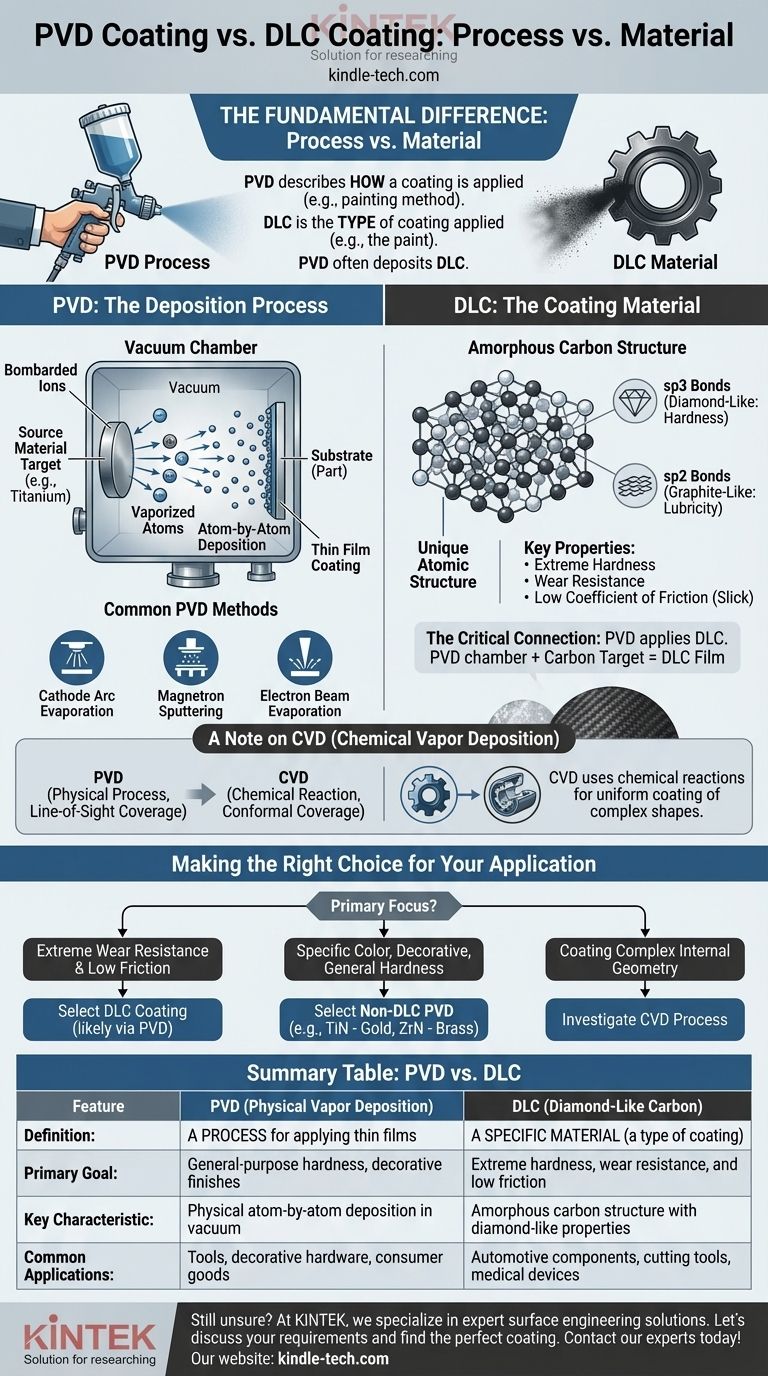
The fundamental difference is that Physical Vapor Deposition (PVD) is a process, while Diamond-Like Carbon (DLC) is a specific material. PVD is a method used to apply a thin film coating to a surface, whereas DLC is one of the many types of coatings that can be applied. In fact, PVD is a very common method used to deposit DLC coatings.

Think of it this way: PVD describes how a coating is applied, like a method of painting. DLC is the type of coating being applied, like the specific paint itself. The two are not mutually exclusive; they work together.
What is the difference between PVD coating and DLC coating? Unraveling Process vs. Material

What is PVD? The Deposition Process

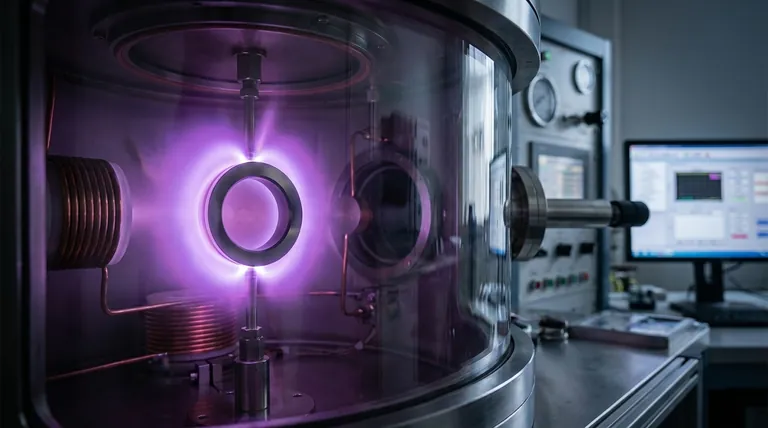
PVD is a category of vacuum deposition methods used to produce high-performance thin films. The general principle involves transforming a solid material into a vapor, transporting it through a vacuum, and condensing it onto a target substrate.

The Core Principle: A Vacuum Chamber

The entire PVD process takes place under a high vacuum. This controlled environment is critical to ensure the purity of the coating and prevent contamination from atmospheric gases.

Vaporizing the Source Material

A solid source material, often a metal like titanium or chromium known as a "target," is vaporized. This is achieved through high-energy physical processes like sputtering (bombarding the target with ions) or arc discharge (using a high-current electric arc).

Atom-by-Atom Deposition

The vaporized material travels through the vacuum chamber and deposits onto the part's surface. This deposition happens atom by atom, creating an extremely thin, bonded, and durable layer. Sometimes, a reactive gas like nitrogen is introduced to form metal-ceramic compounds.

Common PVD Methods

PVD is not a single technique but a family of processes. Common methods include cathode arc evaporation, magnetron sputtering, and electron beam evaporation.

What is DLC? The Coating Material

DLC, or Diamond-Like Carbon, is a specific class of amorphous carbon material. It is not pure diamond, but it exhibits many of the valuable properties of diamond.

The Core Principle: Amorphous Carbon

DLC is a unique material that lacks a rigid crystal structure. This amorphous nature is key to its performance, allowing it to be dense and smooth.

Unique Atomic Structure

Its exceptional properties come from a mixture of two types of carbon bonds: sp3 bonds (the hard, tetrahedral bonds found in diamond) and sp2 bonds (the planar, lubricating bonds found in graphite).

Key Properties: Hardness and Lubricity

The high percentage of sp3 bonds gives DLC coatings extreme hardness and wear resistance. The presence of sp2 bonds provides a very low coefficient of friction, making the surface naturally slick or "lubricious."

The Critical Connection to PVD

PVD is one of the primary industrial processes used to apply DLC coatings. A solid carbon target is vaporized in the PVD chamber and deposited onto the substrate to form the diamond-like film.

A Note on CVD (Chemical Vapor Deposition)

While your question focused on PVD, it's important to briefly distinguish it from Chemical Vapor Deposition (CVD), as they are the two major coating process families.

The Key Difference is Chemistry

Unlike PVD, which is a physical process, CVD uses chemical reactions. Precursor gases are introduced into a chamber where they react and decompose on the substrate's surface, forming the desired coating.

Where CVD Excels

CVD provides excellent conformal coverage. This means it can uniformly coat highly complex shapes and even internal surfaces, which can be challenging for the line-of-sight nature of PVD.

Making the Right Choice for Your Application

Choosing the right surface treatment requires understanding your primary goal. The "PVD vs. DLC" question is better framed as, "What kind of PVD coating do I need?"

  • If your primary focus is extreme wear resistance and low friction: A DLC coating, likely applied via a PVD process, is the superior choice.
  • If your primary focus is a specific color, decorative finish, or general-purpose hardness: A non-DLC PVD coating like Titanium Nitride (TiN, gold color) or Zirconium Nitride (ZrN, brass color) is the correct path.
  • If your primary focus is coating a complex internal geometry: You should investigate CVD as a potential process, as PVD may not provide adequate coverage.

Understanding this distinction between process and material empowers you to select the precise surface engineering solution your application demands.

Summary Table:

Feature PVD (Physical Vapor Deposition) DLC (Diamond-Like Carbon)
Definition A process for applying thin films A specific material (a type of coating)
Primary Goal General-purpose hardness, decorative finishes Extreme hardness, wear resistance, and low friction
Key Characteristic Physical atom-by-atom deposition in a vacuum Amorphous carbon structure with diamond-like properties
Common Applications Tools, decorative hardware, consumer goods Automotive components, cutting tools, medical devices

Still unsure which coating is right for your application?

At KINTEK, we specialize in providing expert solutions for all your laboratory equipment and consumable needs. Our team can help you navigate the complexities of surface engineering to select the ideal PVD or DLC coating for your specific project, ensuring superior performance and durability.

Let's discuss your requirements and find the perfect solution. Contact our experts today!

Visual Guide
What is the difference between PVD coating and DLC coating? Unraveling Process vs. Material Visual Guide

Related Products

People Also Ask

Related Products

Custom CVD Diamond Coating for Lab Applications

Custom CVD Diamond Coating for Lab Applications

CVD Diamond Coating: Superior Thermal Conductivity, Crystal Quality, and Adhesion for Cutting Tools, Friction, and Acoustic Applications

Vacuum Hot Press Furnace Machine for Lamination and Heating

Vacuum Hot Press Furnace Machine for Lamination and Heating

Experience clean and precise lamination with Vacuum Lamination Press. Perfect for wafer bonding, thin-film transformations, and LCP lamination. Order now!

Split Chamber CVD Tube Furnace with Vacuum Station Chemical Vapor Deposition System Equipment Machine

Split Chamber CVD Tube Furnace with Vacuum Station Chemical Vapor Deposition System Equipment Machine

Efficient split chamber CVD furnace with vacuum station for intuitive sample checking and quick cooling. Up to 1200℃ max temperature with accurate MFC mass flowmeter control.

1400℃ Controlled Atmosphere Furnace with Nitrogen and Inert Atmosphere

1400℃ Controlled Atmosphere Furnace with Nitrogen and Inert Atmosphere

Achieve precise heat treatment with KT-14A controlled atmosphere furnace. Vacuum sealed with a smart controller, it's ideal for lab and industrial use up to 1400℃.

Vacuum Heat Treat Furnace with Ceramic Fiber Liner

Vacuum Heat Treat Furnace with Ceramic Fiber Liner

Vacuum furnace with polycrystalline ceramic fiber insulation liner for excellent heat insulation and uniform temperature field. Choose from 1200℃ or 1700℃ max. working temperature with high vacuum performance and precise temperature control.

2200 ℃ Tungsten Vacuum Heat Treat and Sintering Furnace

2200 ℃ Tungsten Vacuum Heat Treat and Sintering Furnace

Experience the ultimate refractory metal furnace with our Tungsten vacuum furnace. Capable of reaching 2200℃, perfect for sintering advanced ceramics and refractory metals. Order now for high-quality results.

Molybdenum Vacuum Heat Treat Furnace

Molybdenum Vacuum Heat Treat Furnace

Discover the benefits of a high-configuration molybdenum vacuum furnace with heat shield insulation. Ideal for high-purity, vacuum environments like sapphire crystal growth and heat treatment.

Vacuum Dental Porcelain Sintering Furnace

Vacuum Dental Porcelain Sintering Furnace

Get precise and reliable results with KinTek's Vacuum Porcelain Furnace. Suitable for all porcelain powders, it features hyperbolic ceramic furnace function, voice prompt, and automatic temperature calibration.

Oil Free Diaphragm Vacuum Pump for Laboratory and Industrial Use

Oil Free Diaphragm Vacuum Pump for Laboratory and Industrial Use

Oil-free diaphragm vacuum pump for labs: clean, reliable, chemical-resistant. Ideal for filtration, SPE, and rotary evaporation. Maintenance-free operation.

1200℃ Controlled Atmosphere Furnace Nitrogen Inert Atmosphere Furnace

1200℃ Controlled Atmosphere Furnace Nitrogen Inert Atmosphere Furnace

Discover our KT-12A Pro Controlled atmosphere furnace - high precision, heavy duty vacuum chamber, versatile smart touch screen controller, and excellent temperature uniformity up to 1200C. Ideal for both laboratory and industrial application.

30T 40T Split Automatic Heated Hydraulic Press Machine with Heated Plates for Laboratory Hot Press

30T 40T Split Automatic Heated Hydraulic Press Machine with Heated Plates for Laboratory Hot Press

Discover our split automatic heated lab press 30T/40T for precise sample preparation in material research, pharmacy, ceramics, and electronics industries. With a small footprint and heating up to 300°C, it's perfect for processing under vacuum environment.

Large Vertical Graphite Vacuum Graphitization Furnace

Large Vertical Graphite Vacuum Graphitization Furnace

A large vertical high-temperature graphitization furnace is a type of industrial furnace used for the graphitization of carbon materials, such as carbon fiber and carbon black. It is a high-temperature furnace that can reach temperatures of up to 3100°C.

Ultra-High Temperature Graphite Vacuum Graphitization Furnace

Ultra-High Temperature Graphite Vacuum Graphitization Furnace

The ultra-high temperature graphitization furnace utilizes medium frequency induction heating in a vacuum or inert gas environment. The induction coil generates an alternating magnetic field, inducing eddy currents in the graphite crucible, which heats up and radiates heat to the workpiece, bringing it to the desired temperature. This furnace is primarily used for graphitization and sintering of carbon materials, carbon fiber materials, and other composite materials.

Small Vacuum Heat Treat and Tungsten Wire Sintering Furnace

Small Vacuum Heat Treat and Tungsten Wire Sintering Furnace

The small vacuum tungsten wire sintering furnace is a compact experimental vacuum furnace specially designed for universities and scientific research institutes. The furnace features a CNC welded shell and vacuum piping to ensure leak-free operation. Quick-connect electrical connections facilitate relocation and debugging, and the standard electrical control cabinet is safe and convenient to operate.

Vacuum Heat Treat and Molybdenum Wire Sintering Furnace for Vacuum Sintering

Vacuum Heat Treat and Molybdenum Wire Sintering Furnace for Vacuum Sintering

A vacuum molybdenum wire sintering furnace is a vertical or bedroom structure, which is suitable for withdrawal, brazing, sintering and degassing of metal materials under high vacuum and high temperature conditions. It is also suitable for dehydroxylation treatment of quartz materials.

2200 ℃ Graphite Vacuum Heat Treat Furnace

2200 ℃ Graphite Vacuum Heat Treat Furnace

Discover the power of the KT-VG Graphite Vacuum Furnace - with a maximum working temperature of 2200℃, it's perfect for vacuum sintering of various materials. Learn more now.

1700℃ Controlled Atmosphere Furnace Nitrogen Inert Atmosphere Furnace

1700℃ Controlled Atmosphere Furnace Nitrogen Inert Atmosphere Furnace

KT-17A Controlled atmosphere furnace: 1700℃ heating, vacuum sealing technology, PID temperature control, and versatile TFT smart touch screen controller for laboratory and industrial use.

Electric Heated Hydraulic Vacuum Heat Press for Lab

Electric Heated Hydraulic Vacuum Heat Press for Lab

The Electric Vacuum Heat Press is a specialized heat press equipment that operates in a vacuum environment, utilizing advanced infrared heating and precise temperature control for high quality, rugged and reliable performance.

Graphite Vacuum Continuous Graphitization Furnace

Graphite Vacuum Continuous Graphitization Furnace

High-temperature graphitization furnace is a professional equipment for graphitization treatment of carbon materials. It is a key equipment for the production of high-quality graphite products. It has high temperature, high efficiency and uniform heating. It is suitable for various high-temperature treatments and graphitization treatments. It is widely used in metallurgy, electronics, aerospace, etc. industry.

Vertical High Temperature Graphite Vacuum Graphitization Furnace

Vertical High Temperature Graphite Vacuum Graphitization Furnace

Vertical high temperature graphitization furnace for carbonization and graphitization of carbon materials up to 3100℃.Suitable for shaped graphitization of carbon fiber filaments and other materials sintered in a carbon environment.Applications in metallurgy, electronics, and aerospace for producing high-quality graphite products like electrodes and crucibles.


Leave Your Message