Knowledge Resources What is the electric arc furnace? A Sustainable Solution for Modern Steel Recycling
Author avatar

Tech Team · Kintek Solution

Updated 2 months ago

What is the electric arc furnace? A Sustainable Solution for Modern Steel Recycling


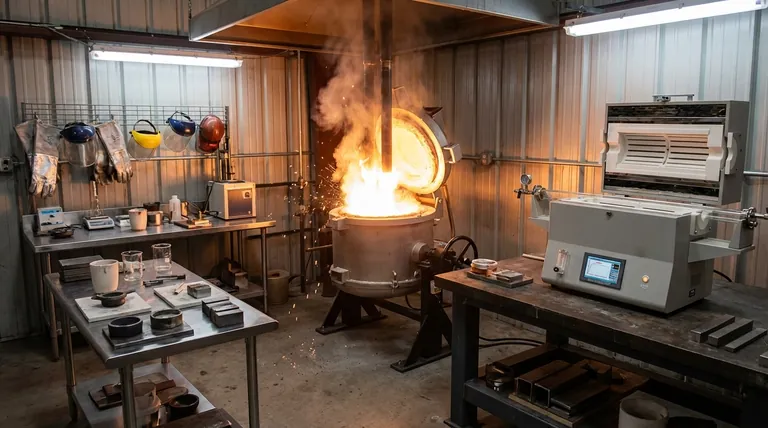
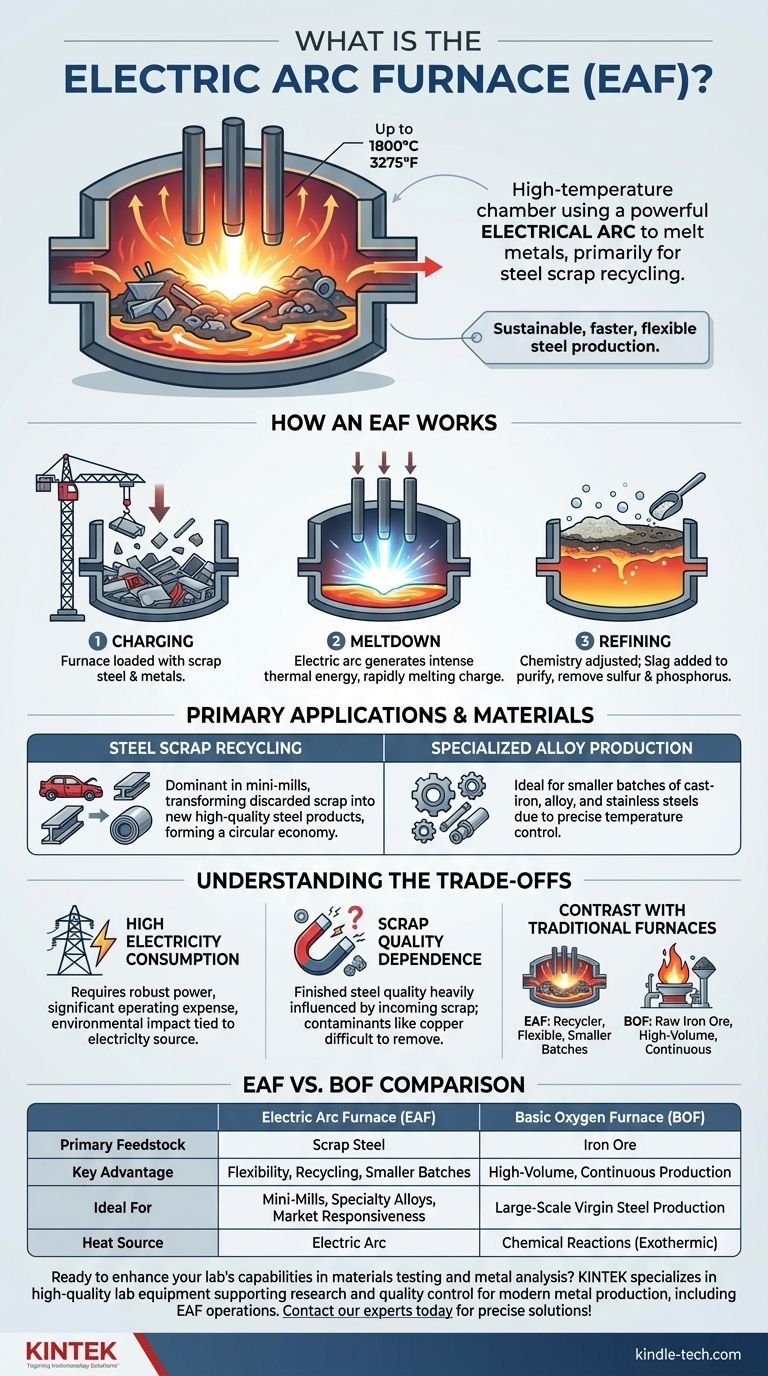
At its core, an electric arc furnace (EAF) is a high-temperature chamber that uses a powerful electrical arc to melt metals. This process is primarily used to recycle steel scrap, transforming it into new, high-quality steel products by generating immense heat—up to 1800°C (3275°F)—through a controlled plasma discharge.

The electric arc furnace is a cornerstone of modern recycling. It bypasses the need for raw iron ore by using electricity to efficiently melt down and refine existing scrap metal, making it a faster, more flexible, and often more sustainable method of steel production.
What is the electric arc furnace? A Sustainable Solution for Modern Steel Recycling

How an Electric Arc Furnace Works

The operation of an EAF is a multi-stage process that leverages the intense energy of electricity to convert solid metal into a molten, refinable liquid.

The Principle of the Electric Arc

The heat source is not a flame but an electric arc. This is a sustained plasma discharge, essentially a continuous, high-energy spark, that forms between graphite electrodes and the metallic charge within the furnace.

This arc converts electrical energy into intense thermal energy, creating a pocket of plasma that rapidly melts the scrap metal it contacts.

The Step-by-Step Melting Process

The furnace operates in a distinct sequence to ensure efficient melting and purification.

  1. Charging: The process begins by loading the furnace, typically from the top, with a carefully selected mix of scrap steel and other metals.

  2. Meltdown: The large graphite electrodes are lowered into the furnace. A high voltage is applied, striking an arc between the electrodes and the scrap. The resulting heat quickly begins to melt the charge from the top down.

  3. Refining: Once the metal is molten, the chemistry is adjusted. Materials like burnt lime are added to form a layer of slag on top of the molten metal. This slag acts as a purifying agent, drawing out impurities like sulfur and phosphorus from the steel.

Primary Applications and Materials

While versatile, the EAF is dominant in specific areas алюминий of metal production due to its unique characteristics.

Steel Scrap Recycling

The most significant application of the EAF is in "mini-mills" that focus on recycling. It allows producers to create new steel products directly from old cars, structural steel, and other discarded sources, forming a critical loop in the circular economy.

Specialized Metal and Alloy Production

Beyond carbon steel, EAFs are also used to produce cast-iron products, alloy steels, and stainless steels. Their precise temperature control and smaller batch sizes make them ideal for creating specialized metal grades.

Understanding the Trade-offs

The EAF is not a universal solution. Its advantages in flexibility and recycling come with specific operational considerations.

High Electricity Consumption

The primary drawback is its immense demand for electricity. An EAF requires a robust and reliable power grid, and electricity costs represent a major portion of its operating expense. The environmental footprint of the furnace is therefore directly tied to how that electricity is generated.

Dependence on Scrap Quality

The quality of the finished steel is heavily influenced by the quality of the incoming scrap. Contaminants in the scrap (like copper or tin) can be difficult to remove and may impact the final product's properties, requiring careful scrap selection and management.

Contrast with Traditional Furnaces

Unlike a Basic Oxygen Furnace (BOF), which primarily uses raw iron ore and produces its own heat through chemical reactions, an EAF is a recycler. A BOF is suited for massive, continuous production of virgin steel, while an EAF excels at smaller, more flexible batch production from scrap.

How to Apply This to Your Goal

Your choice of furnace technology depends entirely on your production strategy, available raw materials, and market focus.

  • If your primary focus is recycling and market responsiveness: The EAF is the definitive choice for its ability to quickly and efficiently process scrap steel into new products.
  • If your primary focus is high-volume production from raw materials: A Basic Oxygen Furnace is better suited for the large-scale conversion of iron ore into steel.
  • If your primary focus is creating specialized alloys in smaller batches: The EAF provides the process control and flexibility needed for specialty steel and cast-iron manufacturing.

Ultimately, the electric arc furnace represents a pivotal technology that enables a more agile and sustainable approach to modern metal production.

Summary Table:

Aspect Electric Arc Furnace (EAF) Basic Oxygen Furnace (BOF)
Primary Feedstock Scrap Steel Iron Ore
Key Advantage Flexibility, Recycling, Smaller Batches High-Volume, Continuous Production
Ideal For Mini-Mills, Specialty Alloys, Market Responsiveness Large-Scale Virgin Steel Production
Heat Source Electric Arc Chemical Reactions (Exothermic)

Ready to enhance your lab's capabilities in materials testing and metal analysis? KINTEK specializes in providing high-quality lab equipment and consumables that support the research and quality control processes essential for modern metal production, including electric arc furnace operations. Our reliable tools help you achieve precise results. Contact our experts today to find the perfect solutions for your laboratory needs!

Visual Guide
What is the electric arc furnace? A Sustainable Solution for Modern Steel Recycling Visual Guide

Related Products

People Also Ask

Related Products

Vacuum Arc Induction Melting Furnace

Vacuum Arc Induction Melting Furnace

Discover the power of Vacuum Arc Furnace for melting active & refractory metals. High-speed, remarkable degassing effect, and free of contamination. Learn more now!

Non Consumable Vacuum Arc Induction Melting Furnace

Non Consumable Vacuum Arc Induction Melting Furnace

Explore the benefits of Non-Consumable Vacuum Arc Furnace with high melting point electrodes. Small, easy to operate & eco-friendly. Ideal for laboratory research on refractory metals & carbides.

Electric Rotary Kiln Small Rotary Furnace for Activated Carbon Regeneration

Electric Rotary Kiln Small Rotary Furnace for Activated Carbon Regeneration

Revitalize your activated carbon with KinTek's Electric Regeneration Furnace. Achieve efficient and cost-effective regeneration with our highly automated rotary kiln and intelligent thermal controller.

Electric Rotary Kiln Pyrolysis Furnace Plant Machine Calciner Small Rotary Kiln Rotating Furnace

Electric Rotary Kiln Pyrolysis Furnace Plant Machine Calciner Small Rotary Kiln Rotating Furnace

Electric rotary kiln - precisely controlled, it's ideal for calcination and drying of materials like lithium cobalate, rare earths, and non-ferrous metals.

Electric Rotary Kiln Continuous Working Small Rotary Furnace Heating Pyrolysis Plant

Electric Rotary Kiln Continuous Working Small Rotary Furnace Heating Pyrolysis Plant

Efficiently calcine and dry bulk powder and lump fluid materials with an electric heating rotary furnace. Ideal for processing lithium ion battery materials and more.

Silicon Carbide SiC Thermal Heating Elements for Electric Furnace

Silicon Carbide SiC Thermal Heating Elements for Electric Furnace

Experience the advantages of Silicon Carbide (SiC) Heating Element: Long service life, high corrosion and oxidation resistance, fast heating speed, and easy maintenance. Learn more now!

Graphite Vacuum Furnace Negative Material Graphitization Furnace

Graphite Vacuum Furnace Negative Material Graphitization Furnace

Graphitization furnace for battery production has uniform temperature and low energy consumption. Graphitization furnace for negative electrode materials: an efficient graphitization solution for battery production and advanced functions to enhance battery performance.

Vertical High Temperature Graphite Vacuum Graphitization Furnace

Vertical High Temperature Graphite Vacuum Graphitization Furnace

Vertical high temperature graphitization furnace for carbonization and graphitization of carbon materials up to 3100℃.Suitable for shaped graphitization of carbon fiber filaments and other materials sintered in a carbon environment.Applications in metallurgy, electronics, and aerospace for producing high-quality graphite products like electrodes and crucibles.

Large Vertical Graphite Vacuum Graphitization Furnace

Large Vertical Graphite Vacuum Graphitization Furnace

A large vertical high-temperature graphitization furnace is a type of industrial furnace used for the graphitization of carbon materials, such as carbon fiber and carbon black. It is a high-temperature furnace that can reach temperatures of up to 3100°C.

Horizontal High Temperature Graphite Vacuum Graphitization Furnace

Horizontal High Temperature Graphite Vacuum Graphitization Furnace

Horizontal Graphitization Furnace: This type of furnace is designed with the heating elements placed horizontally, allowing for uniform heating of the sample. It's well-suited for graphitizing large or bulky samples that require precise temperature control and uniformity.

Mesh belt controlled atmosphere furnace

Mesh belt controlled atmosphere furnace

Discover our KT-MB mesh belt sintering furnace - perfect for high-temperature sintering of electronic components & glass insulators. Available for open air or controlled atmosphere environments.

Vacuum Heat Treat and Molybdenum Wire Sintering Furnace for Vacuum Sintering

Vacuum Heat Treat and Molybdenum Wire Sintering Furnace for Vacuum Sintering

A vacuum molybdenum wire sintering furnace is a vertical or bedroom structure, which is suitable for withdrawal, brazing, sintering and degassing of metal materials under high vacuum and high temperature conditions. It is also suitable for dehydroxylation treatment of quartz materials.

Graphite Vacuum Continuous Graphitization Furnace

Graphite Vacuum Continuous Graphitization Furnace

High-temperature graphitization furnace is a professional equipment for graphitization treatment of carbon materials. It is a key equipment for the production of high-quality graphite products. It has high temperature, high efficiency and uniform heating. It is suitable for various high-temperature treatments and graphitization treatments. It is widely used in metallurgy, electronics, aerospace, etc. industry.

High Temperature Muffle Oven Furnace for Laboratory Debinding and Pre Sintering

High Temperature Muffle Oven Furnace for Laboratory Debinding and Pre Sintering

KT-MD High temperature debinding and pre-sintering furnace for ceramic materials with various molding processes. Ideal for electronic components such as MLCC and NFC.

1700℃ Controlled Atmosphere Furnace Nitrogen Inert Atmosphere Furnace

1700℃ Controlled Atmosphere Furnace Nitrogen Inert Atmosphere Furnace

KT-17A Controlled atmosphere furnace: 1700℃ heating, vacuum sealing technology, PID temperature control, and versatile TFT smart touch screen controller for laboratory and industrial use.

Graphite Vacuum Furnace High Thermal Conductivity Film Graphitization Furnace

Graphite Vacuum Furnace High Thermal Conductivity Film Graphitization Furnace

The high thermal conductivity film graphitization furnace has uniform temperature, low energy consumption and can operate continuously.

Laboratory Rapid Thermal Processing (RTP) Quartz Tube Furnace

Laboratory Rapid Thermal Processing (RTP) Quartz Tube Furnace

Get lightning-fast heating with our RTP Rapid Heating Tube Furnace. Designed for precise, high-speed heating and cooling with convenient sliding rail and TFT touch screen controller. Order now for ideal thermal processing!

600T Vacuum Induction Hot Press Furnace for Heat Treat and Sintering

600T Vacuum Induction Hot Press Furnace for Heat Treat and Sintering

Discover the 600T Vacuum Induction Hot Press Furnace, designed for high-temperature sintering experiments in vacuum or protected atmospheres. Its precise temperature and pressure control, adjustable working pressure, and advanced safety features make it ideal for nonmetal materials, carbon composites, ceramics, and metal powders.

Ultra-High Temperature Graphite Vacuum Graphitization Furnace

Ultra-High Temperature Graphite Vacuum Graphitization Furnace

The ultra-high temperature graphitization furnace utilizes medium frequency induction heating in a vacuum or inert gas environment. The induction coil generates an alternating magnetic field, inducing eddy currents in the graphite crucible, which heats up and radiates heat to the workpiece, bringing it to the desired temperature. This furnace is primarily used for graphitization and sintering of carbon materials, carbon fiber materials, and other composite materials.

Controlled Nitrogen Inert Hydrogen Atmosphere Furnace

Controlled Nitrogen Inert Hydrogen Atmosphere Furnace

KT-AH Hydrogen atmosphere furnace - induction gas furnace for sintering/annealing with built-in safety features, dual housing design, and energy-saving efficiency. Ideal for lab and industrial use.


Leave Your Message