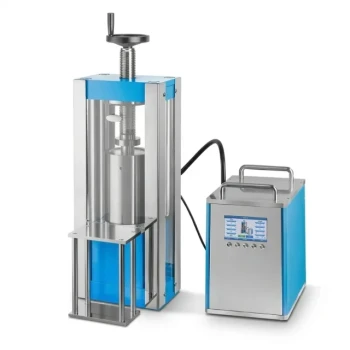
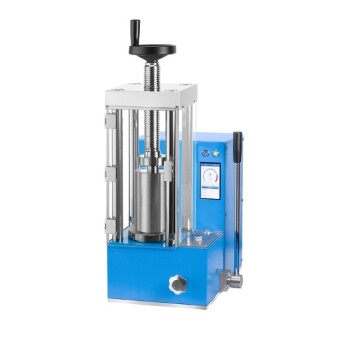
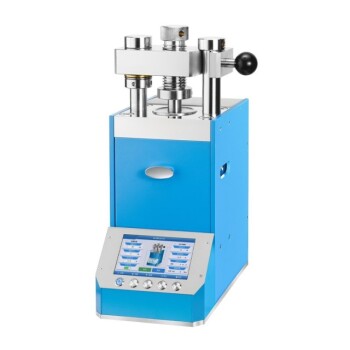
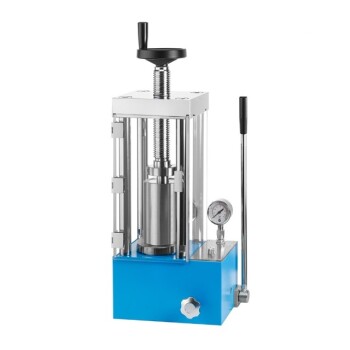
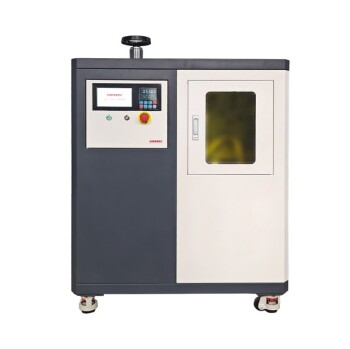
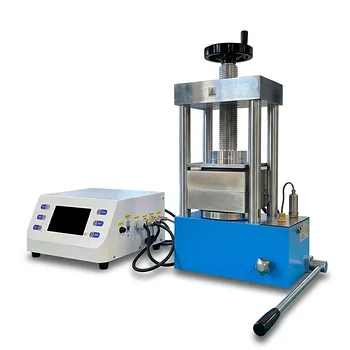
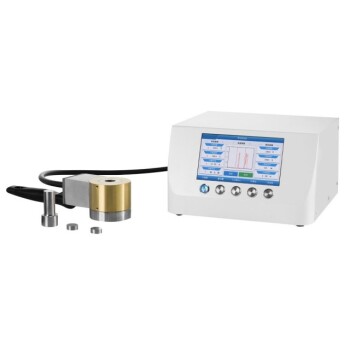
A Cold Isostatic Press (CIP) functions as a critical densification tool in the assembly of pouch-type all-solid-state batteries. It applies high, uniform isotropic pressure to the stacked layers of the battery—comprising the cathode composite, solid electrolyte, and anode—to merge them into a single, cohesive unit.
Unlike traditional uniaxial pressing, which applies force from only one direction, CIP utilizes a liquid medium to exert equal pressure from all sides. This ensures that the multilayer structure achieves uniform density without the internal stress gradients often caused by mechanical pressing.
The Core Value of CIP: By eliminating internal voids and maximizing physical contact between solid layers, CIP drastically reduces interfacial impedance. This process transforms a loose stack of films into a mechanically stable, high-performance battery cell capable of efficient ion transport.
Solving the Solid-Solid Interface Challenge
In liquid-electrolyte batteries, the liquid naturally "wets" the electrodes, creating excellent contact. In all-solid-state batteries, establishing this contact between rigid solid particles is the primary engineering hurdle.
Enhancing Physical Contact
The primary function of the CIP is to force the solid particles of the cathode, anode, and electrolyte into intimate contact.
High pressure bridges the microscopic gaps between these layers. This is essential for establishing a continuous path for lithium ions to move between the anode and cathode.
Reducing Interfacial Impedance
Poor contact results in high resistance (impedance) at the interfaces, which chokes battery performance.
By densifying the stack, the CIP minimizes this resistance. The result is a smoother transport of lithium ions and electrons, directly improving the battery's power density and efficiency.
Eliminating Structural Voids
Air pockets or voids within the battery stack are detrimental to performance and structural integrity.
The isostatic nature of the pressure—applied uniformly from every angle—collapses these voids. This ensures the component layers are chemically and mechanically integrated, preventing delamination during battery operation.
Critical Performance Implications
Beyond basic assembly, the CIP process creates specific physical characteristics that enhance the safety and longevity of the cell.
Mechanical Stability and "Green Strength"
The CIP process significantly improves the mechanical stability of the multilayer structure.
In powder metallurgy terms, this creates high "green strength," meaning the pressed stack is robust enough to be handled and packaged without crumbling or separating. This durability is vital for the practical manufacturing and long-term durability of the pouch cell.
Suppression of Lithium Dendrites
One of the most valuable functions of CIP is its ability to increase the puncture strength of the electrolyte layer.
Supplementary data indicates that CIP can increase the mechanical strength of polymer electrolytes (e.g., from ~500g to 540g). A denser, more uniform electrolyte layer is better at physically blocking the growth of lithium dendrites—metallic spikes that can pierce the separator and cause short circuits.
Understanding the Trade-offs
While CIP provides superior densification compared to uniaxial pressing, it introduces specific constraints that must be managed.
Dimensional Constraints
The size of the battery pouch is strictly limited by the dimensions of the CIP pressure vessel.
While there is no theoretical limit to the pressure applied, the height-to-diameter ratio and overall volume of the chamber dictate the maximum batch size. Manufacturers must scale their equipment significantly to handle larger automotive-grade pouch cells.
Process Complexity
CIP is generally more complex than standard roll pressing or flat pressing.
It requires the battery stack to be sealed in a flexible, leak-proof mold (bagging) to isolate it from the liquid pressure medium. This adds a step to the manufacturing flow compared to continuous roll-to-roll processes, potentially impacting throughput speed.
Making the Right Choice for Your Goal
When integrating CIP into your fabrication line, consider your primary performance objectives:
- If your primary focus is Efficiency and Power: Utilize CIP to maximize the densification of the cathode-electrolyte interface, as this is the most critical area for reducing impedance.
- If your primary focus is Safety and Longevity: Optimize CIP parameters to increase the puncture strength of the solid electrolyte layer, specifically to suppress dendrite formation.
Ultimately, CIP is not just a pressing step; it is the enabling technology that allows solid-state batteries to overcome their inherent interfacial resistance and achieve viable performance levels.
Summary Table:
| Feature | Function in Solid-State Battery Fabrication | Impact on Performance |
|---|---|---|
| Isotropic Pressure | Applies equal force from all directions via liquid medium | Ensures uniform density and eliminates internal stress gradients |
| Interfacial Contact | Forces rigid solid particles into intimate physical contact | Drastically reduces resistance and enables efficient ion transport |
| Void Elimination | Collapses microscopic air pockets within the multilayer stack | Prevents delamination and ensures structural integration |
| Mechanical Strength | Increases "green strength" and electrolyte puncture resistance | Suppresses lithium dendrite growth and enhances safety |
| Densification | Merges cathode, electrolyte, and anode into a cohesive unit | Improves power density and overall battery life |
Elevate Your Battery Research with KINTEK Precision Engineering
Overcome the solid-solid interface challenge and maximize the efficiency of your all-solid-state battery cells. KINTEK specializes in advanced laboratory equipment designed for high-performance material fabrication. Our industry-leading isostatic presses (cold and hot) provide the uniform densification required to eliminate impedance and suppress dendrite formation in pouch-type cells.
Beyond isostatic pressing, KINTEK offers a comprehensive suite of tools for your research facility, including:
- Battery Research Tools: Specialized tools and consumables for next-generation energy storage.
- High-Pressure Solutions: Autoclaves and reactors for advanced material synthesis.
- Processing Equipment: Precision crushing, milling, and hydraulic pellet presses.
- Thermal Management: High-temperature furnaces and cooling solutions like ULT freezers and freeze dryers.
Ready to optimize your fabrication process? Contact KINTEK today to discuss how our laboratory solutions can drive your research toward commercial-grade performance.
Related Products
- Electric Split Lab Cold Isostatic Press CIP Machine for Cold Isostatic Pressing
- Electric Lab Cold Isostatic Press CIP Machine for Cold Isostatic Pressing
- Automatic Lab Cold Isostatic Press CIP Machine Cold Isostatic Pressing
- Manual Cold Isostatic Pressing Machine CIP Pellet Press
- Warm Isostatic Press for Solid State Battery Research
People Also Ask
- How is isostatic pressing equipment utilized to integrate lithium metal anodes during solid-state battery assembly?
- How does isostatic pressing equipment enhance lithium metal anode contact? Optimize Your Solid-State Battery Assembly
- What is the meaning of isostatic pressing? Achieve Uniform Density in Complex Parts
- What is isostatic pressing method for ceramics? Achieve Uniform Density for Complex Parts
- What role does cold isostatic pressing play in the formation of feed rods for single crystal growth? Ensure Stability.