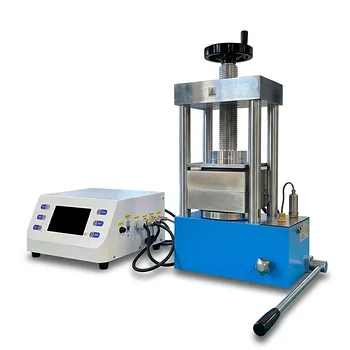
The primary function of a hot rolling press in this context is to apply a combination of heat and mechanical pressure to densify dried solid-state electrolyte films. This post-treatment is essential for reducing internal porosity and forcing individual particles into closer contact, creating a cohesive layer that offers both high ionic conductivity and sufficient mechanical strength for battery assembly.
By simultaneously applying thermal energy and compression, the hot rolling process transforms a porous, fragile coating into a dense, robust film. This step is the critical link between improving the material's electrochemical performance and ensuring it can withstand physical handling during manufacturing.
Mechanisms of Structural Improvement
Reduction of Porosity
When solid-state electrolyte films are initially dried, they often retain microscopic voids or pores.
The hot rolling press mechanically collapses these voids. By eliminating air gaps, the machine significantly increases the relative density of the film, bringing it closer to its theoretical maximum density.
Enhanced Particle Contact
For a solid-state battery to function, ions must travel through solid particles.
The combination of heat and pressure forces these individual electrolyte particles to touch and bond more effectively. This creates a continuous, uninterrupted pathway for ions to move through the material.
Impact on Performance and Assembly
Ionic Transport Efficiency
The direct result of densification is improved performance.
By minimizing the distance between particles and removing insulating pores, the ionic transport efficiency is drastically increased. A denser film offers lower resistance to ion flow, which is fundamental to battery power and efficiency.
Mechanical Integrity
Beyond electrical performance, the physical properties of the film are vital.
The hot rolling treatment hardens and consolidates the layer, improving its mechanical strength. This prevents the film from crumbling or cracking during subsequent processing steps, such as cutting (slitting) and cell assembly.
Understanding the Trade-offs
Continuous Processing vs. Static Pressing
It is important to distinguish the hot rolling press from a standard laboratory hydraulic press.
While a hydraulic press (often used for pellets or green bodies) applies high pressure statically to a mold, a hot rolling press is designed for continuous films. This makes it the appropriate choice for scalable manufacturing of electrolyte sheets rather than individual bulk samples.
The Necessity of Heat
Pressure alone is often insufficient for optimal densification of binder-rich layers.
Mechanical pressure pushes particles together, but the addition of heat softens the binder and electrolyte materials. This allows them to flow slightly and fill voids more completely than cold rolling would achieve, resulting in a more uniform structure.
Making the Right Choice for Your Goal
To maximize the effectiveness of your solid-state electrolyte fabrication, align your processing parameters with your specific targets.
- If your primary focus is electrochemical performance: Prioritize temperature and pressure settings that maximize density to establish continuous ion transport channels and minimize resistance.
- If your primary focus is manufacturing yield: Utilize hot rolling to enhance the mechanical cohesion of the film, ensuring it is robust enough to endure cutting and stacking without defects.
Effective post-treatment via hot rolling turns a brittle, resistive coating into a viable, high-performance battery component.
Summary Table:
| Feature | Function in Post-Treatment | Benefit for Solid-State Batteries |
|---|---|---|
| Porosity Reduction | Mechanically collapses microscopic voids | Increases relative density to theoretical maximum |
| Thermal Energy | Softens binders and electrolyte materials | Facilitates material flow for a more uniform structure |
| Particle Contact | Forces individual particles into closer contact | Creates continuous pathways for ionic transport |
| Mechanical Pressure | Consolidates and hardens the film layer | Enhances structural integrity for cutting and assembly |
| Continuous Processing | Applies uniform heat/pressure to sheets | Enables scalable manufacturing of electrolyte films |
Elevate Your Battery Research with KINTEK Precision Solutions
Transitioning from a porous coating to a high-performance solid-state electrolyte requires the perfect balance of heat and pressure. KINTEK specializes in advanced laboratory equipment designed to meet the rigorous demands of next-generation battery manufacturing.
Whether you are scaling production with our hot rolling presses, preparing bulk samples with isostatic and hydraulic pellet presses, or exploring material synthesis via CVD and vacuum furnaces, we provide the tools necessary for electrochemical excellence. Our comprehensive portfolio also includes battery research consumables, high-temperature reactors, and homogenizers to support every stage of your workflow.
Ready to achieve superior film density and mechanical integrity? Contact KINTEK today to discuss your specific application and discover how our equipment can drive your innovation forward.
Related Products
- Automatic High Temperature Heated Hydraulic Press Machine with Heated Plates for Lab
- Automatic Heated Hydraulic Press Machine with Heated Plates for Laboratory Hot Press 25T 30T 50T
- 24T 30T 60T Heated Hydraulic Press Machine with Heated Plates for Laboratory Hot Press
- Manual High Temperature Heated Hydraulic Press Machine with Heated Plates for Lab
- Heated Hydraulic Press Machine with Heated Plates Split Manual Laboratory Hot Press
People Also Ask
- What is a heated hydraulic press used for? Essential Tool for Curing, Molding, and Laminating
- Why is a heated hydraulic press used for warm pressing NASICON green tapes? Optimize Your Solid Electrolyte Density
- Why is a heated laboratory hydraulic press necessary for composite laminates? Achieve Void-Free Structural Integrity
- What is a hot hydraulic press? Harness Heat and Pressure for Advanced Manufacturing
- Why is the heating function of a laboratory hydraulic press essential for MEA assembly in DEFC? Optimize Cell Bonding