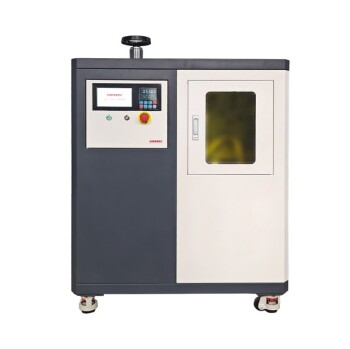
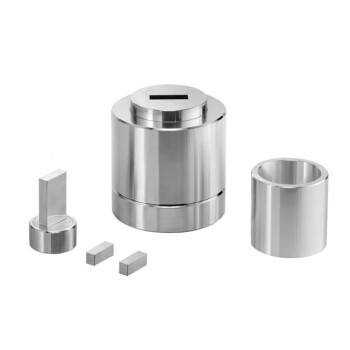
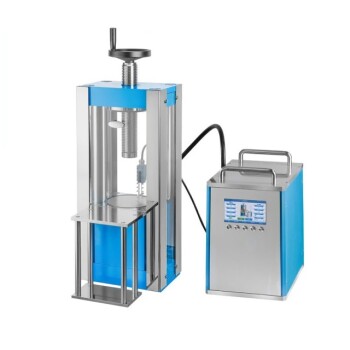
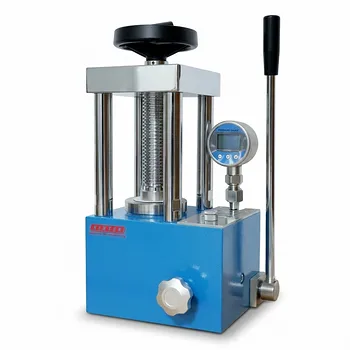
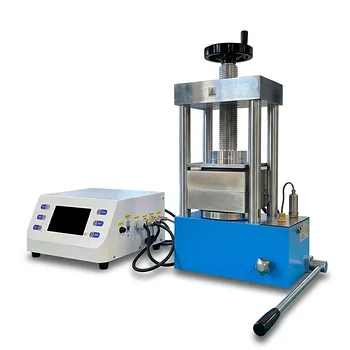
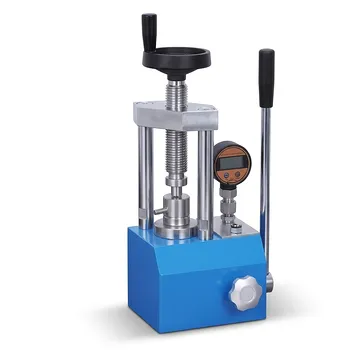
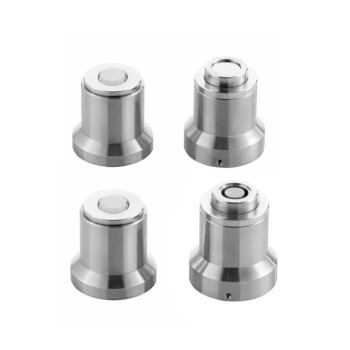
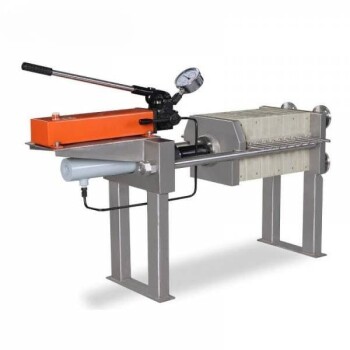
The primary function of a laboratory hydraulic press in this context is to force the plastic deformation of Argyrodite-type sulfide electrolyte powders, transforming them from loose particles into a highly dense, continuous solid layer. This mechanical consolidation is the fundamental step required to create a viable ion-conducting medium within the battery.
The Core Takeaway Unlike liquid electrolytes that naturally "wet" surfaces, solid electrolytes require immense physical force to establish connectivity. The hydraulic press eliminates air voids and merges distinct layers into a unified system, effectively lowering the barrier for lithium-ion movement and reducing the battery's internal resistance.
The Mechanics of Densification
Achieving Plastic Deformation
Argyrodite-type sulfide electrolytes possess a unique material property: they are relatively soft. When the hydraulic press applies high pressure, these powders do not merely pack together; they undergo plastic deformation.
This means the particles physically change shape, squashing against one another to fill the microscopic gaps that naturally exist in a loose powder bed.
Eliminating Internal Pores
The presence of pores (air gaps) within the electrolyte layer is detrimental to performance, as lithium ions cannot travel through air.
The press applies sufficient force to eliminate these internal pores. By removing void space, the equipment maximizes the volume of active material available for ion transport.
Establishing Transport Channels
The ultimate goal of this densification is connectivity. By crushing the particles into a cohesive mass, the press creates continuous lithium-ion transport channels.
Without this continuous pathway, ions would be trapped in isolated particles, rendering the battery non-functional.
Optimizing the Critical Interfaces
Bridging the Solid-Solid Gap
In all-solid-state batteries, the interface between the cathode and the electrolyte is a "solid-solid" boundary. Achieving contact here is significantly harder than in liquid batteries.
The hydraulic press ensures tight physical contact between the sulfide electrolyte and the cathode (specifically LLZTO-coated cathodes). This physical pressure substitutes for the wetting action of liquid electrolytes.
Reducing Internal Resistance
The quality of the contact determines the resistance of the battery.
By forcing the electrolyte and cathode layers to merge physically, the press serves as the primary technical means for reducing internal resistance. A poorly pressed cell will exhibit high impedance, leading to poor power output and efficiency.
Stepwise Integration
Ideally, this is not a one-step action. The press is often used in a stepwise process:
- Pre-pressing: The cathode mixture is pressed gently to form a base.
- Co-pressing: The electrolyte powder is added, and the entire assembly is pressed at a much higher pressure (e.g., 8 tons).
This technique integrates layers with different functions into a single, cohesive pellet.
Understanding the Process Variables
The Necessity of Uniformity
While pressure is vital, uniformity is equally critical. The hydraulic press must apply force evenly across the surface of the mold. Uneven pressure can lead to density gradients, where one part of the pellet is dense and another is porous, causing localized failure points.
Balancing Pressure and Integrity
There is a trade-off between achieving density and maintaining structural integrity.
- Too little pressure: The electrolyte remains porous, resulting in low ionic conductivity and high resistance.
- Excessive pressure: While sulfides deform well, extreme pressure without proper containment can damage the mold or cause the pellet to crack upon release (delamination).
Making the Right Choice for Your Goal
When configuring your hydraulic press protocols for sulfide electrolytes, align your parameters with your specific testing objectives:
- If your primary focus is Maximizing Ionic Conductivity: Prioritize higher pressures to ensure maximum plastic deformation and the complete elimination of grain boundary voids within the electrolyte layer itself.
- If your primary focus is Reducing Interfacial Resistance: Focus on the "co-pressing" stage; ensure the cathode and electrolyte are pressed together at the final high pressure to lock the two distinct materials into a unified interface.
Success in solid-state battery assembly relies not just on the material chemistry, but on the mechanical precision used to densify it.
Summary Table:
| Process Objective | Mechanism | Key Benefit |
|---|---|---|
| Densification | Plastic deformation of sulfide powders | Eliminates air voids and internal pores |
| Connectivity | Establishing solid-solid contact | Creates continuous lithium-ion transport channels |
| Interface Quality | Co-pressing cathode and electrolyte | Reduces internal resistance and impedance |
| Mechanical Integrity | Stepwise integration (Pre-press/Co-press) | Merges distinct layers into a unified, cohesive pellet |
Elevate Your Battery Research with KINTEK Precision
Precise mechanical consolidation is the foundation of high-performance all-solid-state batteries. KINTEK specializes in advanced laboratory solutions tailored for researchers working with sensitive sulfide electrolytes. Our high-performance manual and electric hydraulic presses (pellet, hot, and isostatic) provide the uniform pressure control essential for achieving maximum density and reducing interfacial resistance.
Beyond pressing technology, KINTEK offers a comprehensive portfolio including:
- High-temperature high-pressure reactors and autoclaves
- Crushing and milling systems for powder preparation
- Cooling solutions (ULT freezers, freeze dryers)
- Specialized consumables (PTFE products, ceramics, and crucibles)
Ready to optimize your cell assembly and maximize ionic conductivity? Contact our laboratory specialists today to find the perfect equipment for your material research needs.
Related Products
- Warm Isostatic Press for Solid State Battery Research
- Laboratory Hydraulic Press Lab Pellet Press for Button Battery
- Assemble Square Lab Press Mold for Laboratory Applications
- Automatic Laboratory Hydraulic Press for XRF & KBR Pellet Press
- Laboratory Hydraulic Press Split Electric Lab Pellet Press
People Also Ask
- What is the temperature of a warm isostatic press? Achieve Optimal Densification for Your Materials
- What is the function of a Warm Isostatic Press (WIP) in all-solid-state pouch cells? Optimize Battery Density
- Why are Warm Isostatic Presses (WIP) necessary for solid-state batteries? Achieve Atomic-Level Contact
- What advantages does a warm isostatic press offer over a traditional uniaxial press for Li6PS5Cl electrolyte sheets?
- How do warm isostatic presses improve dry electrode performance? Enhance ASSB Conductivity with Heat & Pressure