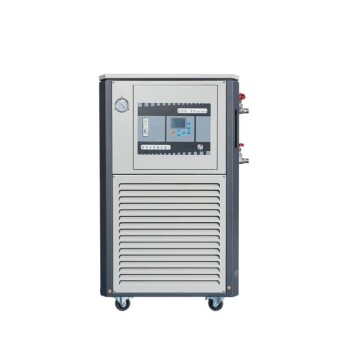
The primary function of a reaction vessel with controlled humidity is to act as a precise environmental regulator during the Chemical Vapor Deposition (CVD) process. By maintaining relative humidity levels typically between 26% and 40%, the vessel ensures the necessary conditions to trigger the hydrolysis and polycondensation of the trichloromethylsilane precursor.
The reaction vessel does not merely contain the chemicals; it actively dictates the reaction kinetics. By managing moisture levels, it controls the activation of the precursor, directly determining the density, length, and uniformity of the resulting silicone nanofilaments.
The Mechanism of Filament Growth
Triggering the Chemical Reaction
The central role of humidity within the vessel is to initiate a specific chemical chain reaction. The moisture present in the air acts as a catalyst.
It triggers the hydrolysis and polycondensation of the trichloromethylsilane precursor. Without this controlled introduction of water vapor, the precursor would remain inert or react unpredictably.
Regulating Morphology
The vessel's ability to hold humidity steady directly impacts the physical structure of the nanofilaments.
This regulation determines the growth density and length of the filaments on the substrate. Precise control ensures that the filaments grow to the exact dimensions required for the intended application.
Ensuring Uniform Coverage
Beyond individual filament growth, the vessel ensures the coating is consistent across the entire textile.
By managing the environmental moisture, the vessel promotes coverage uniformity. This prevents patchiness and ensures every part of the textile receives an equal treatment of nanofilaments.
Achieving Surface Functionality
Creating Multi-Scale Roughness
The ultimate goal of growing these filaments is to alter the physical texture of the textile at a microscopic level.
The controlled growth process creates multi-scale roughness. This specific physical texture is a prerequisite for advanced surface properties, such as superhydrophobicity or oleophobicity.
Delivering High Oleophobicity
The interaction between the filament structure and the textile surface results in specific chemical repellency.
The precise growth conditions foster high oleophobicity, allowing the textile to repel oils effectively. This property is strictly dependent on the uniformity and density achieved through humidity control.
Understanding the Constraints
The Importance of the 26-40% Window
The process relies on a specific window of operation. The primary reference highlights a target relative humidity range of 26% to 40%.
Operating outside this range can lead to suboptimal results. Too little humidity may fail to trigger the reaction effectively, while excessive humidity could disrupt the controlled growth of the filaments.
Sensitivity to Environmental Fluctuations
The reliance on atmospheric moisture makes the process sensitive.
If the reaction vessel cannot maintain the specified humidity parameters, the uniformity and performance of the final coating will be compromised. Precision in the vessel’s environmental controls is the defining factor for success.
Making the Right Choice for Your Goal
To maximize the effectiveness of your CVD process, consider how humidity parameters align with your specific objectives:
- If your primary focus is surface consistency: strict adherence to the 26-40% humidity range is critical to ensure uniform coverage and prevent coating defects.
- If your primary focus is oil repellency (oleophobicity): prioritize the control of growth density, as the resulting multi-scale roughness is the key factor in repelling oils.
Precision in humidity control is the difference between a functional, high-performance textile and a failed coating.
Summary Table:
| Parameter | Function/Requirement | Impact on Silicone Nanofilaments |
|---|---|---|
| Relative Humidity | 26% to 40% Range | Triggers hydrolysis & polycondensation of precursor |
| Moisture Control | Environmental Catalyst | Dictates reaction kinetics & activation of trichloromethylsilane |
| Growth Regulation | Density & Length Control | Determines morphology & physical structure |
| Environmental Stability | Uniformity Management | Ensures consistent coverage & prevents patchiness on textiles |
| Surface Texture | Multi-scale Roughness | Enables advanced properties like superhydrophobicity/oleophobicity |
Elevate Your Material Science with KINTEK Precision
Achieving the perfect 26-40% humidity window for silicone nanofilament growth requires uncompromising equipment precision. At KINTEK, we specialize in providing researchers and industrial manufacturers with advanced laboratory solutions tailored for complex Chemical Vapor Deposition (CVD) processes.
Whether you are developing superhydrophobic textiles or oil-repellent surfaces, our comprehensive portfolio includes:
- High-Temperature High-Pressure Reactors & Autoclaves for precise environmental control.
- Advanced CVD & PECVD Systems designed for uniform thin-film and filament deposition.
- Specialized Ceramic & PTFE Consumables to ensure chemical purity during synthesis.
- Precision Cooling & Homogenizers to manage post-reaction stability.
Ready to optimize your CVD outcomes? Contact KINTEK today to consult with our experts on the right reaction vessels and equipment for your next innovation." breakthrough."
References
- Georg R. J. Artus, Stefan Seeger. A superoleophobic textile repellent towards impacting drops of alkanes. DOI: 10.1016/j.apsusc.2011.12.041
This article is also based on technical information from Kintek Solution Knowledge Base .
Related Products
- Customer Made Versatile CVD Tube Furnace Chemical Vapor Deposition Chamber System Equipment
- Multi Heating Zones CVD Tube Furnace Machine Chemical Vapor Deposition Chamber System Equipment
- Chemical Vapor Deposition CVD Equipment System Chamber Slide PECVD Tube Furnace with Liquid Gasifier PECVD Machine
- Microwave Plasma Chemical Vapor Deposition MPCVD Machine System Reactor for Lab and Diamond Growth
- Split Chamber CVD Tube Furnace with Vacuum Station Chemical Vapor Deposition System Equipment Machine
People Also Ask
- What is a CVD tube furnace? A Complete Guide to Thin-Film Deposition
- What is the function of a high-temperature CVD tube furnace in 3D graphene foam prep? Master 3D Nanomaterial Growth
- What are the technical advantages of using a CVD tube furnace? Optimize Silicon-Carbon Battery Anodes
- How does a CVD tube furnace inhibit the sintering of silver supports? Boost Membrane Durability and Performance
- What is the function of a tube furnace in CVD SiC synthesis? Achieving Ultra-Pure Silicon Carbide Powders