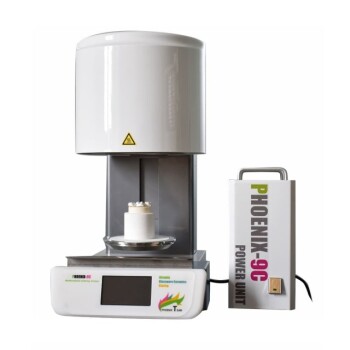
The solution treatment furnace serves as the functional activator for the alloy. Its primary role in the post-processing of cellular CuAlMn is to heat the sintered porous samples to 800 degrees Celsius, setting the stage for a rapid quenching process. This specific thermal cycle is the mandatory mechanism for inducing martensitic phase transformation, which unlocks the material's shape memory and superelastic properties.
While sintering creates the physical metal skeleton, the solution treatment furnace determines its functional identity. It reconfigures the alloy's microstructure to ensure the final porous material exhibits the active superelastic capabilities required for its application.
The Mechanism of Functional Activation
The solution treatment furnace operates on the material after the initial structure has been formed. Its function is distinct from the shaping or sintering phases.
Reaching the Critical Temperature
The furnace must bring the CuAlMn material to a precise temperature of 800 degrees Celsius.
At this temperature, the material enters a state that allows for atomic reordering. This high-temperature environment is necessary to prepare the crystal lattice for the changes that will occur during cooling.
Inducing Martensitic Transformation
The ultimate goal of this heating phase is not the heating itself, but the preparation for quenching.
By heating to 800°C and then quenching, the furnace process forces the alloy to undergo a martensitic phase transformation. This transformation is the physical phenomenon that allows the material to "remember" a shape or exhibit superelasticity under stress.
Without this specific heat treatment, the porous CuAlMn would remain a static metal structure without functional shape memory properties.
Distinction from Sintering
It is critical to distinguish this post-processing step from the initial creation of the material.
The material's physical skeleton is formed earlier, often using a vacuum hot press at slightly lower temperatures (e.g., 780°C) to bond metal particles. The solution treatment furnace is a separate, subsequent step focused entirely on property activation rather than physical consolidation.
Understanding the Trade-offs
While the solution treatment is essential for functionality, it introduces specific processing challenges that must be managed.
Thermal Shock Risks
The process requires heating a porous, cellular structure to 800°C and then subjecting it to quenching (rapid cooling).
Porous materials are inherently less dense and structurally complex compared to solid ingots. The rapid temperature change required to induce the martensitic phase can induce significant thermal stress, potentially leading to micro-cracking within the delicate metal struts.
Precision vs. Segregation
Successful treatment relies on absolute temperature uniformity.
If the furnace fails to maintain the target 800°C homogeneously, the phase transformation may be incomplete. This results in a material with inconsistent superelastic behavior, where some regions exhibit shape memory effects and others do not.
Making the Right Choice for Your Goal
The post-processing workflow for CuAlMn involves distinct stages, each controlling a different aspect of the final material quality.
- If your primary focus is Structural Integrity: Prioritize the parameters of the sintering phase (e.g., pressure-assisted bonding at 780°C), as this builds the continuous metal skeleton and mechanical strength.
- If your primary focus is Functional Performance: Focus strictly on the solution treatment furnace parameters (800°C + Quench), as this is the sole driver of superelasticity and the shape memory effect.
The solution treatment furnace is the defining tool that transitions the material from a porous metal shape into a functional smart material.
Summary Table:
| Process Feature | Solution Treatment Furnace (Post-Processing) | Sintering Phase (Initial Forming) |
|---|---|---|
| Primary Goal | Functional Activation (Shape Memory/Superelasticity) | Physical Consolidation (Structural Skeleton) |
| Target Temp. | 800°C | ~780°C (e.g., Vacuum Hot Press) |
| Cooling Method | Rapid Quenching | Controlled Cooling |
| Key Outcome | Martensitic Phase Transformation | Mechanical Integrity & Bonding |
| Material State | "Smart" Functional Material | Static Metal Structure |
Unlock the Potential of Your Shape Memory Alloys
Precision thermal processing is the bridge between a static metal structure and a functional smart material. At KINTEK, we understand that achieving the perfect martensitic transformation requires uncompromising temperature uniformity and reliability.
Whether you are developing cellular CuAlMn structures or advanced medical components, our expert-grade laboratory equipment is designed for your success. Our portfolio includes:
- High-Temperature Muffle & Vacuum Furnaces for precise 800°C solution treatments.
- Vacuum Hot Presses for high-integrity sintering and material consolidation.
- High-Pressure Reactors & Autoclaves for advanced material synthesis.
- Crushing, Milling & Sieving Systems for superior powder preparation.
Ready to elevate your research or production efficiency? Contact our technical specialists today to find the ideal thermal solution tailored to your specific material requirements.
Related Products
- Vacuum Heat Treat Furnace with Ceramic Fiber Liner
- 2200 ℃ Graphite Vacuum Heat Treat Furnace
- Vacuum Heat Treat and Pressure Sintering Furnace for High Temperature Applications
- Molybdenum Vacuum Heat Treat Furnace
- 600T Vacuum Induction Hot Press Furnace for Heat Treat and Sintering
People Also Ask
- What is a vacuum heat treatment furnace? The Ultimate Guide to Controlled Atmosphere Processing
- How does a vacuum heat treatment work? Achieve Superior Material Properties in a Pristine Environment
- What is the temperature of vacuum heat treatment? Achieve Superior Material Properties & Pristine Finishes
- What is vacuum heat treatment process? Achieve Superior Control, Cleanliness, and Quality
- What is a vacuum heat treatment furnace? Achieve Unmatched Purity and Control