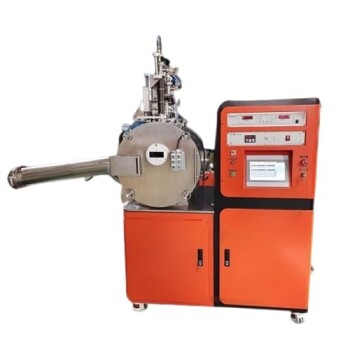
Microwave Plasma Chemical Vapor Deposition (MW PECVD) functions as a high-precision synthesis environment that utilizes microwave energy to generate a stable plasma state from methane and hydrogen gases. In this high-energy state, gas molecules dissociate into active carbon radicals that build the diamond lattice, while simultaneously allowing for the controlled introduction of boron precursors to fundamentally alter the material's electrical properties.
Core Takeaway: MW PECVD is not merely a growth technique; it is a molecular tuning process. By leveraging high-energy plasma, it enables the in-situ doping of diamond, transforming it from a natural electrical insulator into a material with tunable conductivity ranging from semiconducting to metal-like levels.
The Mechanism of Plasma Generation
Microwave Excitation
The core function of the system is the application of high-power microwave radiation, typically at 2.45 GHz. This energy is directed into a chamber containing a specific gas mixture, primarily hydrogen with a small percentage of carbon-containing gas like methane.
Creating the "Fireball"
The microwave energy excites the gas molecules, stripping away electrons to create a high-density plasma "fireball." This plasma environment is critical because it operates at high temperatures (around 1000 °C) while maintaining relatively low pressure, creating the ideal thermodynamic conditions for diamond synthesis.
High-Purity Activation
The plasma state is highly energetic, which ensures the thorough activation of the precursor gases. This high energy density is a distinct advantage of MW PECVD, allowing for the synthesis of high-purity films with minimal contamination compared to other CVD methods.
Carbon Radical Deposition
Molecular Dissociation
Within the plasma, methane molecules are broken down (dissociated) into highly active carbon radicals and hydrogen atoms. These free carbon radicals are the building blocks of the diamond film.
Selective Etching
The hydrogen component plays a dual role. It not only facilitates the reaction but also etches away non-diamond carbon phases (like graphite) that may form.
Lattice Construction
The active carbon species precipitate onto the substrate surface. They arrange themselves into a three-dimensional diamond lattice structure, allowing the film to grow layer by layer on top of diamond seeds.
The Role of Boron Doping
Precise Precursor Introduction
MW PECVD systems allow for the introduction of doping gases, such as trimethylboron, directly into the plasma mix. This is a critical function for functionalizing the diamond.
In-Situ Lattice Integration
Because the boron is introduced during the growth phase (in-situ), boron atoms are incorporated directly into the diamond crystal lattice at the molecular level.
Tuning Electrical Conductivity
This atomic integration changes the electronic band structure of the diamond. By controlling the concentration of the boron precursor, operators can tune the film's properties from a semiconductor to a conductor with metal-like behavior.
Enhancing Structural Integrity
Beyond electrical properties, boron doping also improves the physical quality of the film. It has been observed to reduce growth defects, increase growth rates, and enhance resistance to oxidation and heat.
Understanding the Trade-offs
Sensitivity to Parameters
The MW PECVD process relies on a delicate balance of gas ratios, pressure, and microwave power. Slight deviations in these parameters can lead to the formation of graphite rather than diamond or inconsistent doping levels.
Complexity of Control
Achieving high-quality Boron-Doped Diamond (BDD) requires precise control over the "high-temperature environment" and "reactive atmospheres." The system must strictly regulate the dissociation of precursors to ensure uniform heteroepitaxial growth.
Making the Right Choice for Your Project
MW PECVD is the standard for producing functionalized diamond, but the specific configuration depends on your end goal.
- If your primary focus is electrical components (Semiconductors/Electrodes): Prioritize the system's ability to precisely meter trimethylboron, as this controls the transition from semiconducting to metal-like conductivity.
- If your primary focus is mechanical tooling: Leverage the boron doping capability to reduce growth defects and enhance thermal resistance, extending the lifespan of the tool.
Ultimately, the value of MW PECVD lies in its ability to decouple the physical hardness of diamond from its electrical resistivity, giving you a material that is both mechanically robust and electrically active.
Summary Table:
| Feature | Function in MW PECVD Synthesis |
|---|---|
| Microwave Excitation | Generates high-density plasma 'fireball' for gas activation |
| Hydrogen Etching | Selectively removes non-diamond graphite phases |
| In-situ Doping | Integrates boron atoms directly into the lattice structure |
| Conductivity Control | Enables tuning from semiconducting to metal-like levels |
| Lattice Construction | Facilitates layer-by-layer growth via carbon radical deposition |
Elevate Your Material Research with KINTEK Precision
Unlock the full potential of diamond synthesis with KINTEK’s advanced laboratory solutions. Whether you are developing next-generation semiconductors or robust electrodes, our high-performance MPCVD systems, high-temperature furnaces, and specialized high-temperature high-pressure reactors provide the precision and purity your project demands.
From high-purity ceramics and crucibles to integrated cooling solutions and crushing systems, KINTEK offers a comprehensive ecosystem for advanced material science. Contact our technical experts today to find the ideal configuration for your laboratory and achieve superior results in your synthesis workflows.
References
- Ľubica Grausová, Lucie Bačáková. Enhanced Growth and Osteogenic Differentiation of Human Osteoblast-Like Cells on Boron-Doped Nanocrystalline Diamond Thin Films. DOI: 10.1371/journal.pone.0020943
This article is also based on technical information from Kintek Solution Knowledge Base .
Related Products
- Microwave Plasma Chemical Vapor Deposition MPCVD Machine System Reactor for Lab and Diamond Growth
- 915MHz MPCVD Diamond Machine Microwave Plasma Chemical Vapor Deposition System Reactor
- Chemical Vapor Deposition CVD Equipment System Chamber Slide PECVD Tube Furnace with Liquid Gasifier PECVD Machine
- Cylindrical Resonator MPCVD Machine System Reactor for Microwave Plasma Chemical Vapor Deposition and Lab Diamond Growth
- RF PECVD System Radio Frequency Plasma-Enhanced Chemical Vapor Deposition RF PECVD
People Also Ask
- How does a microwave plasma reactor facilitate the synthesis of diamond? Master MPCVD with Precision Technology
- What are the advantages of a Microwave Plasma CVD reactor for MCD/NCD coatings? Precision Multilayer Diamond Engineering
- How do vacuum pumps and valves collaborate in MPCVD? Achieve Precise Pressure Control for Superior CNT Synthesis
- How does MPCVD work? A Guide to Low-Temperature, High-Quality Film Deposition
- What is microwave plasma chemical vapor deposition? A Guide to High-Purity Diamond Film Growth